Navigator
ORIGINS AND ARTISTIC CONCEPT
01. Furniture Music: Erik Satie
02. Minimalism: Repetition and Duration
03. Ambient: Brian Eno
FIGURE AND GROUND
04. Modes of Listening: Between Attention and Background
05. Art and Function: Music in Everyday Environments
CONCLUSION
Concept
What happens to music when it plays but doesn’t become the object of special attention? In a café, a waiting room, or while working, it exists alongside conversations, movement, and daily activities. It can be noticed only occasionally, but if desired—it can be listened to intently.
This ambivalent position constitutes the research problem. Using background music and ambient sound as an example, we examine how the artistic function of sound and the role of the listener change when a musical piece simultaneously allows for attention and inattention.
The idea of music as part of the environment emerged in Erik Satie’s «furniture music.» Subsequently, the experiments of American minimalists with repetition and duration offered new ways to organize musical time. Brian Eno’s work further develops these explorations in the concept of ambient music and on the album Music for Airports (1978).
Comparing these practices allows us to trace how music relates to its surrounding environment—from deliberately inconspicuous sound to compositions in which the very possibility of background listening becomes an artistic principle.
The core question of this research is: how does ambient music differ from conventional functional background music, given that both types of sound can accompany various activities? It is hypothesized that the distinction is related not only to musical form but also to the composer’s intent, the playback environment, and how the listener is invited to interact with the sound. To describe this contradiction, we use the relationship between figure and ground. Music can remain part of the sonic environment and then move to the forefront when attention is directed toward its texture, repetitions, and gradual shifts.
The research is built upon a comparison of works by Satie, American minimalists, and Eno, alongside an analysis of composers' texts and writings on ambient music and everyday listening. The theoretical foundation is comprised of publications by Hervé Vanel, Anaid Kassabian, John Lycaster, and Victor Sabo.
The musical recordings are correlated with scores, album covers, archival materials, and images of the spaces where the music was played or intended to be heard. The first part is dedicated to the genesis of the artistic idea of background sound, while the second examines how its function changes across various listening practices.
Audio fragments allow a direct engagement with the material: listening to repetitions, durations, pauses, and subtle shifts that construct the composition. «Music for Airports» holds a special place—comparing Eno’s original album with the concert arrangement by Bang on a Can demonstrates how a piece conceived for a specific sound environment can become the focal point of a stage performance. This investigation, therefore, returns to the original question: is the music’s background nature determined by its structure or by its context—where, and for what purpose it is heard?
01. Furniture Music: Erik Satie
Eric Satie Portrait
In a typical concert setting, the musical piece holds a central position: the performance requires a specific amount of time, space, and audience behavior. Conversations cease, and the listeners' attention focuses on what is happening on stage. However, in everyday life, music often exists differently—accompanying other activities and not demanding constant concentration. In the early 20th century, Erik Satie addressed precisely this contradiction. He was interested in the possibility of changing not so much the musical material as the music’s relationship to its surrounding environment. The piece needed to stop being the obligatory center of the event and become one component of the atmosphere.
Unexpected Guests — Ilya Repin (1888)
In 1917, Satie created his first works of musique d’ameublement—or «furniture music.» The title alludes to interior design objects and suggests a specific way of utilizing sound. The score for Tapisserie en fer forgé («Forged Tapestry») indicates that the music is intended to greet guests in a foyer, whereas Carrelage phonique («Acoustic Tile») might accompany a meal or the signing of a marriage contract. Such designations assign the piece not only a title but also a specific domestic context. The music is viewed as part of the organization of space, much like lighting or furnishings. In this way, this function becomes an artistic statement: Satie shifts the focus from the mere act of performance to the conditions under which the work exists.
Score for Tapisserie en fer forgé, 1917
The musical material of early pieces is built upon short phrases that can be repeated multiple times. Instead of the customary progression from one theme to another, a stable sequence of sounds is formed. Repetition allows the piece to continue throughout other activities without requiring obligatory attention to every new event. However, this organizational structure cannot be explained solely by the desire to create an unobtrusive background. In Satie’s scores, instrumental distinctions, accents, and characteristic rhythmic patterns are preserved. The background function emerges not from a lack of musical expressiveness, but from the method of existence the composer proposes for the work.
«Barbazanj» Gallery, 1911
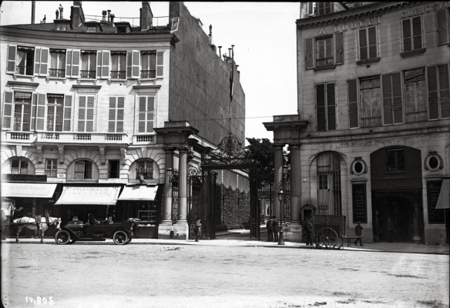
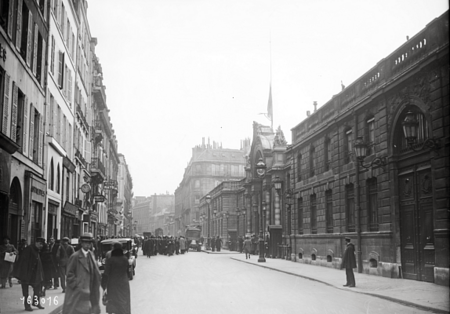
On March 8, 1920, during the intermission of Max Jacob’s performance Ruffian toujours, truand jamais at the Barbazanje Gallery in Paris, Satie’s «furniture music» was presented. For this event, the composer prepared two pieces—Chez un «Bistrot» and Un salon. Darius Milhaud was involved in organizing the performance. The intention was for the music to play simultaneously with the audience’s conversation and movement, without becoming a standalone presentation.
However, according to Milhaud’s memoirs, the audience would return to their seats and begin listening. Even a direct request to ignore the music did not change the audience’s habitual behavior. The work, conceived as part of the ambiance, once again became the centerpiece of the event.
This case allows us to view «furniture music» not only as an experiment with musical form but also as an attempt to alter the social conventions of listening. The composer assigned a new function to the piece; however, the public context maintained the traditional division between performers and listeners. The artistic concept and its execution did not align.A crucial aspect of background sound is revealed here: it cannot be determined solely by the author’s intent. The musical organization, the performance venue, and the audience’s cultural expectations are all relevant. This is precisely why Satie’s experiment interests subsequent history of background music—it turned the relationship between the work and the listener into a subject for artistic inquiry.
02. Minimalism: Repetition and Duration
The repetition Satí used to organize ambient sound takes on different artistic functions in mid-20th-century American experimental music. Composers turn to a limited set of sounds, extended musical structures, and gradual changes. In minimalism, the passage of time itself becomes a significant part of the composition.
However, similarity in musical techniques does not imply similarity in their purpose. If Satí attempted to integrate music into everyday settings, in the works of La Monte Young and Terry Riley, repetition and duration become autonomous objects of study. Musical development here occurs less through the emergence of new themes and more through the modification of relationships within the already existing sonic material.
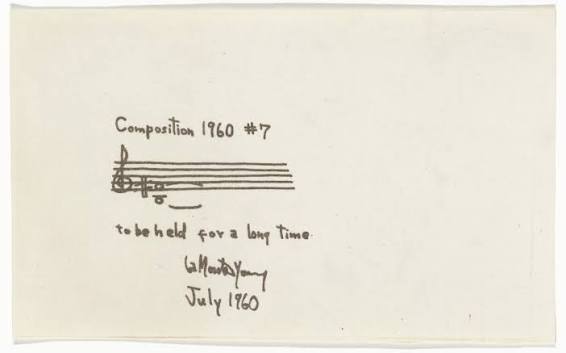
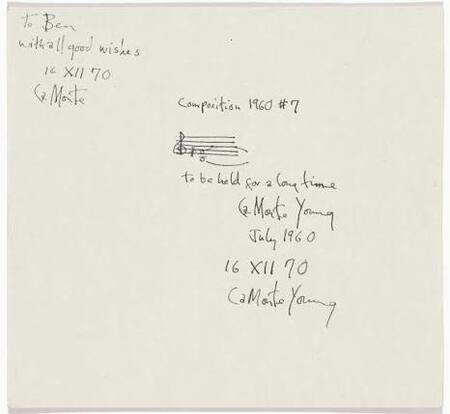
La Monte Young, Composition 1960 #7, score, 1960
In Composition 1960 #7, La Monte Young reduces the musical material to two notes—B and F-sharp—which form a perfect fifth. The score includes instructions to sustain these notes for an extended period. The composer does not establish a conventional sequence of melodic events; the foundation of the piece becomes the prolonged sound of a single interval.This type of organization shifts attention from the quantity of musical events to their duration. The relative constancy of the material makes the acoustic characteristics of the sound itself more significant: the ratio of tones, their stability, and the particular qualities of the execution.
In Yang’s work, the minimal number of sounds does not imply a lack of musical organization. On the contrary, the limitation of material allows duration to be highlighted as an independent compositional principle. The performance instructions define the overall form of the piece but leave the specific duration and sonic characteristics open. Such material may serve as part of a background environment, yet its artistic structure also suggests another possibility—a focused investigation of sustained sound. Unlike Satie’s practice, the sonic stability here is not tied to a specific utilitarian function; instead, it becomes the central content of the work itself.
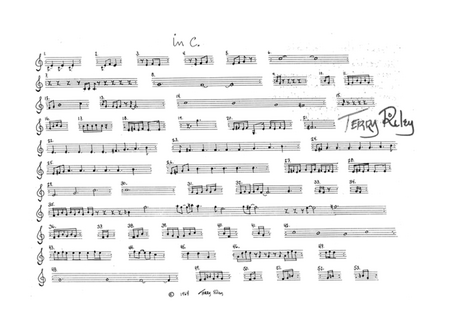
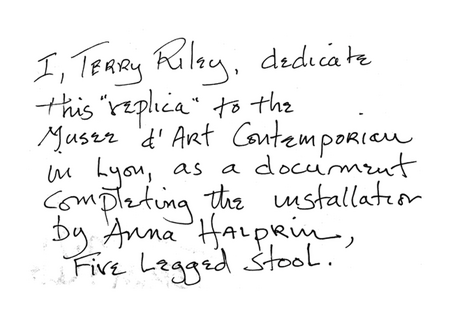
Terry Riley, In C, score, 1964
Another way of organizing time is presented in Terry Riley’s In C (1964). The score consists of 53 short musical fragments that performers repeat sequentially, independently choosing the moment to transition to the next. A constant pulsation serves as the rhythmic foundation, while individual motifs enter, overlap one another, and gradually alter the overall texture.Although the musical fragments are predetermined, their combinations depend on the interaction of the performers. The composition exists not as one fixed sequence of sounds, but as a musical process that unfolds differently each time. Repetition here does not halt development—it becomes the condition for the emergence of new combinations.
In C, several simultaneously existing sound levels can be distinguished. Uniform pulsation forms a stable rhythmic foundation upon which melodic figures emerge and evolve. When one motif is referenced, the others continue to sound alongside it, forming a broader musical texture. Thus, the relationship between figure and background is found not only between the work and its surrounding environment but also within the composition itself.
The comparison of Yang and Riley shows that repetition and duration do not fix music to a single mode of listening. These techniques are capable of maintaining a relatively steady sound while simultaneously opening possibilities for the analysis of musical form. This dual nature is precisely what becomes important for understanding Brian Eno’s ambient work.