— There are no specialized aggregators for art tourism in Russia, although this market is rapidly growing. — Lack of transparency and trust on other services: people either travel with an art professional they know—which limits their initial choice—or they select a tour based on a general aggregator’s description but do not know the author of that tour. There is no single source to evaluate both the program and the «match» with the creator. — Organizers of such tours lack a platform to promote their offerings without marketing budgets; typically, promotion occurs through social media or their tours are listed on separate tabs within general travel aggregators. — Many sites related to design, art, or other cultural forms in Russia need promotion but lack the budget and must apply for programs. A platform would allow them to connect with people specifically interested in their work.
We are creating the travel.mediiia product on the mediiia platform. It will feature standard platform projects containing travel tour information, and users will be able to view the profiles of tour authors. We also plan to integrate a «Request Information» button at the end of each project, allowing the tour authors to view the profiles of interested individuals within mediiia—this is crucial for creative tours to build a cohesive team that ensures both comfort and creative synergy.
We need to implement a filtering system for easy searching: users will be able to select areas of interest, geography, required skill level, and more.
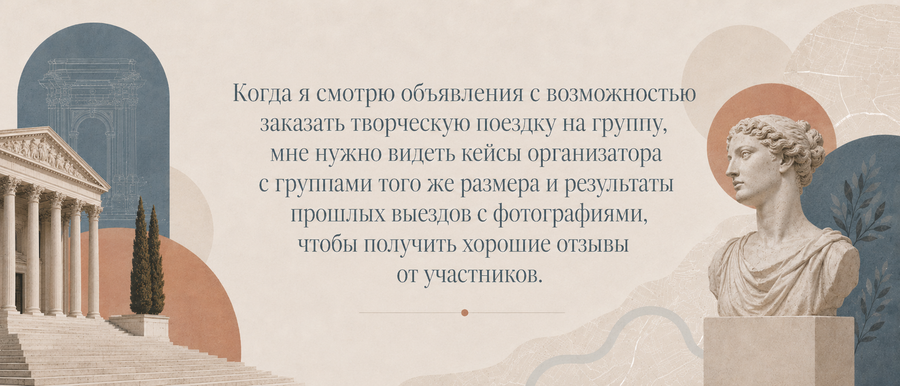
After a trip, tour participants will be able to create their own projects on travel.mediiia, which will be attached to the original tour project—this way, users can view the outcomes and reviews from past excursions.
travel.mediiia — a platform for projects in the field of creative tourism: art and design expeditions, photo tours, architectural research, and creative retreats. It connects creative experts with travelers, allowing the latter not only to learn about the tour program but also to evaluate the author’s portfolio to find the most suitable trip, understanding the creative interests of the organizers.
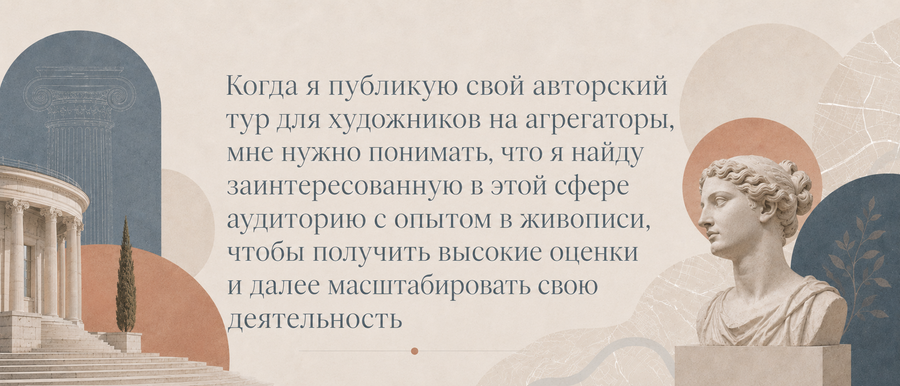
Segment A: Anna, 23, a design school student, organizes design expeditions to various regions to develop local identity. She aims to scale up her project and personal brand to create professional expeditions and work with major clients.
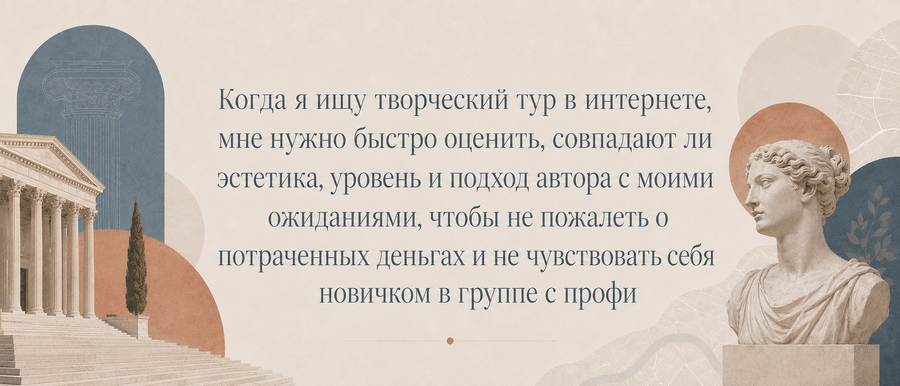
Segment B: Ekaterina, 21, studies journalism and works as a marketer for a company. She wants to travel to China, but not for a typical vacation—she wants to study local painting traditions because she has long been interested in this culture. She has a clear idea of what she wants to learn, but online she only finds classic tours that aren’t suitable for her.
Segment C: Vladimir, 30, is a professional illustrator who earns a living from his creative work and has a strong background in art history. He is looking for new experiences and immersion in a new creative environment. Therefore, he wants to find professionals who can teach him about cultures unknown to him, since the subjects covered in popular tours are already familiar to him.
Segment D: Elena, 35, works in HR at an IT company and is planning a creative team-building trip for designers and programmers. She is searching for an interesting short trip—a couple of days—that would suit any employee, but she keeps finding only lengthy excursions designed for large groups.
Our direct competitors currently are general travel aggregators that feature art tours: Youtravel.me, GoTour (they do not specialize in this niche; information about the author can only be gathered from the text description or their other tours). Indirect competitors: — companies that organize art tours themselves: Firuzzi.net, Artfriends.club, artbook-mania.com. They do not aggregate travel; they only publish their own projects. — bloggers offering author-led tours. — creative retreats (e.g., Insight Camp).
We anticipate that, given the active growth of the art tourism market and the lack of specialized solutions, our product can become a liaison for many experts who are already users of mediiia (in the art, gallery, urban, and other sections), while also attracting many new users—both those creating bespoke tours and those seeking unique leisure experiences.
01 Research: market and trend analysis, conducting in-depth interviews — 1 month
02 Strategy: defining core mechanics and features, Unique Selling Propositions (USPs), and promotion strategies — 2 weeks
03 Planning: defining the Minimum Viable Product (MVP), distributing responsibilities for MVP development, setting specific deadlines for each stage, and establishing key metrics and goals — 1 week
04 Implementation: building the functional MVP, landing page, and initiating MVP promotion — 3 months
05 Results Evaluation: final launch, collecting data on the working MVP and promotion, comparing results to set goals, and deciding on further launch/testing — 1 monthWe project reaching 20,000 users within 4 months, featuring 50 tours, and securing 100 bookings.
The art tourism market is actively growing, with an annual growth rate of approximately 11%. The most vigorous development is observed in Asia and the Pacific region, which offers Russia excellent opportunities to expand tours in this area.
The global art tourism market is estimated at $46.96 billion in 2025, with projections indicating growth to $54.89 billion by 2030.
Calculation based on 2025 data