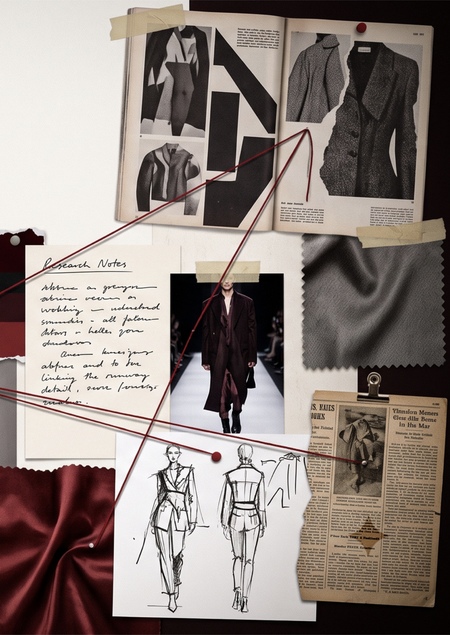
Fashion Detective is a digital media exploration of the origins of modern fashion trends and aesthetics. The project investigates where familiar clothing elements and visual phenomena originated, how they have changed over time, and why they become relevant again.
Media Goal
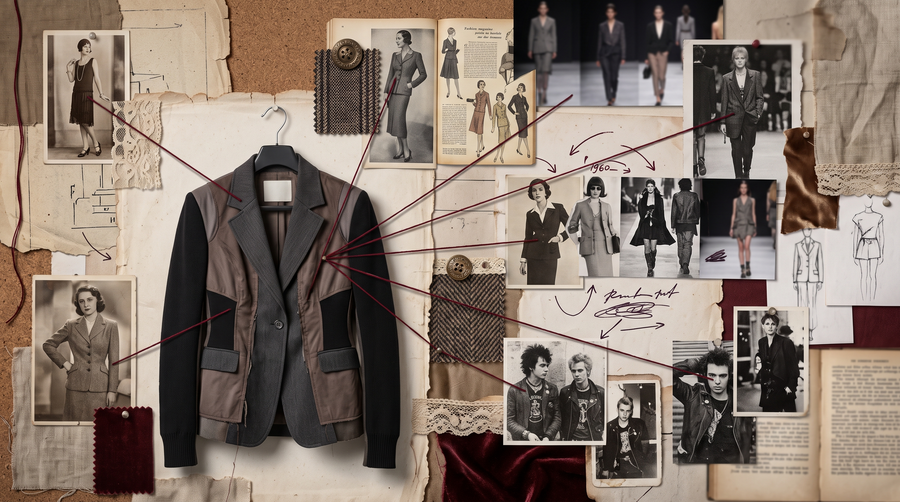
The main goal of Fashion Detective is not just to report on new trends, but to explain their origins and context. Today, we constantly see new aesthetics in social media, on runways, and in popular culture, but we often don’t know where they come from. For example, the modern corset can be linked not only to current collections but also to the history of lingerie, punk, music, and the work of individual designers. Therefore, the media will illustrate the connection between the past and the present and help the audience better understand contemporary fashion.
Media Themes
The main theme of the project is the origin of modern fashion trends and aesthetics.In the media, we will analyze:* individual items of clothing;
* silhouettes;
* materials and prints;
* aesthetics;
* subcultures;
* the influence of film and music;
* the connection between fashion and art;
* the resurgence of historical elements in contemporary fashion.The core principle of the project can be formulated as follows:
not «what is trendy right now?» but «why did this become trendy and where did it come from?»
Each material will begin with a contemporary phenomenon that is already familiar to the audience. Following that, we will trace its historical and cultural origins. For example, we could examine the corset, which is re-emerging in current collections and everyday wear. The study could trace its journey from a historical garment to lingerie, a symbol of punk, and an element of modern fashion.
In Fashion Detective, you can explore various phenomena, such as:
«Why is the corset back in style?”—The history of the corset and its transition from undergarment to a standalone garment.
„Why does the leopard print keep returning?”—The evolution of its meaning from a symbol of luxury to mass fashion and a contemporary trend.
„How did punk make it onto the runway?”—The connection between street subculture, DIY culture, and designer fashion.
„Why have men stopped wearing heels?”—The history of the heel and the shift in its meaning across menswear and womenswear.
This approach allows you to examine even familiar objects from a different perspective.
Competitor Analysis
To research competitors, I analyzed existing fashion media, including their websites and social media channels. The main criteria for comparison included topic, publication formats, visual style, tone of voice, depth of content, and audience engagement.
I divided the competitors into three groups: direct, indirect, and potential.
I consider direct competitors to be media outlets that engage a similar audience while simultaneously linking fashion to cultural and historical context.
Indirect competitors cover trends and fashion content but have a different primary objective.
Potential competitors include bloggers, archival projects, and short-form video creators who might compete for the same segment of audience attention.
Competitors
The Blueprint — a Russian media outlet covering fashion, contemporary culture, beauty, career, and lifestyle.BURO. — an online media platform focused on fashion, beauty, culture, and society. A significant portion of its content is dedicated to current trends, runway shows, designers, and specific garments.Dazed — an international media outlet operating at the intersection of fashion, art, music, film, and contemporary culture.Vogue is one of the primary sources for information on new trends, runway shows, and designers. Its intersection with Fashion Detective lies in its focus on relevant fashion.Highsnobiety operates at the intersection of fashion, streetwear, music, and contemporary culture. Its features illustrate how fashion connects with other cultural phenomena.
After analyzing the competition, I identified several key areas we can leverage for the development of Fashion Detective. First, standard trend content quickly loses relevance. Simply reporting that a certain item has gone viral might make the content uninteresting within a few months. The history behind that item remains relevant much longer. Second, modern fashion media increasingly connects clothing with music, film, art, and subcultures. Therefore, Fashion Detective will not examine fashion in isolation. Third, archives and historical sources can serve not just as supplements to the material, but as the very foundation of the content. Old photographs, collections, and magazines help demonstrate how the same visual motif has evolved over time.
Distribution Channel
I would choose Telegram and VK as the primary platforms for this project.Telegram will be used for more in-depth materials, short investigations, archival collections, polls, and discussions.VK could be used for short videos, cards, visual collages, and briefer content.Additionally, Pinterest could be utilized for visual promotion. This platform is suitable for the project because its content involves a large amount of archival photographs, clothing details, and visual references.
Content Formats
The main format is a full investigation into one trend or piece of clothing.Several regular sections can also be included.«Case File #…» — an in-depth investigation into the origin of a trend.«Clue» — a short piece about a single item, detail, or visual technique.«Archival Dossier» — a comparison of a historical collection or look with contemporary fashion.«Aesthetic DNA» — an analysis of the historical and cultural elements that form a specific aesthetic.«60 Seconds» — short videos featuring one question and a brief answer.
Target Audience
I identify four main audience segments.
The first are individuals interested in fashion who do not have formal professional training. They want to stay abreast of trends but wish to understand them more deeply.
The second group consists of fashion design students, stylists, and emerging professionals. For them, media can be a source of references and historical context.
The third segment includes people interested in visual culture in general—cinema, music, art, and aesthetics. For them, fashion is simply one part of a broader culture.
The fourth segment comprises aspiring designers, stylists, photographers, journalists, and content creators who need inspiration and unconventional connections for their own projects.
Personas
Unique Selling Proposition
After analyzing the competition, I formulated three key advantages of the project.
Fashion Detective doesn’t just report what’s trendy; it investigates why something has become fashionable.
Each trend is analyzed through its origins—from historical archives and subcultures to contemporary designers and social media.
Complex fashion research is presented in a visual and accessible format, allowing it to be used not only for reading but also as a source of new ideas.
Conclusion
Fashion Detective exists at the intersection of fashion media and a small-scale research project. Its purpose is to demonstrate that contemporary fashion rarely emerges from a vacuum. Behind every trend, there is a story—previous interpretations, cultural events, and the people who influenced its development.