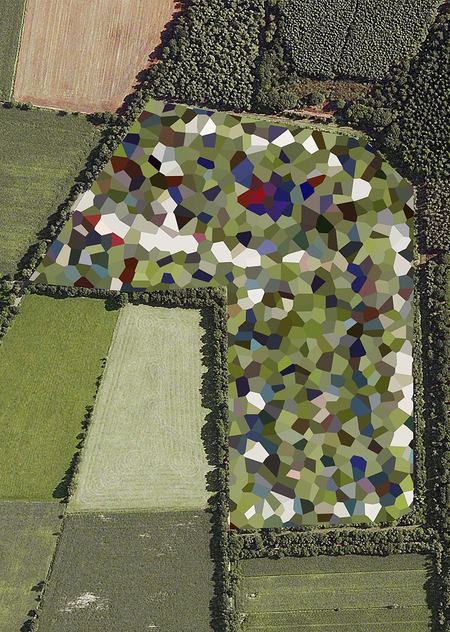
The central theme of this study is the use of images sourced from public domains by artists. Regarding this approach, we will discuss issues of authorship in art. Even more acutely relevant is the question of whether these practices belong to the realm of creativity at all.
In the age of digital technology, many functions previously performed by artists have been delegated to computers. Modern devices create images, write texts, and compose music. So, what remains for the artists themselves—where is their place in the world of digital art?
A rich history of curatorial practices, long established in the museum world, can offer an answer to this question. A curator is a person who organizes exhibitions. They conceive the exhibition’s idea, seek out artists, and select works for the museum.
One could argue that digital artists are gradually becoming curators themselves. The entire technical aspect of the work is entrusted to machines, while the artists become purely concept-holders.
They search for and connect the best elements of content generated using digital methods in their collections. Simultaneously, the technique takes on the role of executor, without embedding intent into the final work.
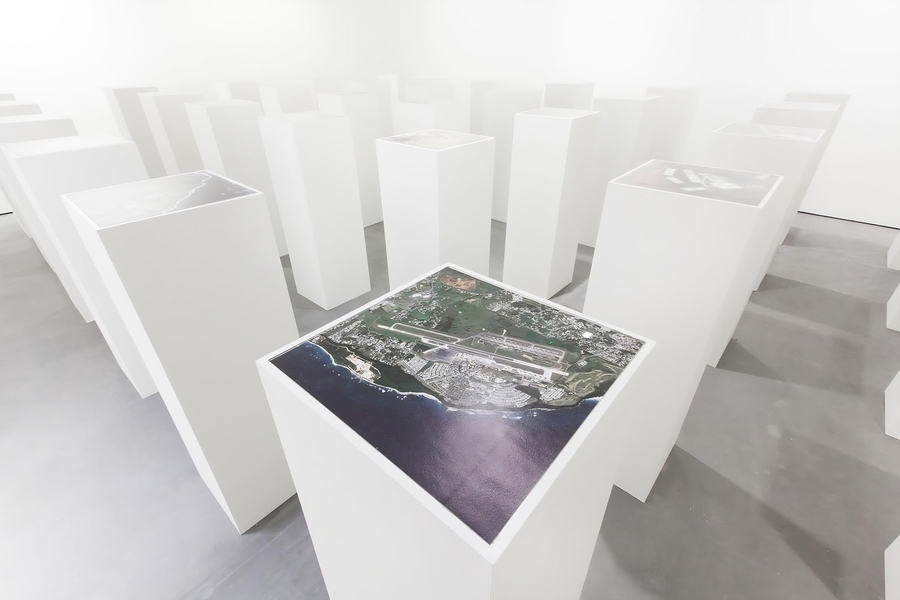
«Fifty-One U.S. Military Posts, ” 2010. Mishka Henner. Exhibition at Grandy Art Gallery, Blackpool.
This work is divided into several sections, each dedicated to describing the achievements and projects of a single photographer whose work relates to the theme of appropriation and surveillance cameras.
It was important that these authors did not take the original photographs themselves, as the main interest lies precisely in transferring responsibility for the «raw material» of the shoot to technology.
The images for this study were primarily taken from the personal galleries of artists, web collections of contemporary museums, and online art shops.
To analyze these works, journal articles were predominantly used. These texts are dedicated either to the artist’s biography or their work.
Additionally, the list includes two major texts on appropriation in art, which provided numerous insightful ideas.
«The Traveler, ” 2001–2023. Jens Sundheim, Bernhard Roiss. Featured in the exhibition „Ctrl+P: Photography Offline, ” 2018. Catherine Edelman Gallery.
In the first section, we meet Jens Sundheim, who is fascinated by street cameras and their role in people’s lives.
Next, we transition to Hugo Ricardo, who studies remote areas of the United States like an anthropologist or ethnographer using Google Street View.
Following him is John Rahman, with his endless interest in contemporary online culture, including digital maps. Then comes Regula Bohsler, who works with Apple Maps.
Finally, we move to the section on Misha Henner, who is dedicated to journalistic investigations into political and environmental issues using Google Earth.
The work is concluded by Jill Magid, with her romantic relationship with police and their cameras, and Arne Svensson, who expresses an active civic stance through his photographs concerning the murder of children in firefights.
Jens Sundheim
He pays particular attention to new trends and methods of photography. Jens is a scholar, a «spy» in the search for the truth about our world and society.
His goal is to find what is visible to everyone but remains unnoticed. He meticulously searches for images and compiles them into a unified cycle with the care of an antique dealer.
«The Traveler, ” 2001–2023 (2003). Jens Sundheim, Bernhard Roiss.
For over 20 years, Jens has been searching for surveillance cameras around the world and has found himself in their sight. He always stands in a recognizable pose and wears almost the same clothing.
The artist looks directly into the camera lens, signaling that he is aware of being recorded. The other people on the street don’t even seem to suspect they are being filmed.
«Traveler, ” Saint-Mary-de-la-Mer, 2001–2023 (2012). Jens Sundheim, Bernhard Roiss. / „Traveler, ” Haltern am See, 2001–2023 (2016). Jens Sundheim, Bernhard Roiss.
The author challenges a system that views every one of us as a potential suspect. What is the worth of our security, built at the cost of total unfreedom?
He makes the impersonal mechanisms aware that he has understood something important—that he has exposed them. His gaze suggests that Jens has awakened from a long sleep and is now determining his own fate.
«100,100 Views of Mount Fuji, ” 2008–2010 (2010). Jens Sundheim. / „100,100 Views of Mount Fuji, ” 2008–2010 (2009). Jens Sundheim.
This collection of photographs by Jens is closely connected to the «Traveler» series. During his travels, the artist found a camera in Japan with a view of the world-renowned Mount Fuji.
The author is deeply interested in the technical aspects and the visual changes in photography caused by varying light conditions and camera functions. Equally important is paying tribute to Katsushika Hokusai, in whose work Fuji held a central place.
«100100 Views of Mount Fuji, ” 2008–2010. Jens Sundheim.
Doug Ricardo
The author’s goal is to shift the role and meaning of photographic art within a national context. The primary data source is public Google imagery.
Dug stands at the foundation of new documentary practice. Is contact with the subject important to the artist? Can distance provide a clearer perspective? How ethical is this?
«New American Landscape, ” Detroit, 2010. Doug Richard.
This photo collection presents an unknown provincial America to us. We only have rumors and speculation, but Doug’s goal is to be as accurate and honest as possible.
Google Street View technology aids him in this. These images are untouched by the artist, his personality, or his mood. It is an unbiased gaze—without focus or judgment. All personal details are shielded by anonymization features.
«New American Painting, ” New Jersey, 2010. Doug Richard. / „New American Painting, ” Detroit, 2010. Doug Richard.
This is a story about the collapse of the image of ideal America—about the fault lines in today’s social structure. The author finds a way to portray poverty, decay, and oppression without isolating the residents of remote areas of the U.S. from their context during their visit.
«New American Painting,» Dallas, 2010. Doug Richard.
The Duba shooting method is unique: it not only borrows photos from open sources but also reshoots the image from the screen, almost as if re-assigning it.
But is it truly possible to grasp the depth of meaning and find the true significance of a topic without seeing the object of study in person? Duba believes that this approach allows for a more rigorous and meticulous selection of material.
«New American Painting, ” Norfolk, 2011. Doug Richard. / „New American Painting, ” Chicago, 2012. Doug Richard.
John Raffman
This artist is a highly visible figure in the internet art community. He has long studied online communities, focal points of opinion, and contemporary archetypes within the digital sphere.
The artist believes that our story as a generation—as a unique collection of cultural phenomena—has not yet been written.
He is one of those who documents recent history, seeks their place in electronic worlds, and is fascinated by the technique of appropriating digital objects.
«Nine Eyes of Google Street View, ” 2008–present (2020). John Rafman. / „Nine Eyes of Google Street View, ” 2008–present (2020). John Rafman.
For many years, John has been on his eternal journey through the world using Google Street View. This is a new phase of his research: you don’t have to be a sightseer, a field scientist, or an anthropologist to wander freely across the globe and pursue the truth and meaning.
John is also fascinated by the image of a distant god observing our universe without any interest. Google’s street photography—devoid of commentary, character, or narrative—is perfectly suited to embody this metaphor in his photographs.
«Nine Eyes of Google Street View, ” 2008–Present. John Rafman.
These walks through digital maps reveal many fascinating facts about humanity and the world as a whole. Rafman uncovers numerous «strange» photographs.
In them, people are caught up in unusual activities, in atypical situations—provocative, illegal, inexplicable. Yet, the all-seeing gaze of the camera remains completely indifferent to all of it.
«Nine Eyes of Google Street View,» 2008–Present (2012). John Rafman. / «Nine Eyes of Google Street View,» 2008–Present (2013). John Rafman.