
HSE’s New Year’s Legacy
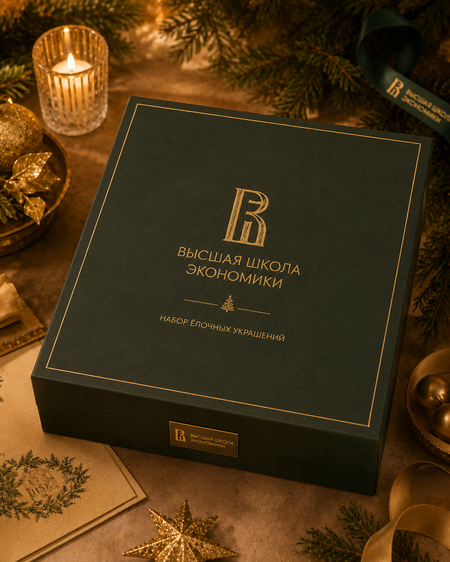
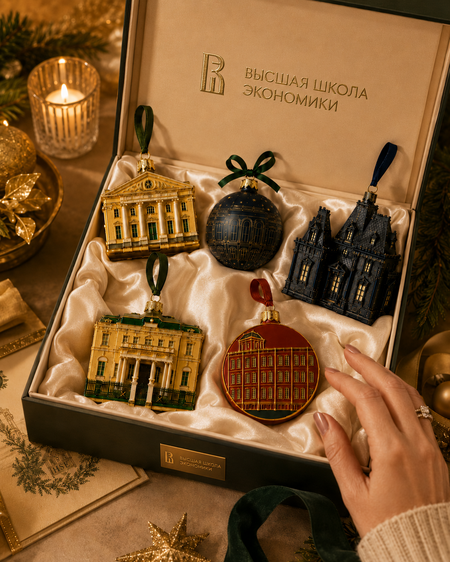
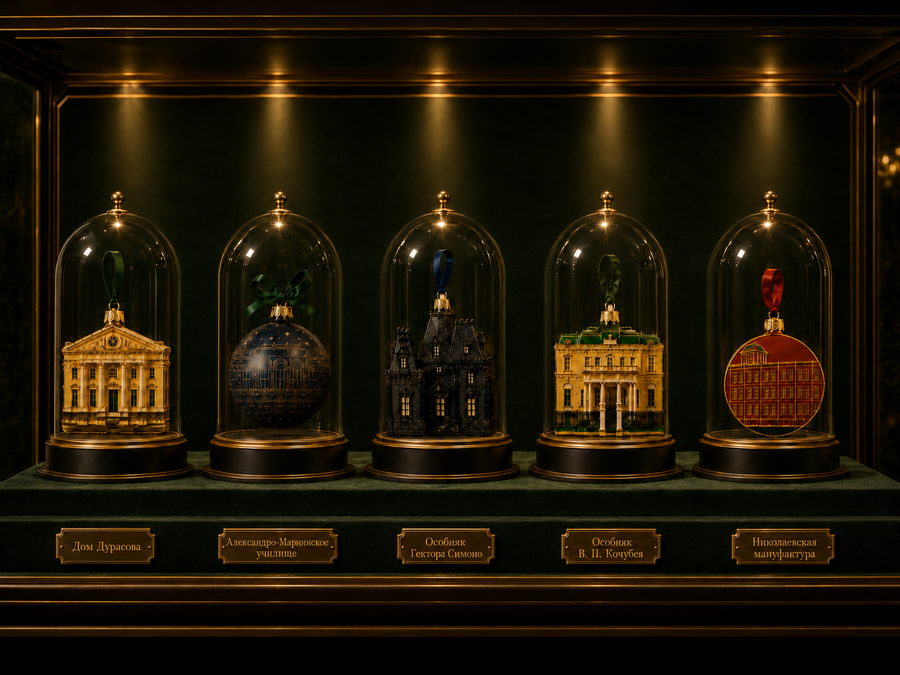
The project is dedicated to creating a series of New Year’s gifts based on the cultural heritage sites of HSE. The concept is rooted in the idea of transforming the university’s architecture into a festive visual language.
I selected five buildings, each with a distinct character—ranging from classical mansions to industrial architecture. Their facades, windows, arches, columns, and decorative details became the foundation for ornaments, packaging, postcards, and gift bags.
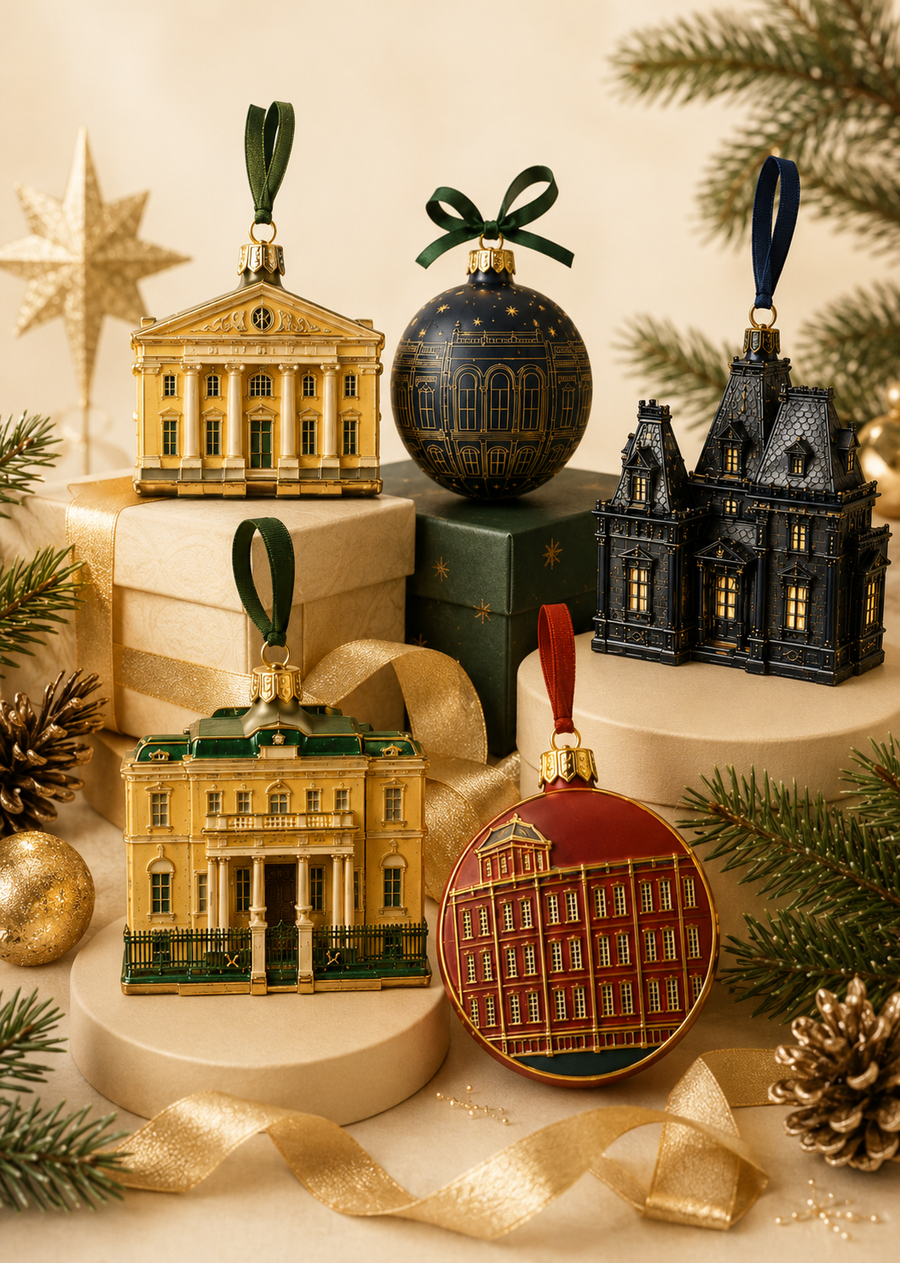
It was important to me not just to transfer the image of the building onto a souvenir, but to ensure that each element functioned as a standalone New Year’s ornament. Therefore, the architectural elements were simplified, emphasized with color, and supplemented with festive details: gold lines, ribbons, stars, and a warm holiday palette.
The result is a series of five concepts that showcase the diversity of HSE’s architectural heritage while unifying under a common festive aesthetic.
1. Durasov House
The initial inspiration for the toy came from the image of the Durasov House. I chose it for its expressive facade, symmetry, and stately columned portico. The building already possesses a sense of grandeur, making it well-suited for a festive, official holiday gift. In the toy, the facade is retained in a recognizable form but has been translated into a more decorative style. The warm yellow hue, white architectural details, and gold accents lend a celebratory feeling without being overwhelming.
2. The Alexandr-Mariinsky College Complex
In the second concept, the image of the Alexandr-Mariinsky School complex was used. I found the rhythm of the facade, the arched windows, and the strict historical plasticity of this building to be important. Therefore, the toy is not made as a literal copy of the building, but rather as a more graphic object. The arches and the facade lines become ornamentation that works well on the Christmas ornament, packaging, and greeting card.
3. Hector Simo’s Mansion
The third toy is inspired by Hector Simono’s mansion, also known as the Tearoom House. It possesses the most fantastical character of the entire collection—a complex roofline, a dark silhouette, and numerous intricate decorative details. In developing this concept, the goal was to preserve the feeling of an unusual winter home. Consequently, the toy came out more atmospheric and slightly theatrical, yet intentionally devoid of juvenile styling.
4. V.P. Kochubey Manor in Tsarskoye Selo
The fourth toy is based on the image of the V. P. Kochubey Mansion in Tsarskoye Selo. It is a serene and noble building characterized by classical symmetry, columns, and a restrained facade. In the gift series, this image serves as the most delicate and sophisticated option. The emphasis here is not on vibrancy, but on neat festivity: a light palette, green details, golden lines, and the feeling of a classic New Year’s gift.
5. The Complex of Nicholas Manufactory Buildings
The fifth toy is inspired by the complex of buildings from the Nikolaev Manufactory. This structure is distinct from the others: instead of classic manor architecture, it features red brick, an elongated facade, and industrial design. It was important to me to demonstrate that HSE’s cultural heritage can be diverse. Therefore, this toy turned out to be more graphic and contrasting. The rhythm of the windows, the brick color, and the golden lines help transform the industrial image into a festive souvenir.
Conclusion
The series of Christmas ornaments showcases HSE’s architectural heritage as an integral part of the vibrant university tradition. While each building maintains its unique character, all the objects are unified by a common festive aesthetic and the format of a collectible gift set. This souvenir functions not only as a New Year’s decoration but also as a symbol of connection to the university, its history, and its community.