Navigation Menu
Introduction
Methodology
Terminator 2: Judgment Day (1991)
Case Study 2: Fantastic Four 2 (2007)
Case Study 3: We Can Be Heroes (2020)
Conclusion
Introduction
Liquid metal is a specific type of visual effect. It must simultaneously reflect the surrounding environment like a mirror, flow like a liquid, and retain an anthropomorphic form. Unlike water or lava, liquid metal has no direct analogue in everyday photography—it always has to be generated on the computer.
In my visual research, I will analyze the evolution of CGI technologies for creating liquid-metal characters, using three films spanning the period from 1991 to 2020. The first part of the work will focus on the iconic T-1000 from Terminator 2, which laid the foundation for all subsequent experiments with digital liquid metal. Next, I will examine the Silver Surfer from Fantastic Four 2, where motion-capture and Subsurface Scattering (SSS) technology allowed for a more organic character. The final section of the work addresses the film We Can Be Heroes (2020), whose nine-meter liquid-metal shark showcases mature procedural animation and multi-layered shaders with adjustable roughness. Including these three films allows me to trace how CGI development has changed approaches to solving the same visual challenges—creating a convincing, fluid, and reflective surface—which directly aligns with the objective of my research.
Terminator 2: Judgment Day (1991)
The idea for T-1000 originated with director James Cameron while working on the film The Abyss (1989), where a tentacle emerged from the water. Cameron explained his decision thus:
I didn’t want to make another film where Arnold Schwarzenegger kicks down the door and shoots everyone. It needed to be something completely different—a robot made of polymer metal, an amorphous drop that can transform into anything.
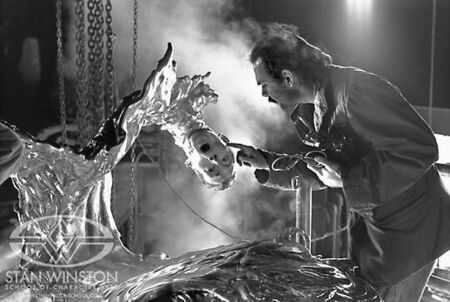
ILM and visual effects supervisor Dennis Meren were responsible for the execution. Three technologies were used in the film.
The first was morphing—the frame-by-frame transformation of one 3D model into another, allowing a character to display traits of two personas simultaneously.
The second was basic fluid simulation using the FLIP algorithm, which allowed drops and streams to move along a realistic trajectory.
The third was the «pure chrome» shader—the creators opted for a mirror-smooth surface because real mercury in life already looks unreal. If the metal on screen appeared too perfect, it was masking technical limitations.
Creation of a 3D scan of Robert Patrick for a grid scene.
T-1000 head-cut scene overlay crafted by Stan Winston Studio.
T-1000 Bust in 3D
Passing Through the Grate
Film still. Passage through a T-1000 grate. Terminator 2: Judgment Day (1991).
Storyboard example for the frame «Head Through Bars» and the final result.
In the prison cell scene, the T-1000’s head passes through the vertical bars. For this shot, the Make Sticky program was used—a tool that «stuck» the face texture to the moving geometry. The texture map was taken from a flat, orthographic image, and then its anchor points were tied to fragments of the 3D data, regardless of how that data moved. This prevented the image from sliding across the surface. Additionally, a procedural displacement generator was applied, which used the shape of the lattice’s cylindrical bars to deform the head’s geometry.
Test render of a head passing through a grate.
Appearance on the chess board
Film still. The appearance of T-1000 in the chessboard pool. Terminator 2: Judgment Day.
The scene in the hospital, where T-1000 rises from a checkerboard-patterned floor, was technically one of the most complex. The problem was that the face and the floor were two unrelated objects. To create the illusion that the face was «growing out of» the floor, the team used a ray-tracing tool: rays were directed from the source surface to the combined surface, intersection points were calculated, and new geometry was created based on them. In essence, two surfaces had to be constructed—one protruding outward, and a second for the internal geometry. The key person here was animator Lisa Kit, who achieved the result after many failures. It is worth noting: the actual hospital floor was entirely white—the black-and-white checkerboard pattern was added manually at James Cameron’s request by sticking black stickers on every other tile.
Test render of the T-1000 head merge / Finished frame from the film «Terminator 2: Judgment Day» (1991).
Exiting the Fire
In this shot, T-1000 emerges unscathed from the flames. The key technical challenge was making the liquid metal reflect fire. Since ray-tracing rendering took too long in 1991, Technical Director Steffen Fangmeier devised a workaround: environment maps were placed, onto which flame elements were overlaid in every frame. A specialized Poly-Alloy shader then used a RenderMan transformation function to calculate the accurate reflections. The «melting» or «dissolving» effect at the end of the shot was achieved by manipulating transparency using fractal noise, which created a jagged and natural transition edge.