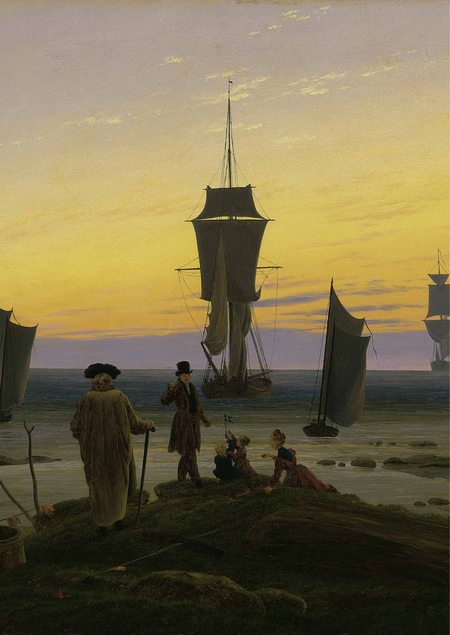
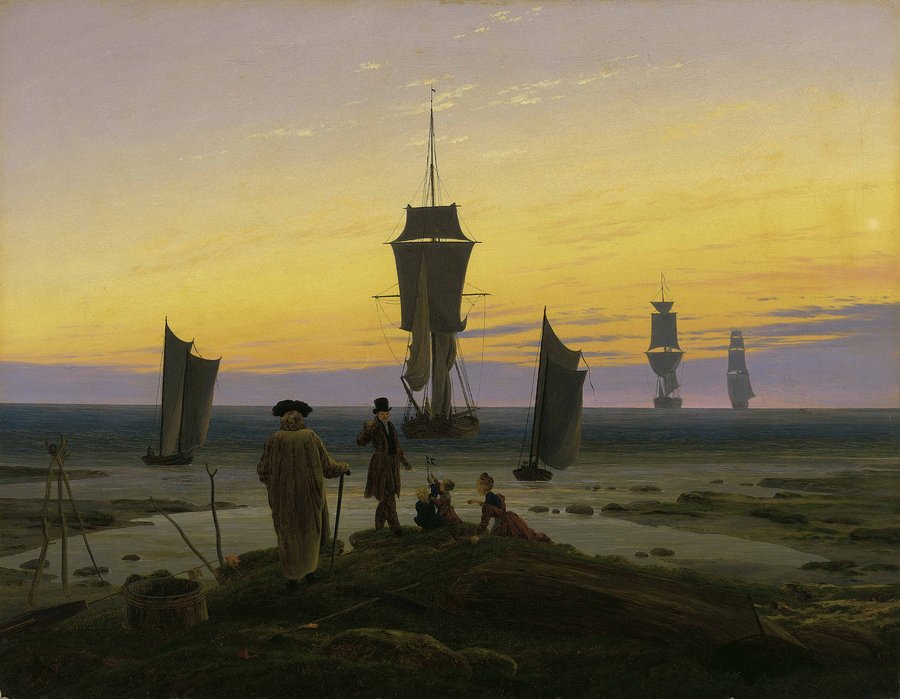
«Stages of Life,» Caspar David Friedrich, 1835
Navigation
— Concept
- Historical and Cultural Context of the Painting’s Creation
- Formal Analysis: Space and Structure
- Symbolic Language of the Painting
- Iconological Analysis and Cultural Parallels
— Conclusion — Sources
Concept
The painting «Stages of Life» (German: Die Lebensstufen) was created by Caspar David Friedrich around 1835—just a few years before the artist’s death, nearing the end of his creative journey. This work belongs to the later period of his career, a period where a tendency toward symbolic restraint and internal silence is particularly evident. At that time, Romanticism in Germany had begun to lose ground (its last stronghold was around 1830–1840), yielding to Realism; however, the artist remained faithful to his style—an art form where nature serves as a medium for expressing the human inner world, rather than the external one.
The painter was born in 1774 in Greifswald, a city in Northern Germany, and from childhood was closely connected to the Baltic landscape, which later became an integral part of his pictorial language. The loss of his mother at an early age, and later the death of several loved ones (including a brother who drowned before him), left a deep imprint on Friedrich’s soul—death, farewell, departure, and loneliness and melancholy became the leitmotifs of his paintings. He developed these themes not through dark imagery, but through silent, meditative landscapes filled with presence and absence simultaneously.
He was one of the central artists of German Romanticism—a movement that strived to convey the inner, spiritual through the external and natural.
«Stages of Life» is one of Friedrich’s most personal works. The painting is presumably a portrait of his family members: his children, wife, and himself. However, the work is not autobiographical in the literal sense; the figures serve as allegories for human aging, while the sea and sunset on the horizon symbolize life and the passage of time—the change of cycles.
The painting contains no overt action, conflict, or pronounced emotion. It exists in a state of quiet contemplation, where every element functions as a visual signifier. This artwork will be examined as a visual allegory of human life, constructed through the language of landscape, rhythm, and silence.
In «Stages of Life, ” Friedrich abandons traditional narrative and classical composition in favor of creating a structure where the concept of time as a flow, and life as a ritual path and cycle change (from day to night), is revealed through figures, space, and light.
To test this hypothesis, the research will focus on: • the influence of the artist’s biography on the construction of the painting’s semantic field; • figurative composition and the symbolism of human ages; • the symbolism of the sea and ships as motifs of movement, departure, and transcendence; • iconological and philosophical allusions, including ancient and Christian conceptions of life as a journey.
- Historical and Cultural Context of the Artwork’s Creation
The nineteenth century was a time of rapid change: industrialization, political reforms, urban growth, the strengthening of scientific thought, and secular rationality. Yet, running parallel to these developments was Romanticism—an aesthetic and worldview movement that served as a response to the rationalism of the Enlightenment. Where Classicism relied on reason and order, Romanticism turned toward emotion, mysticism, religion, the inner world, and the experience of nature as a revelation.
«Stages of Life» is a late work by Caspar David Friedrich, created during a period of physical frailty, near total isolation, and obscurity. During this time, the artist—once a recognized leader of German Romanticism—found himself overshadowed by new artistic movements: mystical contemplation was supplanted by naturalism and social realism, with focus shifting to action, concrete reality, and civic engagement.
Realism, already established in the 1830s: Theodor Rousseau, Market in Normandy, 1830s.
In painting, Romanticism does not strive for external truth like Realism, nor does it idealize classical forms like Neoclassicism. Instead, it leans toward existential states: solitude, melancholy, and anxiety before infinity. In this context, the landscape ceases to be merely a genre—it becomes the primary medium for expressing the human condition.
Caspar David Friedrich, Wanderer above the Sea of Fog, 1818
Caspar David Friedrich was not only a witness but an active participant in this aesthetic shift. He began painting not nature for nature’s sake, but nature as a state of being. Inspired by the philosophy of Kant and Schelling, he viewed nature as a space of revelation—where through fog, rocks, trees, and sky, one glimpses not the external landscape, but the internal state of the person within the world.
The painter was a contemporary and conversationalist with artists such as Friedrich Otto Runge and Karl Gustav Carus, as well as poets and philosophers of the Romantic school—Novalis, Tieck, and the Schlegel brothers. His aesthetics are closely linked to literary Romanticism—particularly the concept of the «sublime,» which was developed by Burke and Kant. The sublime is a feeling that arises on the boundary between the beautiful and the terrible, between awe and fear, and it forms the foundation of Friedrich’s landscape.
At the same time, Friedrich did not escape the influence of the events of his age: in his youth, he witnessed the Napoleonic Wars, the dissolution of the Holy Roman Empire, and the complex identity of the German lands. These events fostered in him a sharp sense of finitude, historical changeability, and loss, which become important themes in his work. In his later paintings, the image of the cross, journeys underway, and receding figures appear more frequently—and «Stages of Life,» in this sense, acts as a kind of testament.
Caspar David Friedrich, Cross in the Mountains, 1808
The choice of subject for this painting is not arbitrary. It unites everything that was important to Friedrich: the landscape of northern Germany, the native Baltic Sea, the figure of a person turned toward the horizon, and the theme of time as transition. On one hand, it is a painting that can be considered personal—it depicts family members of different ages, likely including the artist himself. On the other hand, there is no intimacy or everyday specificity here. The family becomes an allegory for the entire human journey. We also cannot say who is depicted—since almost all the participants are standing with their backs to us, which grants the viewer the freedom to imagine who is being shown. The personal and the universal are fused, and the viewer perceives the scene not as a portrait, but as a symbolic statement.
A similar universality in imagery can be observed in René Magritte’s «The Son of Man, ” where we see a collective image of a person from our time—dressed in the contemporary attire of the era and holding an apple. His face is concealed, allowing us to project ourselves into his place.
René Magritte, The Son of Man, 1964
The painting was created at a moment when Friedrich himself was physically frail and his art was nearly out of vogue. However, contrary to expectations, he did not abandon his principles: he did not chase trends or attempt new styles. On the contrary—he refined the composition even further, stripping away anything superfluous, rendering the form almost ascetic. Before us is a landscape reduced to its essence, yet brimming with maximum semantic density.
Thus, «Stages of Life» is not merely a work of art, but a response to the challenges of its time—an attempt to affirm eternal meanings in an era of loss, change, and disillusionment.
This painting becomes the culmination not only of his life but of an entire cultural era—an era in which humanity, having ceased to be the measure of the world as in the Renaissance, began to seek its place in the boundless, mutable, yet deeply revealing world around it.
2. Formal Analysis: Space and Structure
At first glance, the composition of the painting «Stages of Life» appears extremely simple. Before us is a coastal strip, a wide, calm sea, a high sky, five human figures, and several sailboats receding toward the horizon. Everything is depicted almost frontally, without visual traps or complex perspective.
However, upon closer examination, it becomes clear: the space in this work is organized as a philosophical structure, not as an imitation of nature. Friedrich is not simply staging a scene; he is creating a visual form for contemplating life.
The Logic of Construction. From Earth — to Sky, From Body — to Eternity.
The composition of the painting is structured according to a strict, almost mathematical principle. The space is divided into three levels:
- foreground — a narrow strip of land upon which the figures stand;
- middle ground — the water’s surface of the sea dotted with sailboats;
- background — the lightening sky, devoid of a distinct light source (the sun has almost set below the horizon).
This vertical arrangement (from bottom to top) not only defines the depth of the painting but also initiates a movement of meaning within it: from the material to the immaterial, from the finite to the infinite, from life to what lies beyond it.
The shore, where the figures are situated, is almost devoid of decorative detail: only the uneven texture of the sand, fishing gear, dry sticks resembling crutches, and a few debris pieces. All of this creates a sense of modesty and groundedness, further diminishing the significance of earthly, fleeting life. This is the human space—a space that contrasts with the sea’s soft, uniform, almost musical surface and the sky dissolved in golden light.
Age Range
Five figures positioned on the shore represent different stages of life:
- A boy and a girl at the water’s edge,
- Two adults—a man and a woman—closer to the center,
- An elderly man (presumably the artist’s self-portrait) in the foreground, closest to the viewer.
The figures are arranged diagonally from right to left (or vice versa, if viewed by age), thereby creating a rhythm analogous to a march. Their poses are tranquil and devoid of action: the children are playing, the adults are looking toward the sea, and the old man stands with his back turned, lightly leaning on a cane and contemplating. No one interacts with another. This is not a scene, but a state—and each figure within it is a milestone with its own purpose.
Diagonal Rhythms in Composition
The diagonal of the figures is supported and rhymes with the diagonal of the sailing ships on the sea. This forms a second visual row consisting of three large vessels and two skiffs. They too move from the foreground toward the horizon: one is almost obscured in a bright patch on the line where the sky meets the water, another is sailing under canvas, and the third has already furled its sails.
Thus, the two systems—the human and the maritime—mirror each other, like two octaves of a single melody. The figures on the shore and the ships at sea create parallel rows, and this symmetry transforms the painting into a visual system of being.
The artistic composition is also structured around a double triangle, which not only organizes the space but also expresses the philosophical essence of the painting. The lower triangle, inscribed along the shoreline, includes human figures—ranging from kids to an elderly man. This is the realm of earthly existence, physicality, and finitude. The figures stand on the ground, immersed in the material world, silently observing the sea, yet not crossing into it.
The upper triangle is formed by sailboats venturing out to sea and culminates at the mast of the central ship. This is the realm of other being, a metaphysical space toward which the gaze of the characters and the viewer is directed. The ships echo the rhythm of the figures on the shore, creating a visual parallelism between life and passage, between presence and promise.
The space between the two triangles—the sea—functions as a boundary, as a symbolic threshold between the earthly and the eternal. Thus, the painting’s geometry transforms it into a structured meditation on life as a journey: from the dense to the luminous, from darkness to light, from the moment to infinity.