[1] Concept
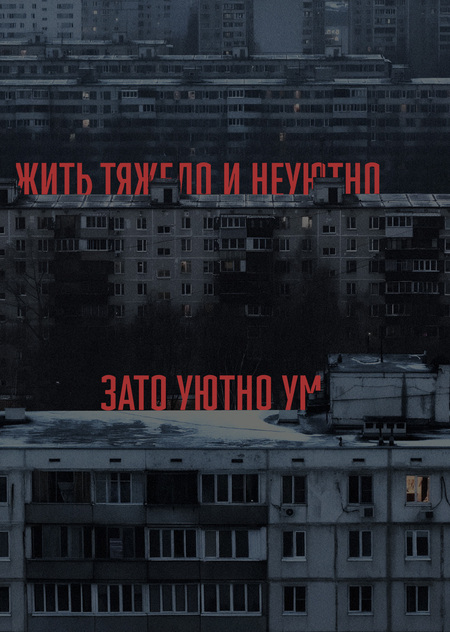
The choice of research topic stems from a desire to understand how the visual codes of depression and apathy—codes that have become recognizable in contemporary Russian and CIS culture—emerged from the trauma of post-Soviet collapse. Even generations born after 2000 are drawn to this aesthetic—to the world of concrete panel buildings, fog-shrouded courtyards, coarse textures, and subdued light.
Alexey Yurchak notes in the book «It Was Forever Until It Ended» that the late-Soviet era created a unique experience of lived stability: «the category of infinity in late socialism was experienced as something obvious, immutable» [1, p. 4]. The rupture of this «perceived infinity» was a cultural blow, the consequences of which continue to manifest in the visual practices of several generations. The post-Soviet utopia did not disappear—it fractured into multiple personal experiences, settling into the cities, interiors, and everyday details. It is these traces that form the fundamental emotional tone of contemporary «Russian depression.»
Research Hypothesis: The visual code of depression and apathy in contemporary Russian and CIS culture is a transformation of post-Soviet trauma and the continuation of a lost utopia, which has shifted into intimate imagery and practices associated with everyday experience. This aesthetic shapes a new collective sensibility, where melancholy and alienation become a means of interpreting reality, rather than merely an emotional reaction.
The research goal is to trace how post-Soviet melancholy from the 1990s and 2000s transformed into the visual language of modern «Russian depression» and became part of mass culture—through photography, music scenes, internet mythology, and digital visual environments. It is important to understand why depressive imagery functions not only as an aesthetic trend but also as a way of articulating the self, the city, and time.
Research methodologies include: analyzing photographic and artistic series from the 1990s to the 2020s; studying musical and digital content that shapes a new sensibility; examining formal characteristics (color, light, texture, architectural and bodily motifs, frame rhythm); semiotic analysis of visual elements as cultural signs; and comparing how the visual language evolves from the era of collapse to the era of digital depersonalization.
Thus, the research concept is built on the idea that the contemporary aesthetic of «heavy» sensibility is not merely a passing visual trend, but a continuation of historical trauma refracted through new media, new generations, and new forms of visual expression.
[2] 1990s–2000s: Fixing Decay
The early 1990s marked the collapse of the Soviet visual system. What yesterday was framed by images of collective labor and faith in the future transformed into a reality devoid of script or set design. Here, the poetry of ruin is born—a careful, almost documentary observation of how the past vanishes and how a new visual language forms from that disappearance. This state of a «stretched-out end, ” where the old still persists through inertia but the new has not arrived, is precisely what Yurchak described in the situation where „everything was forever, until it ended“ [1, pp. 28–30].
Photographers became witnesses to the disappearance of utopia: they did not document events, but the very essence of time itself, emphasizing the „uncelebrated“ body of society. This shift toward documentarianism and the fixation of past traces resonates with Nora’s idea of „sites of memory”—moments where disappearing reality attempts to sustain itself through fixation [4, p. 23].
Alexander Chekmenyov
Alexander Chekmenyov / Untitled / «Street People» series / 1994–1999 (exact year unknown)
Photographer Alexander Chekmenyov documented the post-Soviet reality of Ukraine. His black-and-white series, «Black & White Lugansk» (1994–1999), and the color cycle, «Street People» (1994–1999), document life in the provinces after the collapse of the system, when the city became a space for survival.
The photographs feature unemployed individuals, pensioners, children, and vendors near the walls of semi-ruined buildings. Every picture is like a fragment of a chronicle of internal decay, where former landmarks have vanished. Chekmenyov’s camera does not seek drama—it simply records the fact of existence, as if from the perspective of a witness, not a participant.
In the «Street People» series (1994–1999), one senses a visual continuity with the Soviet documentary school—the directness of the frame, the frontal light, the everyday physicality. But the context is different: people no longer represent the «people» as in Soviet photography; they exist on their own, individually, or in small clusters gathering together. It is not a collective, but a multiplicity of personal isolations.
For instance, the frame with a woman sitting under a tree (Luhansk, 1996) shows the exposed simplicity of everyday life, devoid of heroism or metaphor. In the photograph with boys (Luhansk, 1995), there is a division between the crowd of passersby captured in motion and two static, frozen children. Here, the document transforms into testimony, and the quotidian becomes a language of memory, which is directly related to Barthes’ description of photography’s ability to fix «what was» as a present absence [3, p. 85].
In «Black & White Lugansk» (1995–1998), the city appears as a post-apocalyptic space in the black-and-white palette: people seem to dissolve into the dust of time, frozen among abandoned courtyards and empty merry-go-rounds.
These photographs can be viewed as a visual symptom of transition—from collective utopia to private survivability. In every frame, there is not only a documentation of decay but also an attempt to preserve human dignity amidst everyday hopelessness. Chekmenyov neither judges nor romanticizes his subjects; he shows how a grand historical narrative becomes a personal tragedy.
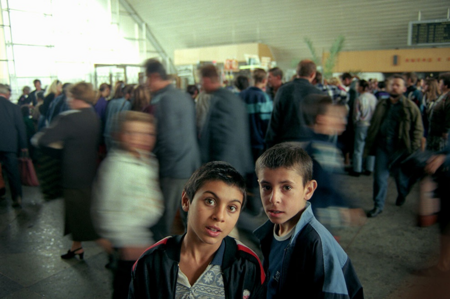
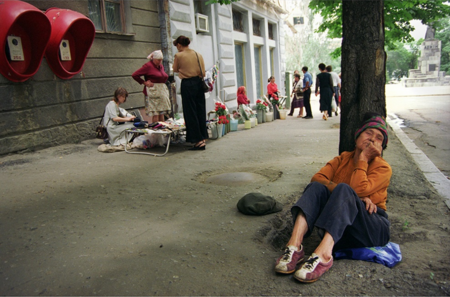
Alexander Chekmenyov / Untitled / «Street People» Series / 1995 Alexander Chekmenyov / Untitled / «Street People» Series / 1996
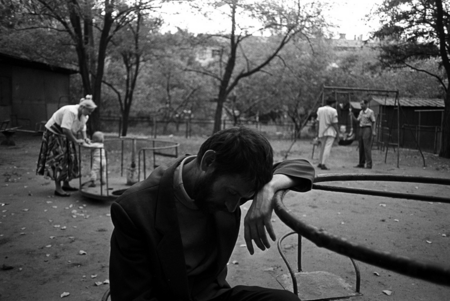
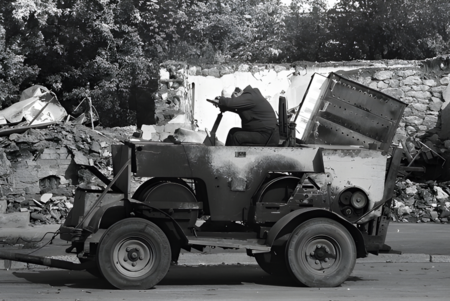
Alexander Chekmenyov / Untitled / «Black & white Lugansk» series / 1992–1997 Alexander Chekmenyov / Untitled / «Black & white Lugansk» series / 1994
Igor Mukhin
Igor Mukhin / St. Arbat / «I Saw Rock and Roll» Series / Moscow / 1998
Mukin—a chronicler of Moscow’s street culture: the rock scene, subcultures, crowds, nocturnal Moscow. His subjects are young musicians, punks, poets, random passersby, the city’s youth drifting through Moscow. His photographs aren’t directly about politics, but about the spirit of the age: how people construct «microcosms» within the space of a massive cultural fracture.
His black-and-white images convey that precarious feeling of time—when the old order has vanished, but the new one has yet to solidify. In the series «I Saw Rock and Roll» (1986–1991), the tremor of an era is palpable: energy directed not toward revolution, but into a void. In one image from the «I Saw Rock and Roll» cycle (1986), a young punk sits against a wall—peeling plaster behind him, no events or movement in the frame. All attention is concentrated in this almost static moment. Mukin’s characters do not pose, nor do they proclaim themselves—they merely exist, as if caught within the persistent hangover following the Soviet euphoria. Through them emerges the era’s psychological marginality—the sensation that former meaning has dissolved, yet nothing new has arrived, leaving only motion by inertia.
In the series «Our Nineties» (1990s), this motif intensifies: crowds at rallies, portraits of elderly women and teens, shots with banners and flags—all these fragments coalesce into a chronicle of scattered memory. In a photograph from the May 9th, 1996 demonstration, the crowd carries portraits of Stalin; in Mukin’s lens, there is neither condemnation nor ecstasy—only the observation of how the past returns in strange forms. This is not politics, but nostalgia as a lived condition. On another photograph, an elderly woman is situated among young police officers; there is no conflict between them, but there is a yawning gap between eras. These visual dissonances become Mukin’s means of addressing the generational rift—how symbols lose their meaning, and how the city transforms into a repository of incongruities and contradictions.
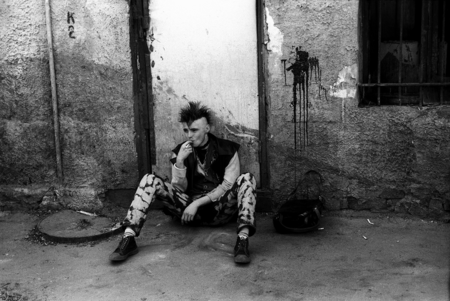

Igor Mukhin / Untitled / «I Saw Rock and Roll» Series / Moscow / 1986 Igor Mukhin / Hans, Surgeon / «I Saw Rock and Roll» Series / Moscow / 1987
Igor Mukhin / Gorkiy Street / «Our Nineties» series / Moscow / 1991
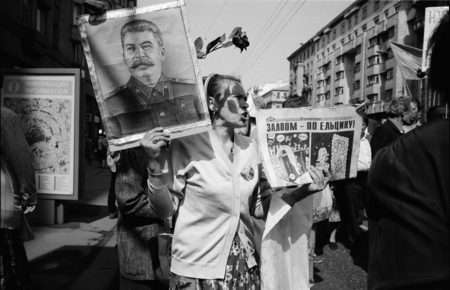
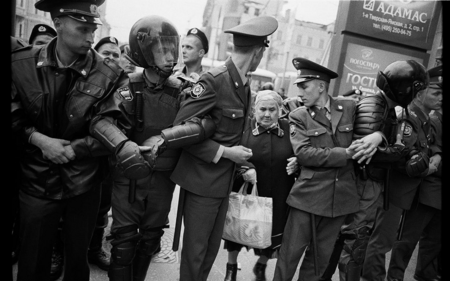
Igor Mukhin / May 9, Tverskaya Street / Series «Our Nineties» / Moscow / 1996 Igor Mukhin / Untitled / Series «Our Nineties» / Moscow / 1996
Sergey Maksimishin
Maximishin isn’t capturing a crisis; he’s documenting inertia: people continue to live in a reality that has lost its meaning, operating on momentum. His frames are saturated with gray, brown, and muted tones—the colors of stagnation and fatigue. Unlike Igor Mukhin, Maximishin presents the other side—life outside of rhythm, where time ceases to move. Visually, the photographs appear mundane and simple: neutral light, quiet (sometimes almost «dormant») compositions, washed-out hues. But it is precisely this simplicity that is effective: it illustrates that nothing «epochal» is happening—only monotony.
Maximishin doesn’t dramatize; he records inertia: people live «by habit, ” and this sense of stagnation becomes the central character of his photographs. Fisher aptly describes this condition as a „world without alternatives, ” where depression becomes a structural experience of time [5, p. 21].
Within the context of the theme, „the aesthetics of Russian depression, ” Maximishin portrays a phase of „not a bright catastrophe, but prolonged apathy.“ While other photographers capture decay as an event—for him, decay has become the backdrop, a background mode integrated into everyday reality.
Sergey Maksimishin / Nevsky Prospect / Saint Petersburg / 2000
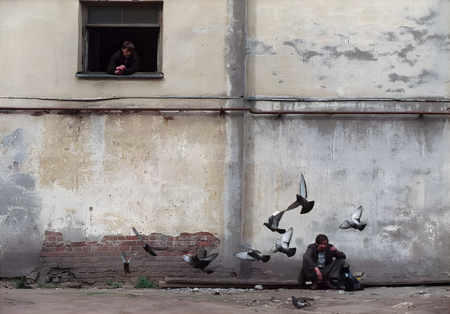
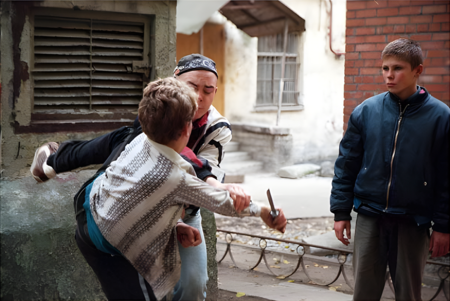
Sergey Maksimishin / Feeding Pigeons / Saint Petersburg / 2001 Sergey Maksimishin / Street Children-3 / Saint Petersburg / 2000
Three photographers illuminate different facets of a single process: Chekmenyov explores loss and the archive of the self; Mukhin examines the collision of past and future; and Maksimishin portrays provincial stagnation. Together, they illustrate that the 1990s–2000s were not merely the era of a collapsed socialist utopia—they were the period when humanity first confronted space, time, and the self. These photographs do not evoke nostalgia—they capture the moment when «we» lost meaning, and the search for «I» began.
[3] The Millennial Generation (2000s–2010s): Archeology of Personal and Collective Experience
After decades when dissolution was documented as an event—a chronicle of survival and change—the focus shifted inward in the 2010s. Artists began to examine the aftermath: not the moment of loss itself, but how that loss embedded itself into everyday perception, into language, and into the memory of families and bodies. The generation of artists from the 2000s–2010s—such as Pavel Odelynov and Timofey Rady—grew up already in the reality post-dissolution. For them, the Soviet past is not personal memory, but an inherited trace—almost a genetic trauma transmitted through space: factories, cities, and domestic habits. This is precisely how the «trace of memory» described by Nora functions—it is transmitted not through events, but through the environment of living [4, pp. 17–19]. Consequently, their work presents not documentation, but an archaeology of personal and collective experience.
Pavel Otdelnov
Pavel Otdelnov / «Abyss. Panel Buildings.» / «Hometown» Series / 2023 / Canvas, oil / 100×120 cm
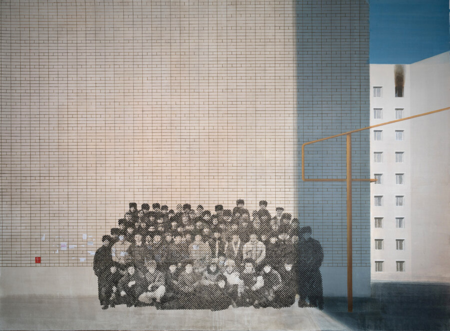
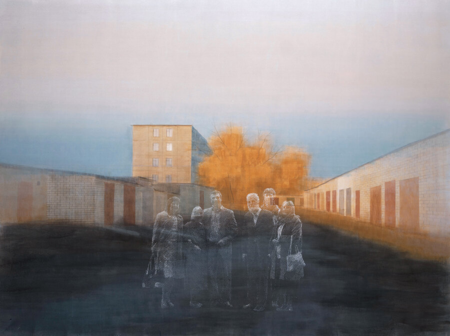
Pavel Otdelnov / «Band» / Hometown Series / Canvas, Acrylic / 210×285 Pavel Otdelnov / «Family» / Hometown Series / 2023 / Canvas, Acrylic / 210×285
Pavel Odelyanov is one of the few artists working at the intersection of the documentary and the personal. He is interested in how the post-Soviet space shapes identity—through architecture, landscape, and language. He is not simply reconstructing the 1990s; he is investigating how that era lives in the present.
The artist grew up in Dzerzhinsk, a factory town, and his painting represents an internal archaeology of Soviet industry. Gray industrial zones, old workshops, deserted corridors—these are depicted with almost photographic accuracy, yet without narrative. This is neither accusation nor nostalgia: in these spaces, Odelyanov captures silence and the echoes of labor, a sense that someone was recently there—but they are gone. His projects «Industrial Zone» (2014) and «Hometown» (2023) address industrial memory: abandoned factories, closed enterprises, ghost towns.
In the projects «Industrial Zone» (2014) and «Hometown» (2023), the artist functions almost as a researcher: studying archives, collecting oral histories, and documenting the personal recollections of former workers—thereby creating a social topography of loss. This engagement with the «sedimentary layers of time» resonates with Benjamin’s idea of melancholy as a mode of viewing the world through remnants and fragments [6, pp. 112–114].
If the photographers of the 1990s captured the «here and now, ” Odelyanov performs an analysis of the trace: he works not with the event itself, but with its reverberation.
His signature faded palette, hazy light, and dust—rendered as an almost physical medium—make his painting a visual metaphor for memory, where time is not linear but settled in layers. Odelyanov shows that post-Soviet melancholy is not just a feeling, but a way of living through history.
Pavel Oddelnov / «Rails» / from the «Industrial Zone» series / 2018 / canvas, oil / 150×200
Timofey Radi: The City as a Canvas for Emotions
Timofey Radi / «Who are we? Where are we from? Where are we going?» / 2017