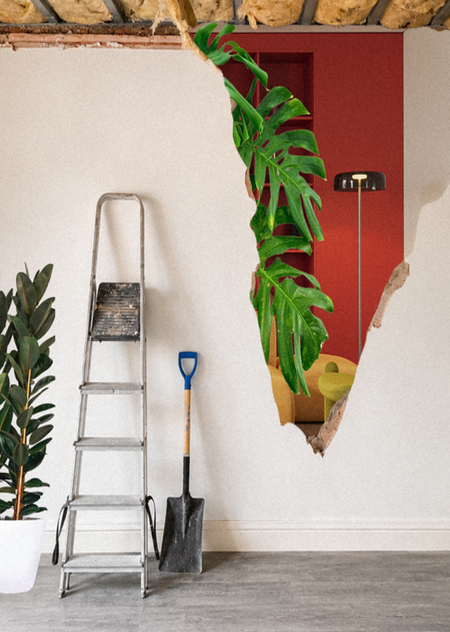
Buying an apartment is simultaneously a moment of joy and the start of a massive, complex quest called «renovation.» This is especially difficult for those who decide to tackle it alone, without the help of a professional designer. It seems like opening Pinterest and finding a beautiful picture is enough, but in reality, this often leads to financial and aesthetic losses. We spoke with Stepan Bugayev, a designer who calls himself an «interior champion, ” and have compiled a clear strategy for you to conquer your ideal space.
Where Does Conscious Repair Begin?
Buying your own apartment is simultaneously euphoric and the start of an incredibly complex quest—especially if you decide to tackle it without a guide, such as a designer. The first mistake almost everyone makes is rushing to the store for wallpaper and tile right after signing the documents. Professionals advise the opposite: take a pause.
Before choosing a dopamine sofa or a contrasting paint color, simply spend time in the empty space. Walk through the rooms, study the light at different times of the day, and feel the dimensions. A specialist can always visualize the final result before any work begins—that is a skill worth cultivating. Let your project «mature,» much like a fine wine. Impulsive decisions at the outset almost always lead to disappointment and costly revisions.
Once the initial excitement subsides, begin systematically building your visual vocabulary. Read relevant publications and study the principles of styles that resonate with you. However, there is a crucial nuance here: do not try to assemble the interior piece by piece. Selecting the flooring, then separately choosing wall paint, and finally picking a random sofa—that is a surefire way to end up with an «interior Frankenstein.» Instead, practice reverse engineering: find a beautiful image and break it down into its components. What is the floor made of? How do the textures work together? How does the light function? This approach helps form a cohesive picture in your mind and helps you understand the direction you are moving.
How to work with color, trends, and sources of inspiration
The most challenging stage for a beginner is working with color and color theory. Choosing a shade on a small swatch card and imagining it across an entire room’s walls is a nearly impossible task. Here, the key is not to reinvent the wheel. Utilize professional color palettes available online—there are numerous resources where harmonious pairings for walls, furniture, and accents have already been curated.
However, if you decide to forge your own path, be prepared for intense scrutiny. Take all your samples to the store at once: a piece of flooring, the fabric for the future sofa, the cabinet facade. And be sure to view them under different lighting conditions. Only then can you determine if the shades will complement each other in real life, rather than under showroom lamps.
Now, let’s discuss trends. Many fear them intensely, believing that a trendy interior must be impersonal and expensive. In reality, the problem isn’t the trends themselves, but their sheer quantity. The rule is simple: choose one dominant motif (for example, curved forms or eco-friendly materials) and make it the foundation. This motif should run through the arches, furniture, and textiles. Add all other influences—metallic finishes, bright accents, or geometry—sparingly, focusing on hardware and small details. If you try to cram everything in at once, your apartment will turn into an overcrowded store display, where every room operates under its own chaotic set of rules.
And the sharpest question is about sources of inspiration. For a professional designer, Pinterest is a working tool; for the amateur, it is often a minefield. It is easy to stumble upon secondary content, rehashes, or overtly weak works presented as standards. Therefore, first, explore specialized portals that feature editorial curation (such as InMyRoom). Study professional design projects that come with detailed explanations—briefs that articulate the logic behind the decisions. Build a base of high-quality visual knowledge, and only then use Pinterest as a search engine for specific details.
How to Avoid Fatal Mistakes and Save Budget
Let’s move on to the riskiest part—the technical and ergonomic aspects. The main pitfall for beginners is trying to grasp everything at once and choosing «the best of everything immediately.» A person sees beautiful sink bowls and stylish faucets and starts convincing themselves they need them. But this is where cold mathematics kicks in: if a faucet is too powerful and the sink is too small, the water will flood the floor. If you plan to make a bathroom countertop out of epoxy resin with pebbles, you must know the exact height and the appropriate specifications for the plumbing fixtures. Don’t try to engineer the ergonomics yourself—it should always be vetted by professionals or at least by consultants in stores that deal with this daily.
The second area of risk is collisions—clashes between elements. The most common scenario is hanging a trendy lamp only to have the closet door hit it when opening. To prevent this, run a mental experiment: how will all the purchased items stand, hang, and interact within the room’s volume? A very useful life hack is modeling. Use painter’s tape, tracing paper, cardboard boxes, or foam mats to lay out the contours of the future furniture directly on the floor of an empty apartment. This instantly snaps you to reality: you see the actual dimensions, you understand whether walking around is comfortable, and you can tell if a cabinet is blocking a pathway.
And finally, an important rule: start broad and narrow down. First, establish the foundation: the walls, the floor, the main coverings, and the primary color blocks. Only then move on to the sofa, the tables, and the cabinets. And last of all—the decorative touches, pillows, and vases. If you disrupt this sequence, the risk of creating an interior cacophony multiplies. Remember: a complex and beautiful interior is not only for elite clients. Today’s market offers countless adapted solutions: instead of expensive natural stone, use porcelain stoneware with a unique pattern; instead of high-end designer furniture, opt for quality local brands. The key is to approach the process with intention, respect the industry, and never be afraid to consult with those who know more than you do.
Read the full article on the «Tsekh» website.
Cover: «Workshop» collage. Photo: © ProximaCentauri1, Laci_10, Rina SN, Olena Hniezdilova / Shutterstock / Fotodom