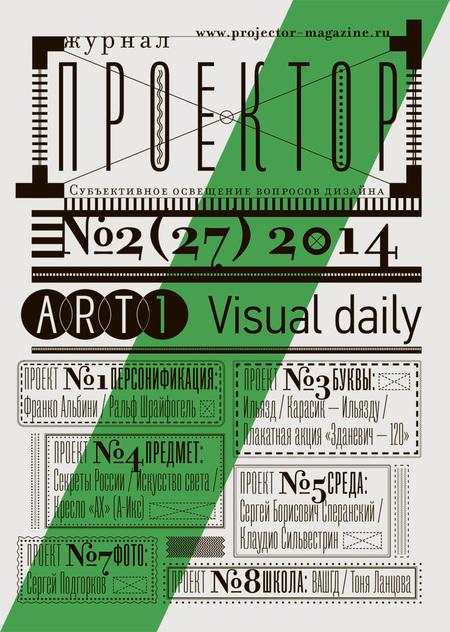
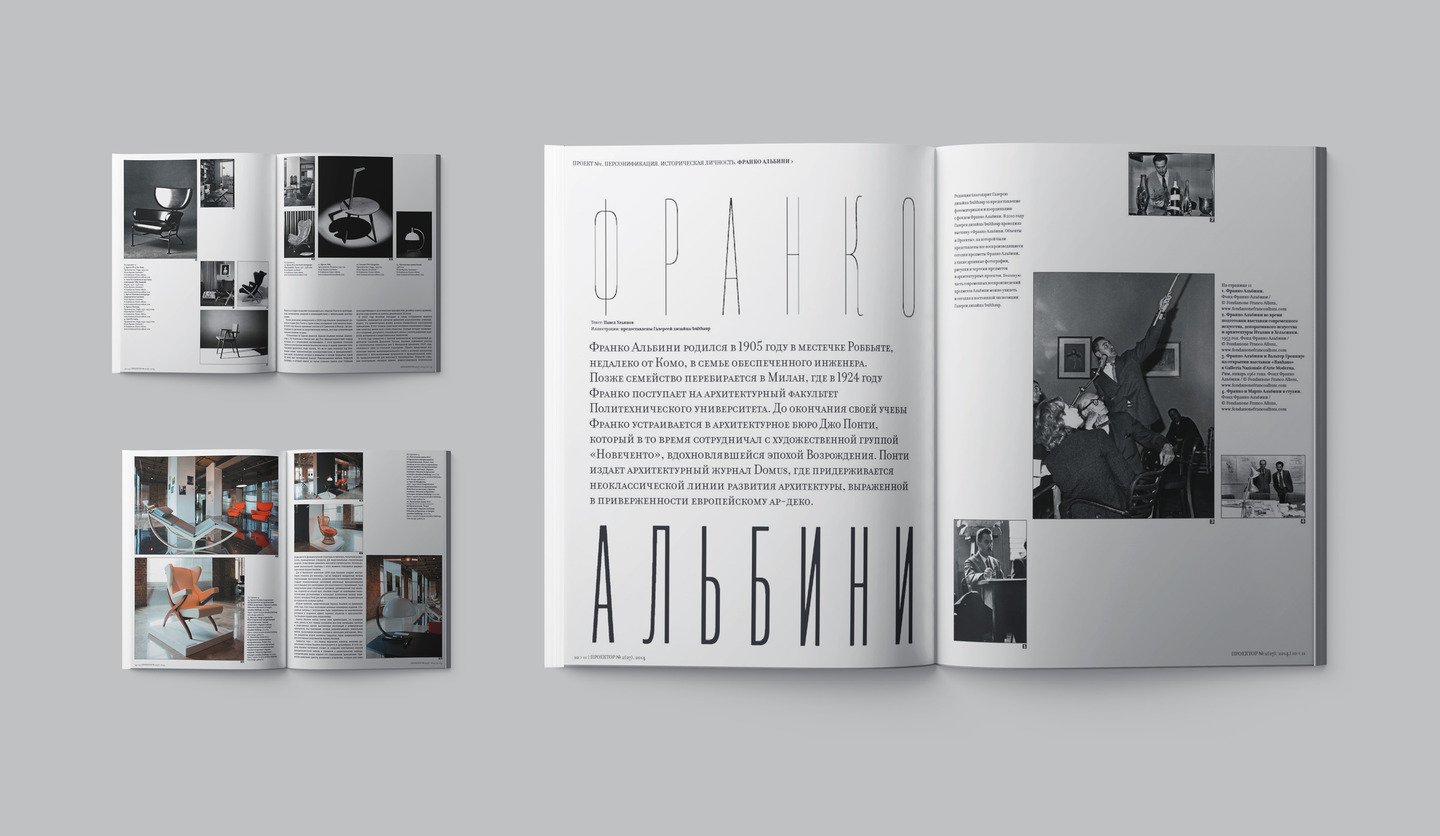
The issue starts with another episode of Pavel Ulyanov’s series about the great Italians of the 20th century. Its historical digest features Franco Albini. «The prestigiously awarded designer, and the owner of a lot of titles in architecture, maestro Franco Albini passed away in the autumn of 1977. Albini’s priceless contribution to the school of national design, formed by the individual styles of Italian masters, was the floating in the air objects, which seemed to have defied gravity by their sophisticated construction. In 2007 the works by Franco Albini were considered the national heritage of Italy».
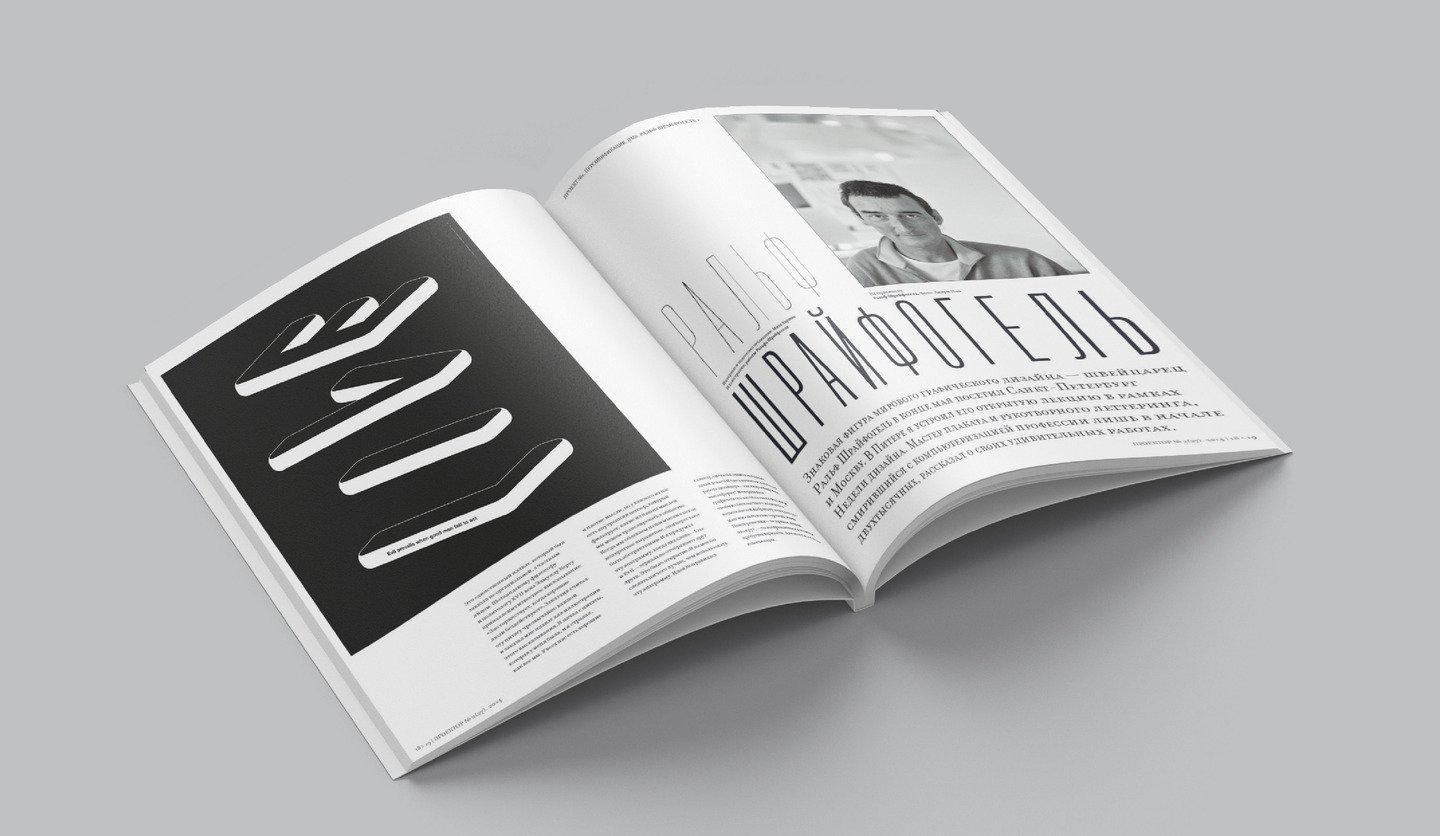
This issue features an exclusive interview with Ralph Schraivogel he gave us during his stay in St.Petersburg: «I took up graphic design because back in my childhood I loved drawing and painting. In my studies, I was surrounded by the best examples of Swiss graphic design. Nowadays they already don’t seem so boring they used to be when I was 20. I started working right after the graduation, but all those commissions made me burn out in a two-year’s time. The only pleasure I got from my job was being paid for it. However, it wasn’t rewarding in any other way, so I tried to remember why I’d become a graphic designer. I asked myself where in this field I could find drawing and painting, and posters seemed to be the closest to what I had initially wanted to do».
Entire «Lettering» section commemorates Ilya Zdanevich, whose 120th anniversary was celebrated that year. Mikhail Karasik has prepared the historical column about him: «We know from Talks of Leonid Lipovskiy and Daniil Harms, that the latter was born out of some caviar barely put onto a slice of bread. However, it’s not quite correct. The curious case of Harms stems from the macaronic autobiography written by Ilya Zdanevich in his Ilyazda: „Next morning it came out I had teeth. I was eager to chew meat instead of being nursed“. Let alone his birth, Zdanevich mystifies his death as well, predicting it half a century before! In the drama lidentU fAram, which we are going to mention below, he shares his dates of life with a minor discrepancy of two years: 1894—1973».
The last Russian futurist Daniil Harms, following the tradition and keeping up with Zdanevich, also mocks at his own birth in any way possible in literature. Notably, both of them, though at a different time, overcame futurism, which Zdanevich was directly relevant to: in 1912 he introduced this notion in Russia (in the manner of Marinetti), while David Burliuk, Vladimir Mayakovskiy, and Velimir Khlebnikov were still considering themselves as the budetlyane (Rus: «people of the future»). We’re not going to blame Daniil for cheating, as Zdanevich wrote Ilyazda in Paris, and first read it in a little restaurant «Hubert» on 12 May, 1922, during his public talk «About Myself». For that, he’d designed a radical lithographical poster, a kind of a parody on typography.
To conclude the theme of Ilyazd, here’s the selection of the best works from the international poster campaign Zdanevich 120, organized by Serge Serov: «It all started two years ago with „Rodchenko 120“, last year it went on with „Mayakovsky 120“, this year it was „Ermilov 120“ and „Zdanevich 120“. All the campaigns were held within Moscow international biennale Golden Bee. They logically continue the topics, brought up for the previous biennales: Russian Avant-garde and Futurism 100. Russian avant-garde is a unique era in the history of art and design, which we are rightly to be proud of. This is the major contribution of Russia into the world of visual culture of the 20th century».
For the Object column, I have interviewed Aamu Song and Johan Olin, the two Finnish designers who are in love with Russia. Having traveled all over the country, they came up with their own project Russian Secrets. Within it, they created new designer products by means of traditional manufacturing. Mitya Kharshak (M.K.): Aamy, you come from Korea, and I guess you won’t have trouble comparing the Finns and the Russians. Do we have much in common? Are we somehow different? А.S.: You’re quite different — same as the Germans and Dutch. They are closely related but different. There’s a big difference that the Russians love cooking, and the Finns are not so much into culinary. M.K.: What do they like then? Probably, design? J.O.: Creating private spaces. We are quite good at living on our own.
In the course of the Fourth St.Petersburg Design Week, the Exhibition Hall of the Union of Designers had Art of Light exhibition organized by the lighting company Artlight. The project implied the display of custom-made copyright items, which refer at the same time to art and design. As a rule, these are pieces of functional sculpture, or interior objects able to become an accent in the room.
Philipp Kondratenko tells the story of Sergey Speransky, an outstanding architect of the Leningrad school. He turned out to be one of the leading architects of the city during the construction sector hegemony, and he accepted the challenge of the time. Looking at his works, we feel they correspond with the spirit of old St.Petersburg, «…not historically established but planned for harmony», as Sergei used to emphasize», — this is what Vladimir Frolov, one of the curators of the exhibition, respectfully says in the introductory article for the catalogue. «The architect and his associates managed to create a unique and incomparable either with the West European or local analogues classicistic modernism, where an art form isn’t led by the function, and space becomes the main element.
We have interviewed the famous Italian architect Claudio Silvestrin: «Back in the past, everyone would believe there is something you cannot touch but it still exists. The approach to architecture was entirely different: they would build for the men and their inner state. Nowadays, the architecture serves for the human body. I don’t know why I wanted to say this. I keep thinking of the soul. I am interested in antique and ancient architecture. When working, I’m trying to think that a human is something more than just a skin. I believe you are familiar with the feeling of an inner flutter when being in a church. This has an explanation: the space, geometry, forms talk to your soul. This is what we are deprived of today, and this is what I am trying to achieve».
The «Photo» section is dedicated to the works by the Leningrad and St.Petersburg master Sergey Podgorkov: «In the beginning, I considered photography as a hobby. I was working shifts at factories and then had a job of an electrician on a ship, which allowed me to get another part-time job. This is how I became an electrician for the Hermitage, where I would often scrutinize the works by Little Dutch masters. I suddenly had an insight: basically, nothing had changed since those times. The canvases reveal common people in their everyday life situations — that’s the same reportage but in painting. So I must say the Dutch paintings encouraged me to start taking pictures consciously».
«School» section starts with a big interview with Serge Serov about the Higher Academic School of Graphic Design: «We don’t have a system as such. There are educational principles, the common spirit and the team of teaching designers. That’s the state education what is based on the system, standards, methodology, hours, and the priority of „what to teach“ instead of „who’s the teacher“. The School concept is opposed to this kind of approach. It stems from my principle „we don’t have design but we do have designers“. This is why we highly appreciate the author-developed pedagogic, when it primarily matters who is teaching. In other words, the priority is given not to the programs but the personal experience and the artistic intuition of a teacher».
Next, we move on to a particular graduation project: «My strongest impression of students’ works of the previous season was the graduation project defense, curated by Kirill and Elena Cheburashkin, at the department of furniture design at Stroganov Academy. Over the past two years, the quality of the projects has reached the European level. I can easily imagine this kind of performance at the University of Alvar Aalto, where it surely would be highly appreciated. I would like to especially mention the project by Tonya Lantsova, which stands out against the traditional high-quality background. Its performance and the amount of work done definitely make it highly remarkable».
«Art» section is entirely dedicated to the newly opened Museum of Street-Art in St.Petersburg, which is the first street-art museum in the world. It is located on the grounds of an operating factory of plastic laminates on the outskirts of the city. Until now, culture spaces would actively reclaim the city center, whereas a new and up-to-date space on the margins establishes another interesting trend in the gentrification of industrial areas of St.Petersburg. Projector has talked to the founder and developer of the museum. They are: Dmitry Zaitsev (the owner of the factory of plastic laminates; the person who came up with the idea of this museum and then provided its financing), and Andrey Voronov (an architect; one of the founders of «Les» studio, which created the concept of the museum).