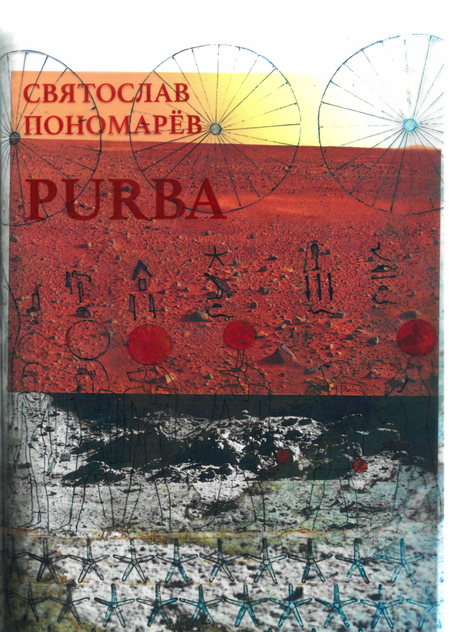
On May 28, there will be a camera performer and a musical performance by a legendary domestic artist, Saint-Slav Ponomareuv, the leader of the PURBA project, at the film pavilion of the School of Design in Izmaylovsky. The event will be part of the Sound Art and Sound Design programme HSE SOUND LAB and the Dark Matter Club: Mystics and Chorror in Visual Culture and Music, created by students of the same-named discipline at the History and Theory of Art and Design. In the run-up to the event, we recall the history of the living classic Moscow Andegraund and his project.
Artist and musician
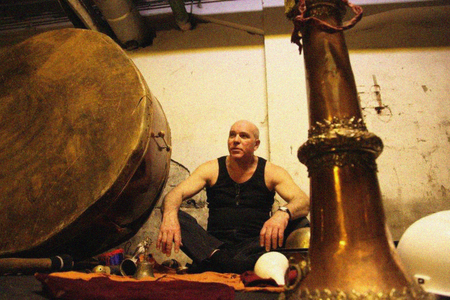
He was born in Moscow on 27 June 1949 in the family of employees. His father, Igor Konstantinović, an educational lawyer, was a great guide in painting, music, and literature. Mother, Afanassieva Antonina Georgievna, studied law with her father at the Institute of Foreign Trade. In those years, it was one of the few places where people had access to information about the world capitalist system, its culture and its way of life. «In those years, it was all a big deficit or a ban, but I did not engage in a dialogue with these limiters.»
Ponomarivov’s house had a huge library collected by Santaslave’s grandfather Constantin Konstantinovich before the revolution. From abroad, art albums, books, gramophones were brought in all the time. «I learned early to take pictures, and I remember grand-grandfather’s wooden photo-appacy boxes, glass records and mountains of cards printed by Grandpa and Dad.»
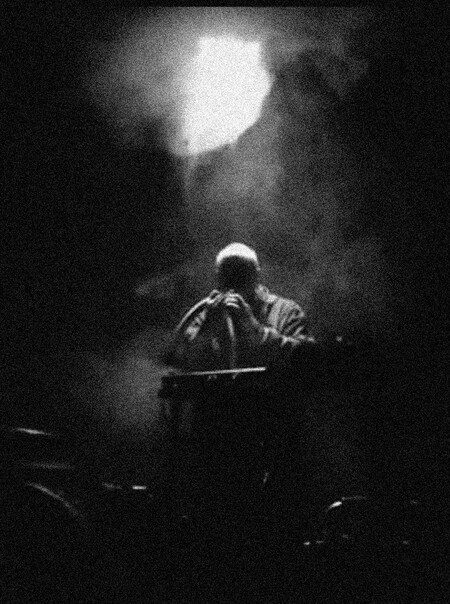
The creative path of Saint-Slav Ponomareuv began in the late 1960s, playing jazz in the band Autumnbry, which at that time was almost the only project focused on the tradition of European progressive rock. However, «Osenebri» was never able to become a Russian analog of Genesis or King Crimson, which was impossible in Soviet reality. Throughout the creative journey, Ponomarev successfully avoided confrontation with the Soviet establishment, as well as with the dissident environment. He actively explored the little-known areas of the European music and art avant-garde at a time when the Soviet Union was actively developing a socially oriented dissident environment that created the so-called social art, one of the most visible areas of postmodern art in the country. It was the social art, with its courage and radicality, that made Western viewers aware of the modern art of the Soviet Union. However, the idea of dialogue with reality based on knowledge of the cultural and social framework of the time was not adhered to by the Holy Slav Ponomariev. Instead, he believed in the possibility of a radical transformation of reality through a miracle that was taking place in the artist himself during the time of his creation. This miracle was considered an important part of his life and destiny. The art of Saint-Slav Ponomareuv is truly independent of social and cultural contexts and has never been linked to modern artistic currents or trends.
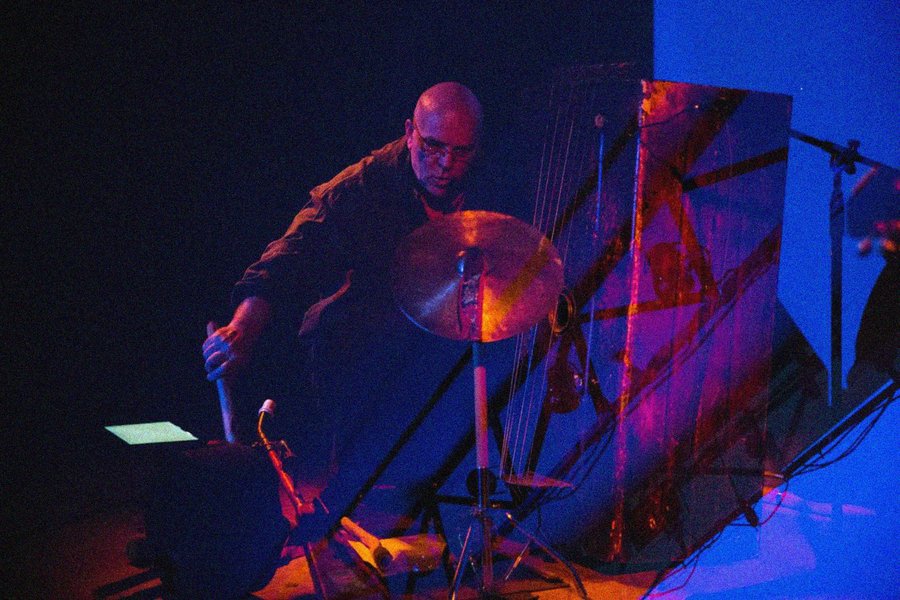
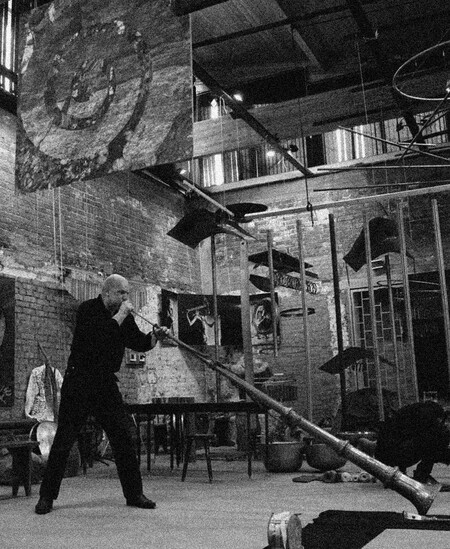
«I’ve always wondered what no one in Moscow was doing. I’ve been filming thousands of slides, connecting images to sound and music. He spent the whole year filming an art film where he built the set and took the props out of Mosfilm and Pomoskovy. In Silence, I turned a huge abandoned apartment into a sounding and glowing space. This was the „Egyptian Series“, where hundreds of thousands of points in column number 1 were grouped in „The Book of the Dead“ and „The Valley of Kings“. The first personal exhibition, „Inner Security“, was held at the Kuntsovo Gallery. I’ve been working with Alexei Tegin for years. At Petlura’s basement in Petrov Boulevard, I suddenly discovered that somewhere deep down I had a sound that belonged only to me. From the beginning and always. I opened Tibet and made my first drum of two cows. After Petrovsk Boulevard, the base moved to the Swamp Square, 200 metres from the Kremlin. The discoveries fell one by one. Sound, noise and light. Ancient Tibetan texts and meditation practices. Many photos were taken: „The possibility of transformation“, „The face to infinity“, „The discovery of a deity“, „The dream“, „The shining darkness“, „Pasport to nowhere“, „Acquire“, „Contact“, „Pilot“, „Travel“, „Before and After Life“, „The State of Dogchen“, „The Palace of the Millennium,“ or the fruits of destruction. When the house was broken on the Bolotna, everything was moved to an abandoned factory across the street. There were no windows or doors, and the life of PURBA, the mysterical theater of Tibetan ritual music, began.
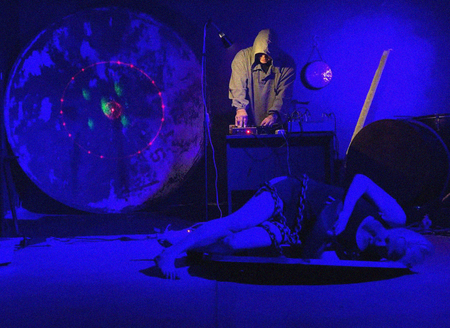
«There followed visits to Berlin and Austria, Petersburg and Ulan Ude. Moscow, Russian and international exhibitions, festivals, biennale, etc. I have had the opportunity to work with the Third-Kow Gallery, the MøRS and Rigina Gallery, the Expo-88 and the Kino Gallery, the Elena Vruble and ROSIZO Gallery, the Lumiere Gallery, the Polina Lobachevskaya Gallery, and the Moscow Museum of Modern Art. I have been working on projects for Art Moskva and Art Maneja, Art Forum in Berlin and Photo Month in Bratislava, Moscow Photo Biennal and Biennal Graphics in Ljubljana, 1st Moscow Biennal and The Armory Photographer Show in New York, Anatoly Vasiliev Theatre and Surgut Gallery „Sterh“, Novosibir State Museum of Modern Art and Photobiennal in Piñao, China, and Odens, Denmark. I also taught photography at the Moscow State Press University at the Department of Art Design. I now live and work in Moscow.»
PURBA
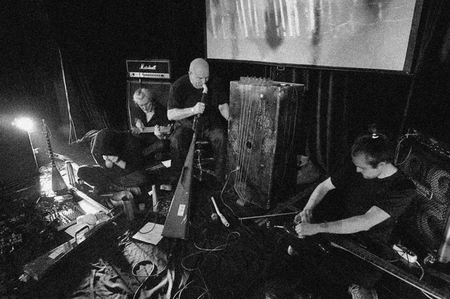
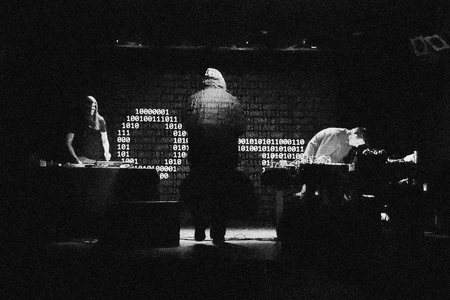
In 1999, he created the PURBA project, which was the first to perform music for ancient Tibetan ceremonies in Russia. The performances were accompanied by theatre and video articles by St. Slav Ponomarev. Performance concerts took place in Russia and abroad, both in concert halls, museums, gallery and abandoned industrial spaces. The style of the project can be described on the one hand as traditional Tibetan rituals and on the other as noise, industrial, drone, dark ambient. PURBA is a composite project, spontaneous design, a state of awakening consciousness of the subcivilizational era, or psychedelic symphosis of post-apocalyptic memory. The collective is often referred to as «the community of hunters of the unsatisfied». At present, the Saintslav Ponomareuv project specializes in Tibetan ritual and industrial music. At first glance, it’s an extremely unusual combination, but if you compare the sounds saved by Tibetans over the centuries with those of modern industrial civilization, you can see some similarities. During the rituals, PURBA uses homemade tools such as string gas tanks, cardboard and metal pipes, drums, springs and other objects. These features go beyond simple music and embody mystical spiritual practices rooted in vibrations and breathing.
«I don’t improvise — I call sound-rething spontaneous design and, if I’m playing with anyone, I never negotiate anything while I’m in the same stream. It doesn’t always work, and if it doesn’t, I just raise the volume of my iron. I’m interested in another person as a tool to understand the ritual, not to talk.»
The eyes of Saint-Slav Ponomariev on art
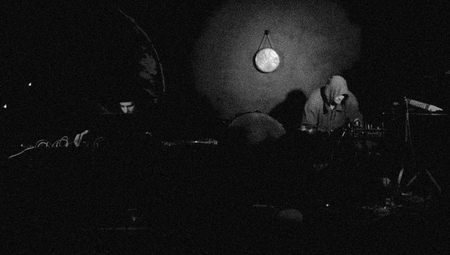
According to the artist, art can be described as objective if it is not linked to socio-cultural reflexes and is «oriented to basic prismical symbols wrapped in a convenient ring inside a box with an unknown message up to time.» Such art does not serve socio-cultural niches; its mission is to disseminate information through the re-establishment of human, pre-social ties to the world. People care about the memory, the sense of the past, which is as intimate as love, like the life of their own child, like the memory of dead parents, or when we were young. The theme of memory and immortality is central to the realization of art through a personal myth. Examples of objective art are possible in any genre. Its main features are the self-sufficiency of the aesthetic expression, which is particularly similar to the hypnotic effect (often acoustically and visually shockingly unprepared listener), the lack of dialogue with the socio-cultural needs of the masses, or the recoded social symbols in the metaphysical reflection of reality (e.g. Boyd Rice), the frequent impersonality of the creator, who acts as a mystagog, a practical medium for this hypnotizing energy, or the concealment of the author ' s role, his de-staffing, or his positioning as superpersonal, demonic artist.
The PURBA style is based on a passion for ancient cultural symbols, an incredible expression of the video and audio series, and a desire to transmit an incredible, super-animalist finding on the other side of the social attributes of the modern world. But these ideas do not only represent a destructive element — this mistrust of the world of forms represents a giant, heroic desire for transpersonal, presocial and social transformation of reality. The key definition of the aesthetic position of Saint-Slav Ponomareuv is catarsis through a miracle. Examples of objective art and world view include Diamanda Galas and Burzum, Swans and Phurpa, some weak groups, Les Légions Noires and Boyd Rice, Herman Nitsh and Jørg Buttgheright, many of Robert Fripp and Kenneth Enger, Vladimir Martinov and Galina Ustella, Nordvarg and Z.Ev, Aural Hypnox and KERPG, Evgeny Golovin and Sergei Kuskov, Vasily Nalimov and Robert Wilson, Julius Evola and Miguel Serrano, among others. All of them have this common aspiration, and almost every single one of them is directly demonstrating a single modification.
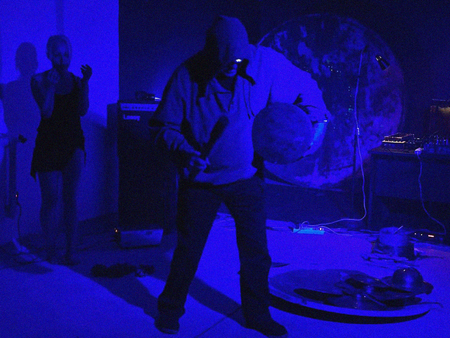
Objective art and practice also have a therapeutic value — rather than leaving the problem, they offer a fundamentally different solution: the realization that the problem was not at all a problem. In general, people do not use the full range of languages and modes of expression, but are limited to black and white perceptions of the world — dualism. They reflect on their lives as final and limited, although the experience of different peoples and cultures shows that there are ways to perceive reality more broadly. This is also the case of some modern psychology practices — for example, the grhof techniques for dealing with shock in the wake of a clear birth of an unsub in the form shown or described by Robert Wilson — the practice of polyvariant perception of reality as a combination of interaction with phenomena of reality. Today’s scientific paradigm is often based on linearity and binarity (black or white), and this one-sided view is perceived as the only correct one. However, there are other approaches. A good example is tantric monodical singing, the effect of which is based on spontaneous but genericly controlled reactions and vocal fluctuations. In a broad projection, this system balance effect can be used to understand complex phenomena and states.
Soon you will have the opportunity to touch the objective art of the performance of Saint-Slav Ponomarev and «the community of hunters of the unsatisfied.» On May 28, there will be a performance of PURBA in Moscow. You’re waiting for Tibetan rituals and an industrial noose from the classics of Underground.