
Introduction
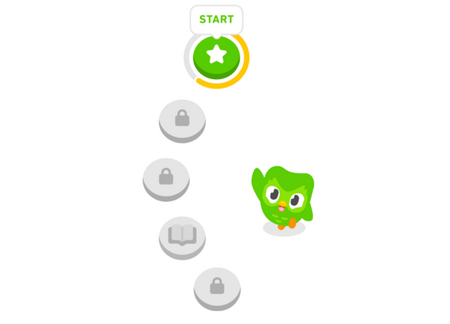
Duolingo is the world’s most widely used language-learning platform, built around a simple yet radical promise: that high-quality language education can be free, mobile-first, and genuinely fun. Founded in 2011 by Luis von Ahn and Severin Hacker, the company transformed a subject most people abandon after school into a daily habit for tens of millions of users by reframing study as a game rather than a chore.
The app’s home screen illustrates this promise in action: a colorful lesson path, a streak counter encouraging daily return, and Duo the owl watching from the corner.
Core positioning
Duolingo positions itself at the intersection of education and entertainment. Its stated mission is to make learning accessible to everyone, but its communicative identity rests on a second pillar: a playful, irreverent, deliberately «unhinged» brand personality embodied by its mascot, Duo the owl. Where most educational brands sound earnest and institutional, Duolingo sounds like a chaotic friend—sarcastic, meme-literate, and self-aware. This dual identity (serious mission, absurd voice) is the engine of everything that follows.
Target Audience

It is important to separate two audiences:
• The app’s user base is extremely broad—learners of all ages and dozens of languages worldwide, with the large majority using the free plan. • The communication and persona target is much narrower and deliberately chosen: Generation Z and younger millennials (roughly 16–30), who live on TikTok and Instagram*, share content fluently, and respond to irony, self-deprecation, and internet humor rather than polished advertising. This split is itself a strategic choice. By directing its voice toward a younger, highly online audience, Duolingo generates organic, shareable cultural relevance that then pulls in the wider user base. The owl is the bait; the free, habit-forming product is the catch.
Communication Channels

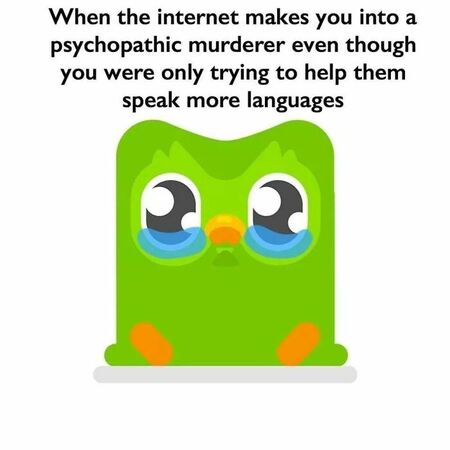
Duolingo’s public presence is overwhelmingly digital, and the brand treats each platform as a distinct instrument with its own role. Crucially, Duolingo does not separate «the product» from «the marketing»: the app itself is a communication channel, and the brand’s social media is a form of entertainment content rather than conventional advertising.
Social media ecosystem
• TikTok — the primary stage for the Duo persona. Short, trend-driven, absurdist videos featuring the owl dancing, «threatening» users, and reacting to pop culture. This is where the brand’s cultural relevance is manufactured.
• Instagram* — memes, reels, and stories that recycle and extend TikTok material to a slightly different audience.
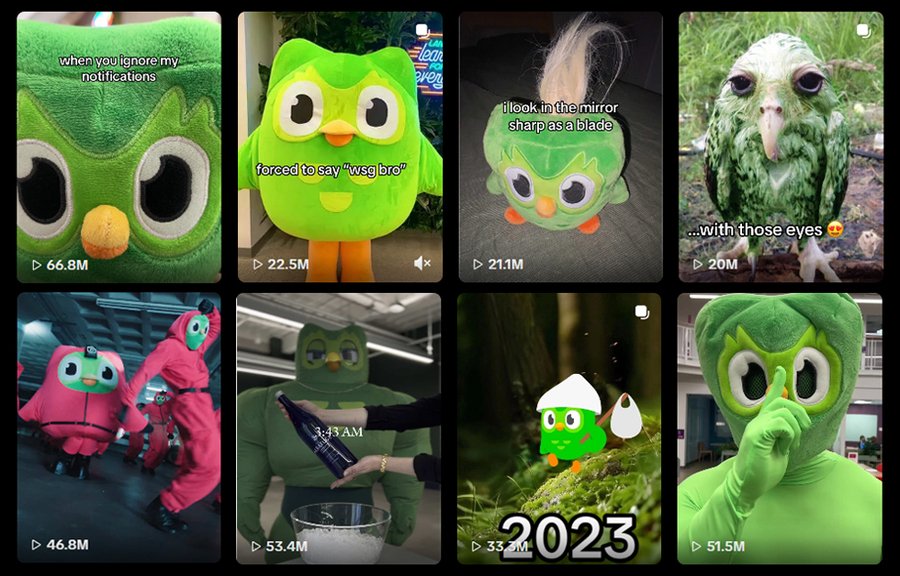
• YouTube — longer-form content, campaign films, and series, utilized for narrative depth and emotional resonance rather than fleeting virality.
• X / Twitter** — fast, reactive, conversational posting and replies; highly effective for real-time trend-jacking.
The app as a channel
The app is not merely a place for learning—it is where the brand speaks most often. Two interface mechanisms function as communication:
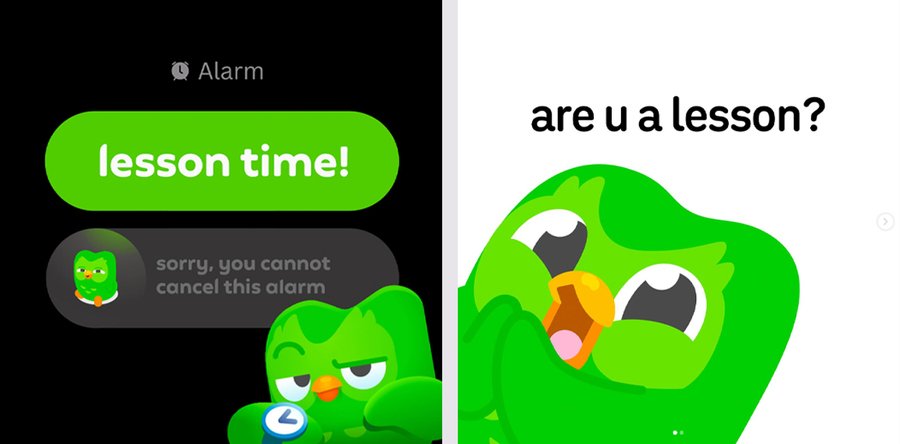
• Push notifications written in Duo’s voice—guilt-inducing, mock-threatening reminders to complete a lesson. These extend the brand’s personality directly onto the user’s lock screen, escalating in emotional intensity the longer a learner goes without engaging—from a broken heart to open fear, as the sequence below illustrates.
• Gamified interface elements—the streak counter, weekly leagues, XP, badges, and the «streak freeze.» These are discussed in detail in the Analysis.
PR strategies
Duolingo’s PR is built on «unhinged» marketing—deliberately unpredictable, self-deprecating content rooted in internet subculture, designed to act as a «pattern interrupt» in the feed so that a brand post feels like a meme from a friend rather than an ad. The December 2024 collaboration with Netflix’s Squid Game is a case in point: rather than running a conventional co-branded spot, Duolingo released a music video—"Korean or Get Eaten"—in which Duo the owl threatens learners with elimination-game consequences for skipping their Korean lessons, blending the show’s high-stakes aesthetic with the brand’s signature menace.
• Trend-jacking and pop-culture insertion. The brand attaches Duo to whatever the internet is buzzing about—celebrity moments, film and music releases, viral sounds. A frequently cited example is Duo’s long-running, one-sided «obsession» with Dua Lipa.
• The «Death of Duo» campaign (2025). The brand staged the mascot’s «death,» paying off years of the «Duo will find you if you skip a lesson» meme, and then «revived» him.
• Influencer and brand collaborations that are selected to align with the brand’s identity rather than simply chasing broad reach.
• Daily organic posting as a retention tool: the brand’s leadership has framed a consistent, engaging social presence as a driver of user retention—not just acquisition—allowing lapsed users to be reminded by the owl that they «haven’t done their Duolingo today.»
The strategic point is that Duolingo spends little on traditional paid advertising relative to competitors, instead relying on organic, earned attention generated by a character that people choose to watch for fun.
Theoretical Frameworks
We analyze Duolingo through two theories that map onto its two communicative surfaces—the app (why users keep returning) and the social channels (how the brand builds relationships).
Uses and Gratifications Theory (U&G)
Associated above all with Blumler and McQuail, Uses and Gratifications Theory emerged as a reaction against the early «powerful effects» tradition of media research. Instead of asking, «What does media do to people?», it asks, «What do people do with media?» The theory rests on the premise of an active audience and is built on four assumptions: the audience pursues certain goals; media choices are made based on needs; media compete with other resources to satisfy those needs; and people are able—at least to some extent—to account for their own media-use patterns.
Blumler and McQuail identified four dimensions of media use that we will use as the analytical framework for Duolingo:
• Diversion — escaping routine and everyday stress; entertainment and emotional release.
• Personal relationships — using media to build connections, including parasocial relationships: one-sided bonds with media figures or characters whose «lives» come to matter to us and who feel like part of our own social world.
• Personal identity — understanding and defining oneself, often through comparison with media figures, and reinforcing one’s own values and status.
• Surveillance — curiosity about the world and about how others live.
It is also useful to keep in mind the distinction between content gratification (where the value lies in what is consumed) and process gratification (where the value lies in the act of using the medium itself), and between utilitarian motivations (getting things done) and affective ones (pleasure or emotion). Duolingo is a near-perfect U&G case because it engineers both its product and its content to satisfy several of these dimensions simultaneously—which is why engagement persists even when the original goal—learning a language—stalls.
Dialogic Theory