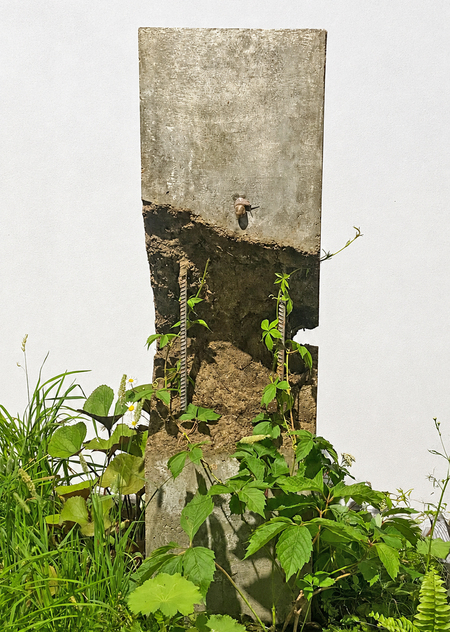
This project serves as a living monument to the Anthropocene—an era in which human activity has become a planetary force. The columns support nothing; their monolithic quality is disrupted, and the fissures have become a habitat for mosses and lichens. The concrete symbolizes confidence in the durability of human-made systems, yet the decay reveals their fragility. My interest lies not in nature’s triumph over humanity, but in the impossibility of separating the natural from the artificial. The columns and the piece of living nature become a speculative model of the future, where human order vanishes, but its structure remains the foundation for continuing life.
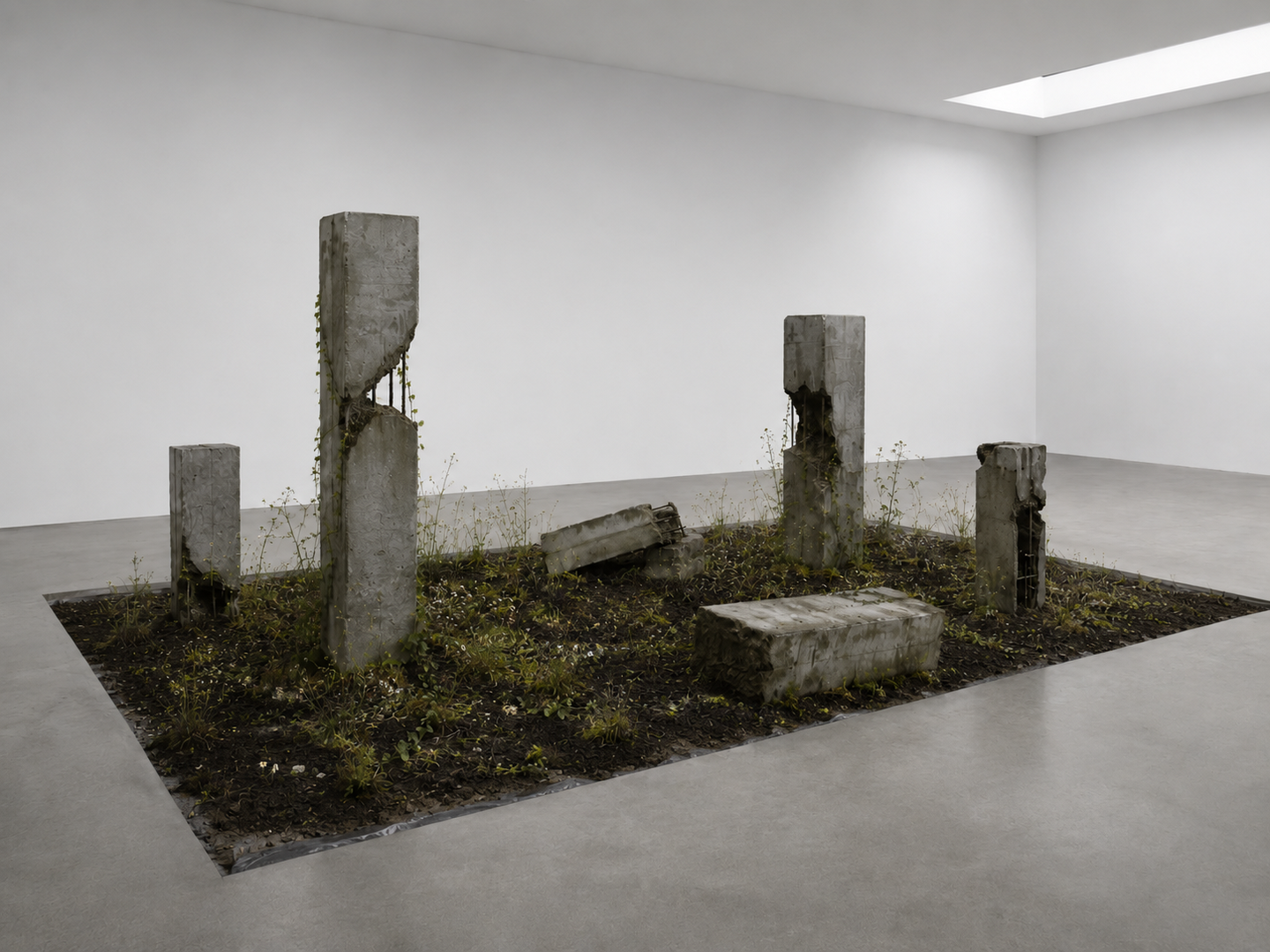
Project scaling sketch for a gallery space
The project was partially realized as part of the diploma exhibition «Form of the Object» at the Rodchenko School in 2026.
Curators: Vladislav Efimov and Alexey Korsi.
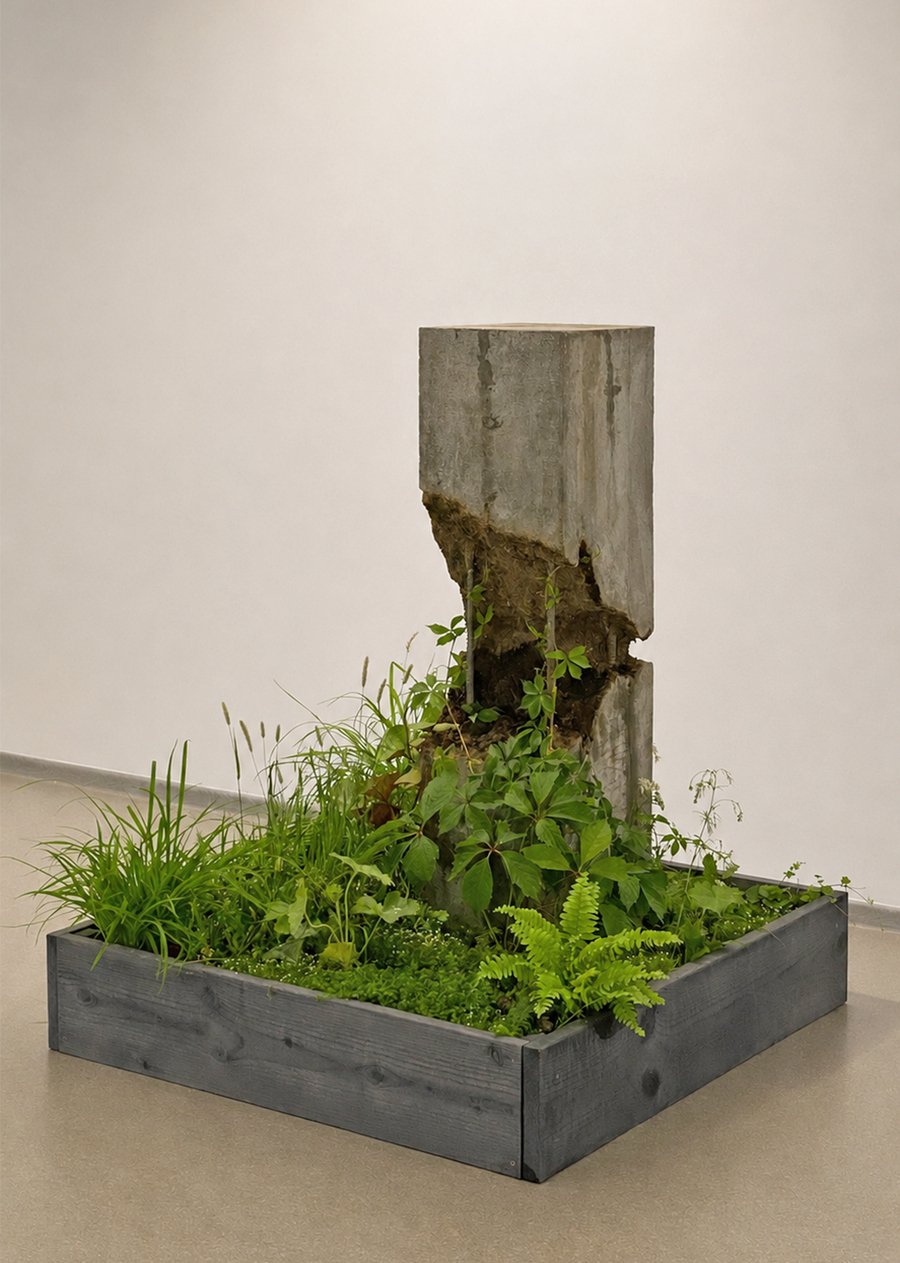
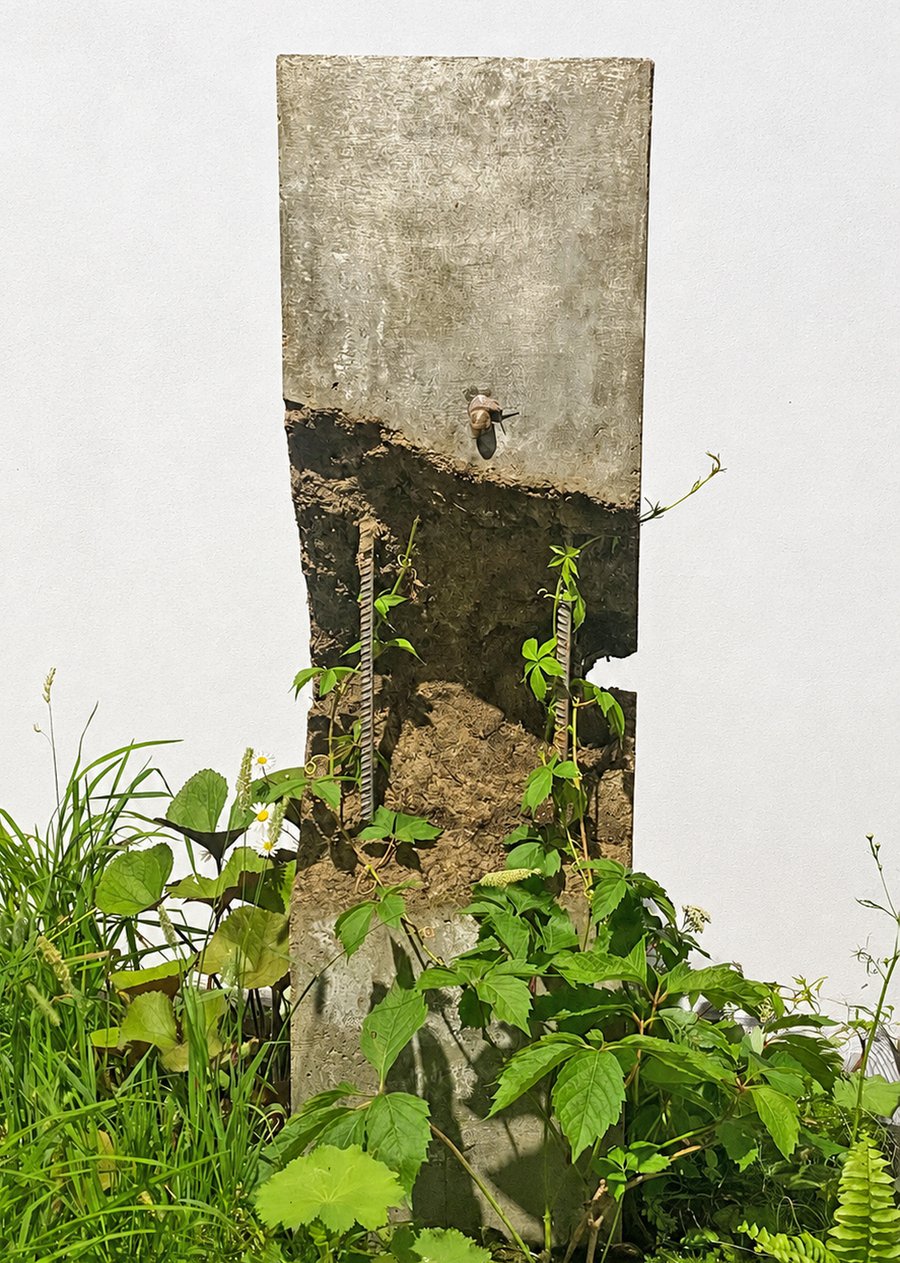
Realized portion of the project for the graduation exhibition «Form of the Object» at the Rodchenko School. Concrete, rebar, wood, live plants. 2026
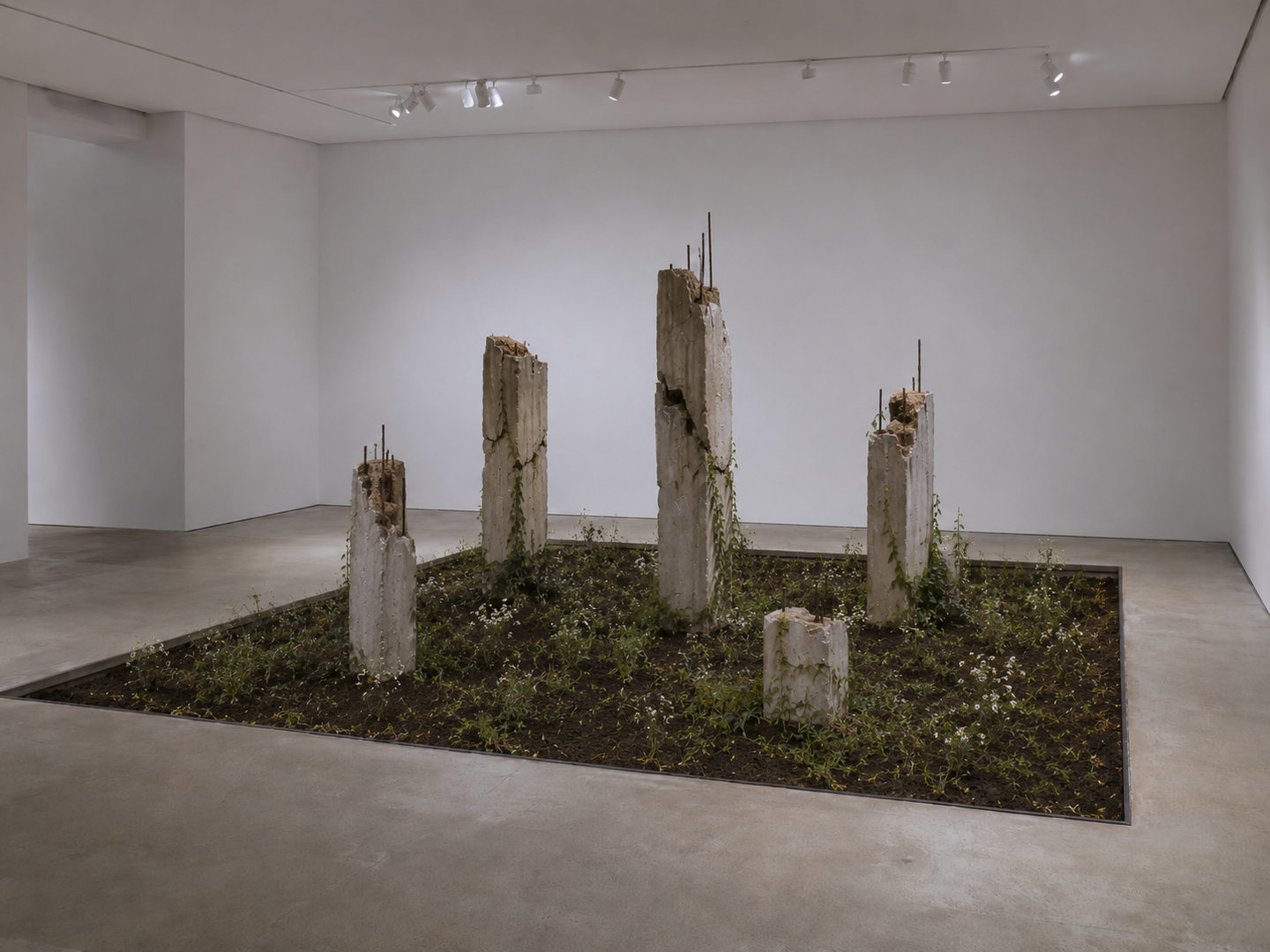
Project scaling sketch for a gallery space
The concrete here embodies humanity’s collective confidence in the permanence of its created systems. By shattering the columns, I intended to illustrate the fragility of that confidence. Within the monolithic structure emerges a space where an independent ecosystem develops. I am not as concerned with the romantic image of nature reclaiming what humanity has taken, but rather with the impossibility of definitively separating the natural from the artificial. Ecological crises, climate change, economic instability, and war do not arrive at humanity from the outside. They are generated within the very system of relationships created by human activity, and then they return to us as consequences.
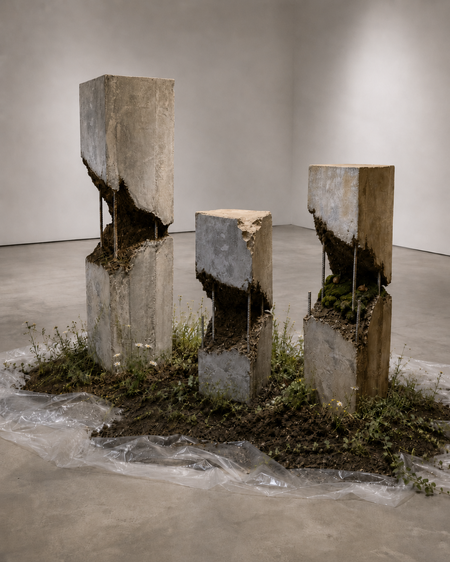
The creation of this work was inspired by Timothy Morton’s texts, which describe ecological consciousness as a «strange loop, ” much like a Möbius strip: by affecting the surrounding world, humans inevitably affect themselves. In this model, it is impossible to occupy the position of an external observer—we are always already inside the processes we attempt to control. The column becomes a model of a possible future, where the human-made structure remains as a trace of a vanished order. The ivy, moss, grass, and snails here do not symbolize nature’s victory over humanity. Instead, they point to a shift in human presence away from the center of the world. For me, the juxtaposition of raw concrete and visually fragile plants is fundamental. It challenges conventional notions of strength and weakness. The concrete appears durable and permanent, yet it gradually degrades as the delicate plant penetrates the cracks, colonizes the surface, and takes root.
As Morton writes, «existence is always co-existence.» This thought has become central to my perspective: a careful attitude toward the environment is not some abstract moral stance, but a prerequisite for the continuation of human life. If humanity maintains its role as the steward and disposer of the world, what first collapses is not nature itself, but the order created by humans.
The work serves as a warning and simultaneously a speculative monument to possible decline—a moment when what humans have created ceases to testify to their power and becomes merely the foundation upon which life continues.
Project scaling sketch for gallery space
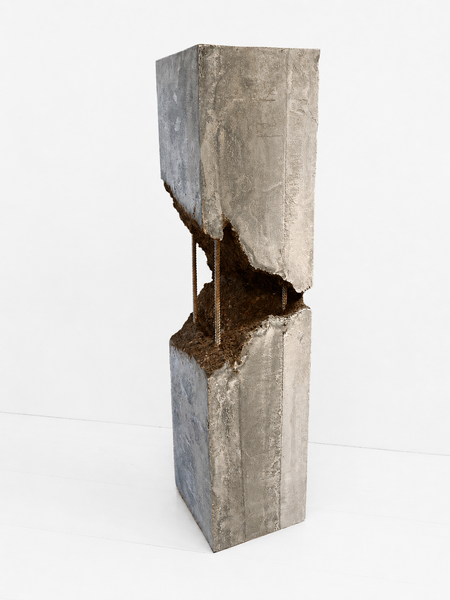
In the gallery, the project can be assembled as a small fragment of a ruined space. The estimated dimensions are 2×3 meters or larger, depending on the available space. The realized column stands 1.2 meters high, with a 0,3×0.3 meter base. The columns are intended to have similar width and length, with heights ranging from 1 to 2 meters to illustrate varying degrees of decay. The realized column features internal voids, and its weight is comparable to that of an adult male. Larger ones are planned to be further lightened through internal cavities. We plan to use actual concrete, not a simulation, since we already have experience pouring and constructing the formwork. The plants selected are native species, mostly those found in the urban environment of the middle belt.
The gallery becomes a space after an event—a place where it is impossible to tell if we are looking at an archaeological site, a graveyard, or an object that was simply unfinished. It is this ambiguity that transforms the installation into an image of the future, already witnessed as the past.