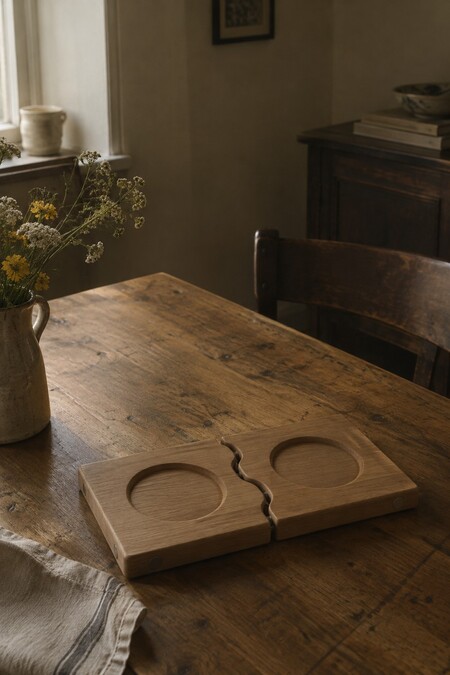
An object that divides a tea service into two personal spaces while maintaining a connection between them.A compact wooden tray, comprised of two halves connected by magnets. When assembled, it functions as a shared surface for serving tea. Before conversation, the tray is divided along a wavy line, and each participant takes their half with a teacup. After the tea service, the components are reconnected.The object was designed for a tea brand whose core concept revolves around kitchen conversations—secrets and confessions. The tray’s construction mirrors the brand’s philosophy: tea becomes a catalyst for dialogue, and the object’s division serves as the gesture that initiates a personal conversation.
Appearance
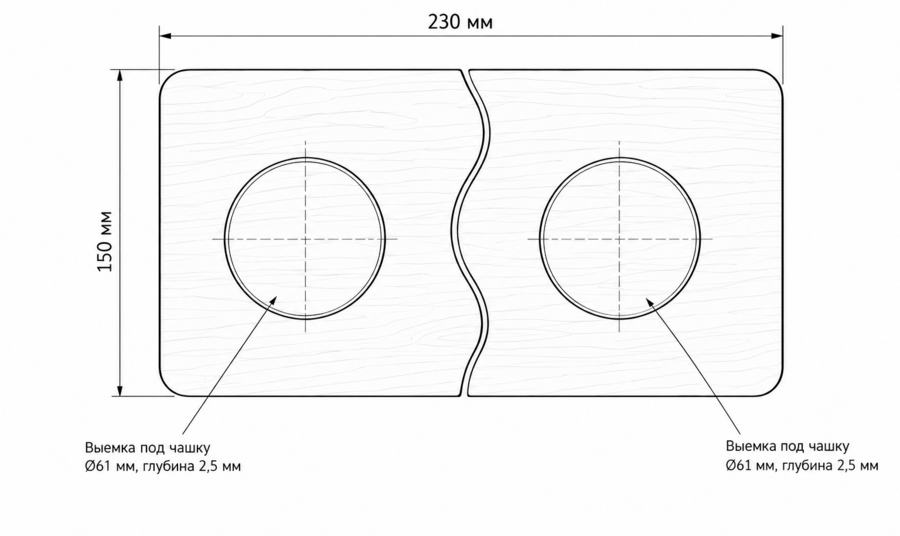
The tray consists of two wooden pieces that, when assembled, form a compact rectangular shape with a wavy dividing line. The outer corners are slightly rounded. Each half features a shallow, circular recess designed to hold a cup base.
The primary material is wood. The light wood, with its pronounced texture, emphasizes the item’s natural quality, making it perfect for a tranquil home tea service. Both halves are planned to be cut from a single plank so that the wood grain visually continues across the joining line.
The wavy seam runs through the center of the tray. Magnets are placed at the connection points to align and hold the halves together. Felt feet are provided on the underside to protect the tabletop surface.
Approximate dimensions
— Tray assembled: 230 × 150 × 20 mm.
— Height with legs: approximately 22 mm.
— Wood component thickness: 20 mm.
— Cup recess diameter: 61 mm.
— Recess depth: 3 mm.
— Magnets: 8 × 3 mm, six pieces.
Visualization
Details and Materials
The construction consists of two main wooden pieces and supplementary fastening and protection elements.
Part 1, wood, 20 mm, CNC milling
Part 2, wood, 20 mm, CNC milling
Magnets, 6 units, Neodymium N35, 8 × 3 mm, purchased
Felt pads, 6 units, felt, 2 mm, purchased
Epoxy adhesive for magnets, as needed, purchased
Finishing coat, oil-wax for wood, purchased
Structure and Connections
The primary structural element of the tray is the wavy seam between two wooden halves. This forms a visual feature of the piece and divides the overall surface into two sections.
The outline consists of smooth waves and short sections designed to accommodate magnets. The radii of the curves and the shape of the individual sections are refined based on the router bit diameter and CNC machining capabilities.
Three pairs of neodymium magnets are placed in the seam. The preliminary size of each magnet is 8 × 3 mm. The sockets are designed to fit the actual dimensions of the purchased magnets, including a small mounting tolerance.
The polarity of the magnets is selected in pairs: the magnets on opposite halves must attract each other. Before gluing, the orientation of all six magnets must be verified.
Cup recesses. Each half features a shallow circular recess. The diameter is 61 mm, and the depth is 3 mm.
Leg attachment. Three felt feet are placed on the underside of each half. They are glued on after the wood has been processed and the final coating has been applied.
Packaging Placement
Tray assembled: — Length — 230 mm; — Width — 150 mm; — Height with legs — 22 mm.
Tray disassembled:
— Two wooden parts, each 20 mm thick; — When the halves are stacked, the total height of the wooden parts is 40 mm; — Considering the felt feet and a small buffer, the estimated height of the complete set is about 44 mm.
The parts are stacked when disassembled. The estimated space required for them is 230 × 150 × 44 mm, not including a possible protective insert. This dimension fits within the allowable space of 280 × 180 × 70 mm.
Production and Assembly
A milled board with a thickness of 20 mm is used for fabrication. The main contours, recesses, and joint elements are produced on a CNC machine. The surface is finished manually after machining.
Stage 1. Blank Preparation. The board’s thickness is verified, along with checking for defects in the processing area and confirming that both halves can be arranged so that the wood grain continues across the seam.
Stage 2. The two halves of the tray, the wavy seam line, rounded outer corners, and recesses for cups are manufactured. The blank size is determined based on the final vector contour.
Stage 3. Mounts for magnets are cut into the end grain surfaces. Their size and placement are verified against the drawing, taking into account the actual components.
Stage 4. Finishing. A wood oil-wax is applied to the wood according to the manufacturer’s instructions. The coating must be completely dry before assembly.
Stage 5. Magnet Installation. Polarity is checked, and then the magnets are glued into the prepared recesses using epoxy adhesive. After the glue cures, the alignment of the two halves and the quality of the joint are inspected.
Stage 6. Leg Installation. Six felt pads are glued to the bottom surface.