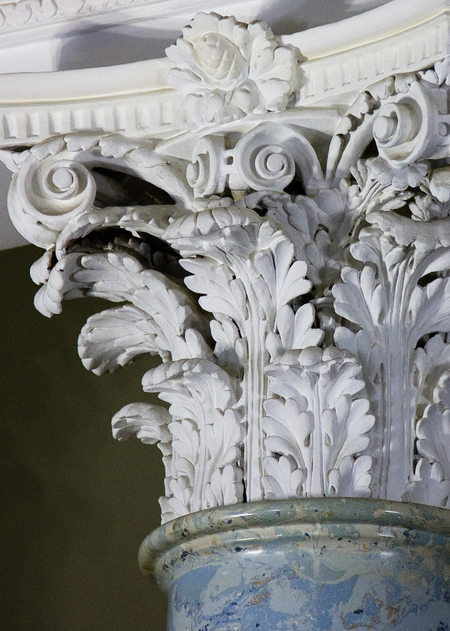
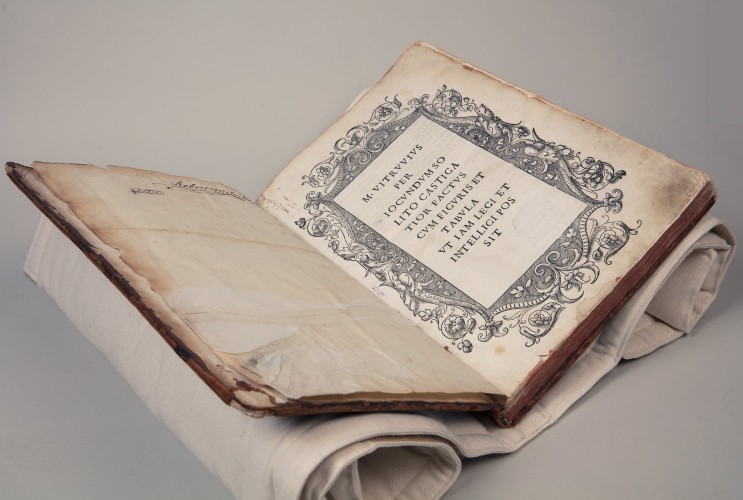
In the fall of 2024, a cycle of three lectures titled «Antiquity After the Renaissance» took place at the Pushkin State Museum of Fine Arts. This series was part of the «Moscow Vitruvius» project, which focused on an example of Vitruvius’s treatise De Architectura, written by a Roman architect of the 1st century BCE. The book was printed in Latin in Venice in 1511 and is the earliest Italian edition in the museum’s collection.
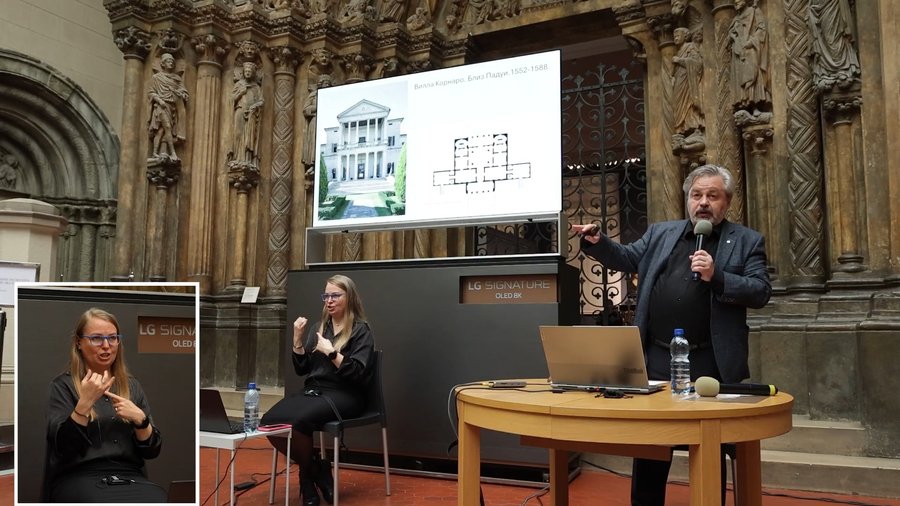
«Baroque in Rome» was presented by Elizaveta Likhacheva—who was the museum director at the time—“Antiquity in Contemporary Architecture» by the renowned neoclassical architect Maksim Atayants, and «Classicism in Moscow» by me, Sergey Kavtaradze, a faculty member at the HSE Art and Design School.
Classicism is a deceptively complex subject. It seems straightforward: you «chop off» the front section of an ancient temple, attach a portico to a symmetrical building with a relatively smooth facade, and voilà—you have the style. In reality, of course, everything is more complicated, and not every building with columns automatically becomes Classicist or Neoclassical. Therefore, I had to begin the lecture with the distant history and the theoretical foundations developed by the theorists and practitioners of this style long ago.
The word «classicism» originates from the noble Latin term classicus—referring to a Roman citizen belonging to the highest rank in the contemporary hierarchy. Later, the term came to be used to mean «first-rate» or «exemplary.» In the 19th century, during fierce aesthetic debates with the Romantics, it was employed to name the style.
Vincenzo Cattaneo Portrait of Gian Giorgio Trissino between 1500 and 1525
Art critics and architects typically begin discussing classicism either as a style or as a neoclassical trend within the Baroque era when referring to the 17th century. However, for literary scholars, it starts a century earlier. The year 1515 is considered the date of classicism’s «birth, ” when the wealthy aristocrat, poet, and playwright Gian Giorgio Trissino created Sophonisbus, the first tragedy of the modern age, modeling it after antiquity and drawing its plot from the ancient Roman historian Titus Livius. This is the same Trissino who, on the construction site of his villa, noticed a talented young boy—an apprentice stonemason—and nurtured him into the great architect Andrea Palladio, whose work many believe contains the origins of classicism itself.
In the 17th century, Classicism fully emerged, initially in painting and literature—most notably in the works of Nicolas Poussin and Nicolas Boulle—and later in architecture.
My nature compels me to seek out and cherish things that are well-ordered, eschewing disorder—which I find as repugnant and hostile as darkness is to light.
N. Poussin. Letter to the Client Paul Chantel Cited in: Daniel S. European Classicism. St. Petersburg: Azbuka-Classica, 2003. p. 36.
Nothing is beautiful except the true
Nicola Bualo Cited from: Pisarchik L.Yu. Descartes and Classicism // Vestnik OSU. 2005. No. 1. P. 51.
The eastern colonnade of the Louvre, conceived by the distinguished amateur architect Claude Perrault, served as the manifestation of this alternative Baroque style.
Back in the 17th century, the renowned «ancient versus modern debate» emerged first among playwrights and later among architects—a debate concerning the potential to surpass the aesthetic virtues of the great masters of Antiquity. Claude Perrault, like his brother Charles Perrault, the celebrated fairytale author, defended the view that under the patronage of a monarch as great as Louis XIV, art must inevitably be magnificent—so much so that even the ancient Greeks and Romans would be compelled to yield glory to contemporary creators.
Roland Frère de Chambres opposed him, advocating for the supremacy of the «ancient» over the «modern.» In 1650, he published an anthology of ten ancient and contemporary writers and classical theorists: Parallels of Ancient and Modern Architecture. This edition included a full French translation of Vitruvius’s treatise.
On August 30, 1694, the leaders of the factions—Boullée and Perrault—officially reconciled publicly during an Academy meeting, but the reverberations of their dispute persisted in 18th-century French aesthetics and philosophy. Theorists of architecture, such as Abbots Jean-Louis de Cormeaux and Marc-Antoine Laugier, participated in the discussions of that era while creating foundational printed works. Important monographs, primarily of the Classicist tendency, were published by Jacques-François Blondel and Jean-François Néffors.
Against this backdrop, Russian classicism developed during the time of Catherine the Great. While working on the lecture, two hypotheses on this topic came to me.
First, it appears the Empress hardly used classically styled buildings, and there aren’t that many in St. Petersburg to begin with. That is, the first building of this style in Russia—the Academy of Arts—was on the periphery, and the Old Palace structures were generally… She herself resided in Baroque palaces by Rastrelli. Cameron built something in Tsarskoye Selo that was more archaeologically enlightening than steeped in genuine Classicist pathos. Also, the palace in Pelle, which was completely demolished.
This means that the buildings of the «new taste» were constructed more in Moscow, while the Empress observed this almost from the outside—as a project external to her. It is known that Catherine grew quite quickly disillusioned with the idea of leveling Moscow and St. Petersburg in terms of capital splendor. However, the momentum had already been set; the «porphyry widow» in the pre-fire era was seemingly packed with grandiose urban mansions, whose predominantly Corinthian porticos may have been associated not just with Antiquity, but specifically with Imperial Rome. What we sadly cannot see today is that it was entirely destroyed in the sacrificial fire of 1812.