Navigator
- Introduction
- California as a New Visual Environment
- Light That Erases Shadows
- The Pool as a Model of Artificial Nature
- Color as Spatial Construction
- Ideal California: From Reality to Visual Myth
- Conclusion
- Bibliography
Introduction
In the latter half of the 20th century, color ceased to be merely a means of representing reality and became an independent tool for shaping visual experience. This is particularly evident in the works of artist David Hockney and during his Californian creative period.
This study examines how color in the Hockney Californian period becomes a tool for creating a new visual reality—an artificial and idealized one.

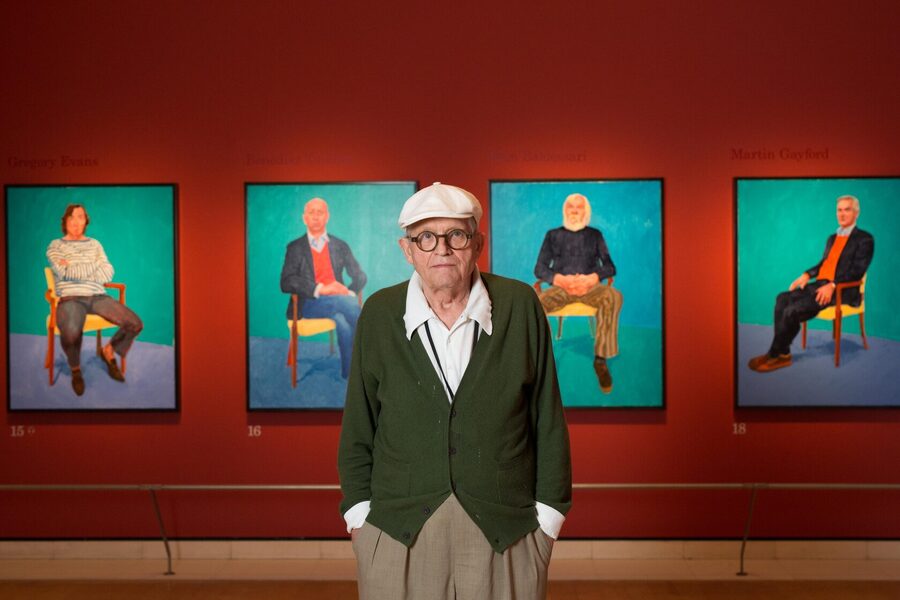
Our contemporary is a British artist, graphic designer, and Pop Art star—one of the most influential artists of the 20th century. He was born in 1937 into a working-class family in Bradford, Yorkshire. He was the fourth of five children. The family was very ordinary and deeply religious. The artist himself described his family as «a family of working-class radicals.» He attended Hockney—not well—but he loved to draw from childhood and made comics for the school paper. His father, an amateur artist, noticed the child’s talent and sent him to art school, and then to the Royal College in London.
David Hockney
California as a New Visual Environment
In 1964, the artist moved from England to California. This became a turning point in his creative career. California became the embodiment of «distant Californian glamour» and a new visual culture of consumption for British Pop Art.
«Every time I left England, the colors became more intense in photographs. California always influenced me with its color. Because of the light, you see more color; people wear more vibrant clothing, you notice it—it doesn’t look bright, it’s just that there is more color in life.» David Hockney, «So I See It, ” London 1993, p. 47
The motif of the swimming pool holds a special significance during this period. The surface of the water, bright blue planes, reflections, and sunlight become symbols of an artificially constructed environment where nature is subjugated to the aesthetics of modernism. Hoekni is interested not so much in the object itself as in the capacity of color to convey the state of the space and perception.
Light that erases shadows
California light is shaping the foundation of Hokni’s new palette. Unlike diffused British lighting, the Californian sun creates sharp shadows and intensifies color saturation. This is why the artist’s work is increasingly dominated by vibrant blue, pink, and yellow hues.
David Hockney, «A Bigger Splash,» 1967
«The Great Splash» is the largest and most vibrant painting in the «splashes» series. Many artists depict a water splash using techniques like chaotic paint splattering or simulating droplets with large brushes and energetic movements. However, Hockney utilized fine brushes, meticulously recreating every droplet by controlling the transparency of the layered paint and the water’s position. Capturing this fleeting, two-second event required two weeks—less time than writing the house behind it.
In the work, the sun makes the space almost artificial: the surface of the pool looks too bright and flat, and the white splash of water resembles a graphic symbol rather than realistic movement.
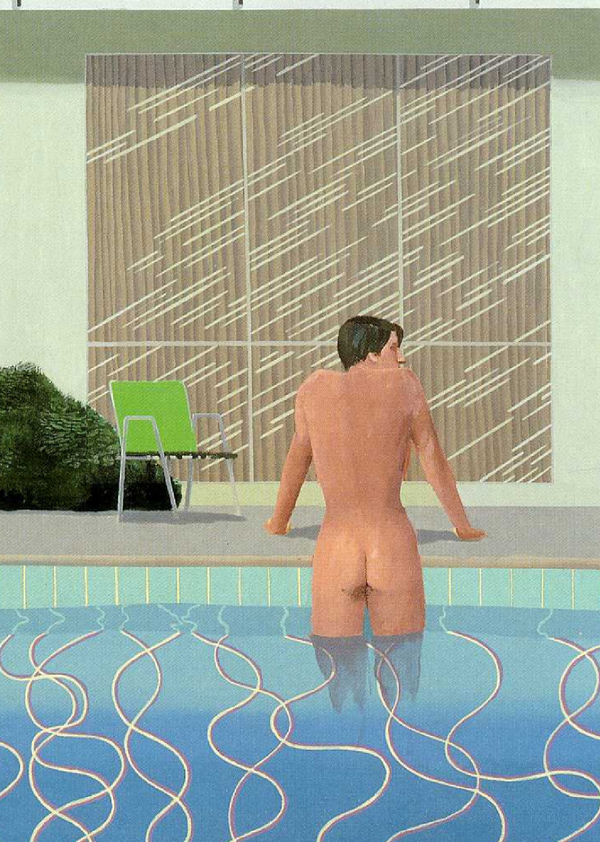
David Hockney, «Peter Exiting the Pool at Nice,» 1966
Under the influence of harsh sunlight, Hockney’s shadows cease to be gray. They become independent fields of color. The artist intentionally simplifies the space: the shadows appear almost cut out of paper, and color begins to replace realistic depth.
David Hockney, «California Art Collector, ” 1964
Modernist architecture in Los Angeles becomes an important part of Hockney’s visual language. The simple geometric forms of the houses, the glass surfaces, and the open spaces enhance the sense of flatness.
The Pool as a Model of Artificial Nature
David Hockney, «The Swimming Pool,» 1967
In the series Splashes, Hockney explores not the water itself, but the interaction between light and surface. The splash is rendered almost schematically: the white lines and spots appear artificial and decorative. The artist is interested not in the realism of the image, but in the visual effect of sunlight, which transforms the movement of water into a graphic form. Hockney captures a brief moment of the water’s motion. However, the splash itself is depicted with almost graphic precision and resembles a decorative sign. The contrast between the static architecture and the instantaneous movement of the water underscores the artificiality of the space.
David Hockney, «Nick Wilde, ” 1966
In post-war California, the swimming pool becomes a symbol of a new lifestyle. It is associated with wealth, leisure, and modernist architecture. Unlike natural bodies of water, the pool is entirely controlled by humans—its shape, color, and surface are artificially constructed. This is precisely why the swimming pool becomes the central motif in Hockney’s California period. The artist is interested not only in the object itself but also in the idea of an artificial environment where nature transforms into an aesthetic element.
David Hockney, «Portrait of an Artist (Swimmer in a Pool),» 1972
In «Portrait of the Artist (Bathers), ” the water is depicted as an impeccably clear and almost unreal surface. The blue pool appears more artificial than the surrounding landscape. The water’s transparency allows Hockney to transform the pool into a space for visual experimentation: the swimmer’s body and the reflections dissolve into a system of blue and turquoise hues. The water ceases to be a natural element and becomes part of a geometrically organized environment.
David Hockney, «Water Lithography, made from thick and thin lines, washes of green, light blue, and dark blue, ” 1978–1980