«The poor lack much; the greedy demand everything.» [1]
In 15th–16th-century Dutch painting, this formula of insatiability finds its literal plastic embodiment. Unlike Italian masters, who placed the ideal human figure at the center of the world, Northern Renaissance artists imbued every object with equal visual weight—from a sealed bill of exchange and money changer’s scales to a chest or an overturned jug. Against the backdrop of the booming trade and banking sector in the Netherlands, greed ceased to be an abstract theological category: painters demonstrated it as a physical dependency, in which material objects pull the pictorial space toward themselves and dictate the heroes' every gesture.
I. Concept and Topic Selection
The rapid growth of trade greatly influenced 15th–16th-century Dutch painting: money began to dictate nearly everything, leading to the depiction of merchants and moneychangers in art. Art historian R. B. Klimov wrote: «…the condemnation of human madness, greed, and cruelty evolves into deep reflections on human destinies, leading masters toward grand and tragic paintings» [2]. Artists do not preach didactic lessons; vice is visible through the composition and the objects surrounding the protagonist—coins, chests, scales. These objects confine the individual and dictate every gesture. Using the works of Hieronymus Bosch, Quentin Massys, and Pieter Bruegel the Elder, I aim to demonstrate how the organization of space and the material environment create an image of avarice.
Categories
I. Concept and Topic Selection
II. The Interior Trap: Greed as Enclosure and the Dictatorship of Things
III. The Pursuit and Absorption: Greed as Social Inertia and Object Chaos
IV. The Grotesque of Possession: Embodiment and Status in the Material Environment
V. Comparative Analysis of Compositional and Material Devices
VI. Conclusion and Bibliography
I organized the material not chronologically, nor by the artists' names, but by how the picture space and the world surrounding the human subject are arranged. First, I examine intimate scenes where objects confine the protagonist within a tight interior. Then, I move to multi-figure canvases, where avarice transforms into a mass pursuit of resources, and objects are scattered across the frame or piled into chaotic heaps. This logic allows me to systematically show how the master reveals different facets of a single vice through the scale of objects, the density of the environment, and the construction of space.
II. The Interior Trap: Greed as Enclosure and the Dictation of Objects
In this section, you will find intimate scenes where the action is confined within a room or a shop. There is no air or open sky here: walls, canopies, and shelves tightly compress the figures. The artists bring the very objects of accumulation into the foreground—chests, coins, scales, and purses. These objects cease to be mere domestic background; they seize the geometric center of the frame and dictate the plasticity of the people. The gazes, postures, and hand movements are directed not toward one another, but toward gold.
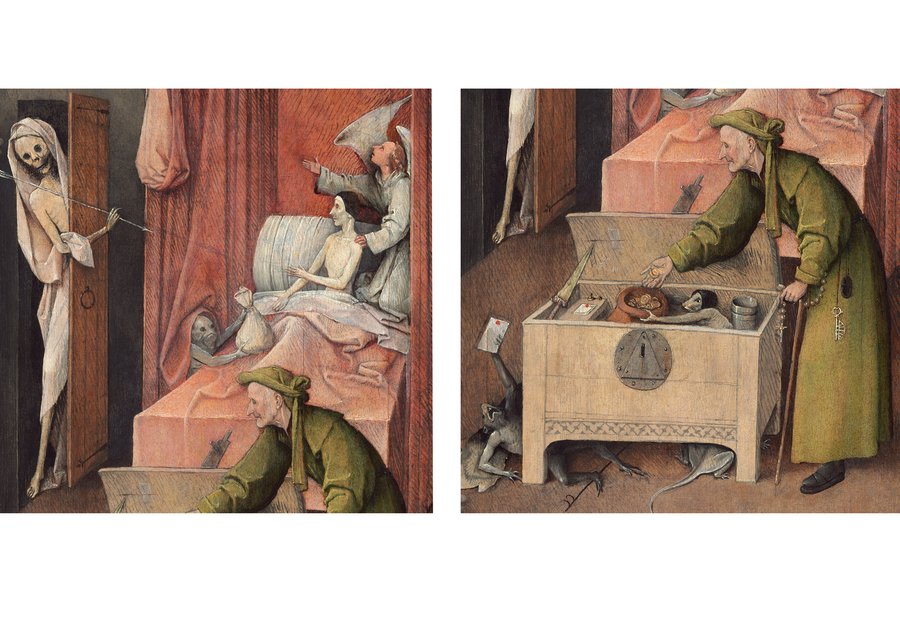
Hieronymus Bosch. Fragments from the painting «The Death of the Miser.» Circa 1494–1516.
In Bosch’s «The Death of the Miser,» the hero is trapped in a narrow, windowless bedroom arranged vertically from bottom to top. Down below, the house owner is shown still robust by an open chest, but upstairs, he lies on his deathbed beneath a heavy crimson canopy. An angel supports the dying man, gesturing upward toward a small window displaying a crucifixion, yet the miser does not look at the light. His attention and body posture are confined within the room—he remains oriented toward the money that fills every space around him. Even facing Death at the doorway, the room functions as a trap from which the hero cannot escape.
Hieronymus Bosch. Details from the painting «The Death of a Miser.» Circa 1494–1516.
In close-ups, the object environment appears to literally push the figure out. A massive wooden chest with a heavy iron lock occupies almost the entire width of the lower tier and serves as the main visual anchor. On the old man’s waist, the metallic texture of the chest key and a string of round prayer beads establishes a rigid vertical rhythm. The viewer’s gaze sweeps across a chain of objects—from gold coins in a bowl to a tight sack clutched in the demon’s paws. The objects here are more heavily detailed and sharply defined than the dying figure itself, so the room reads like a vault where the protagonist has become part of the property.
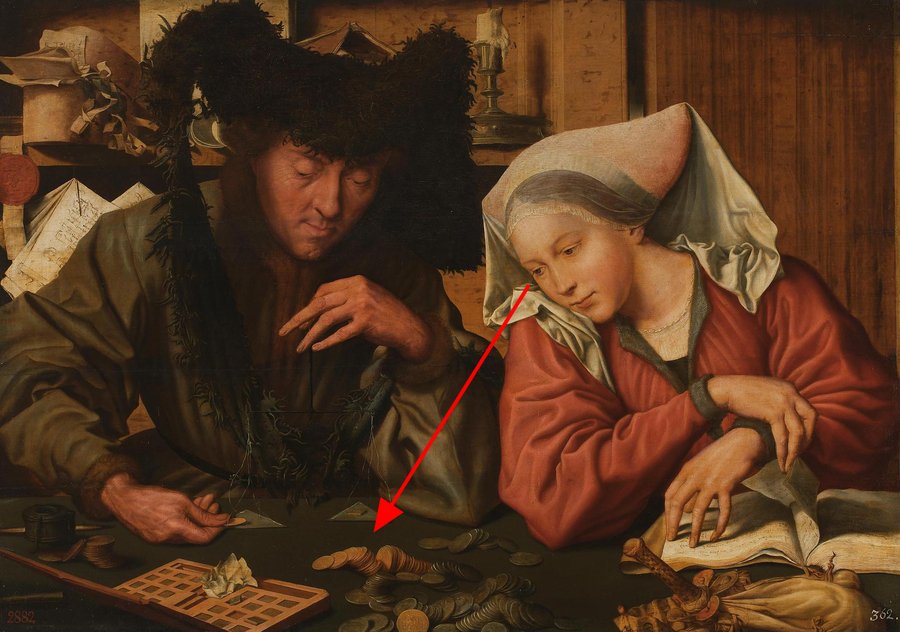
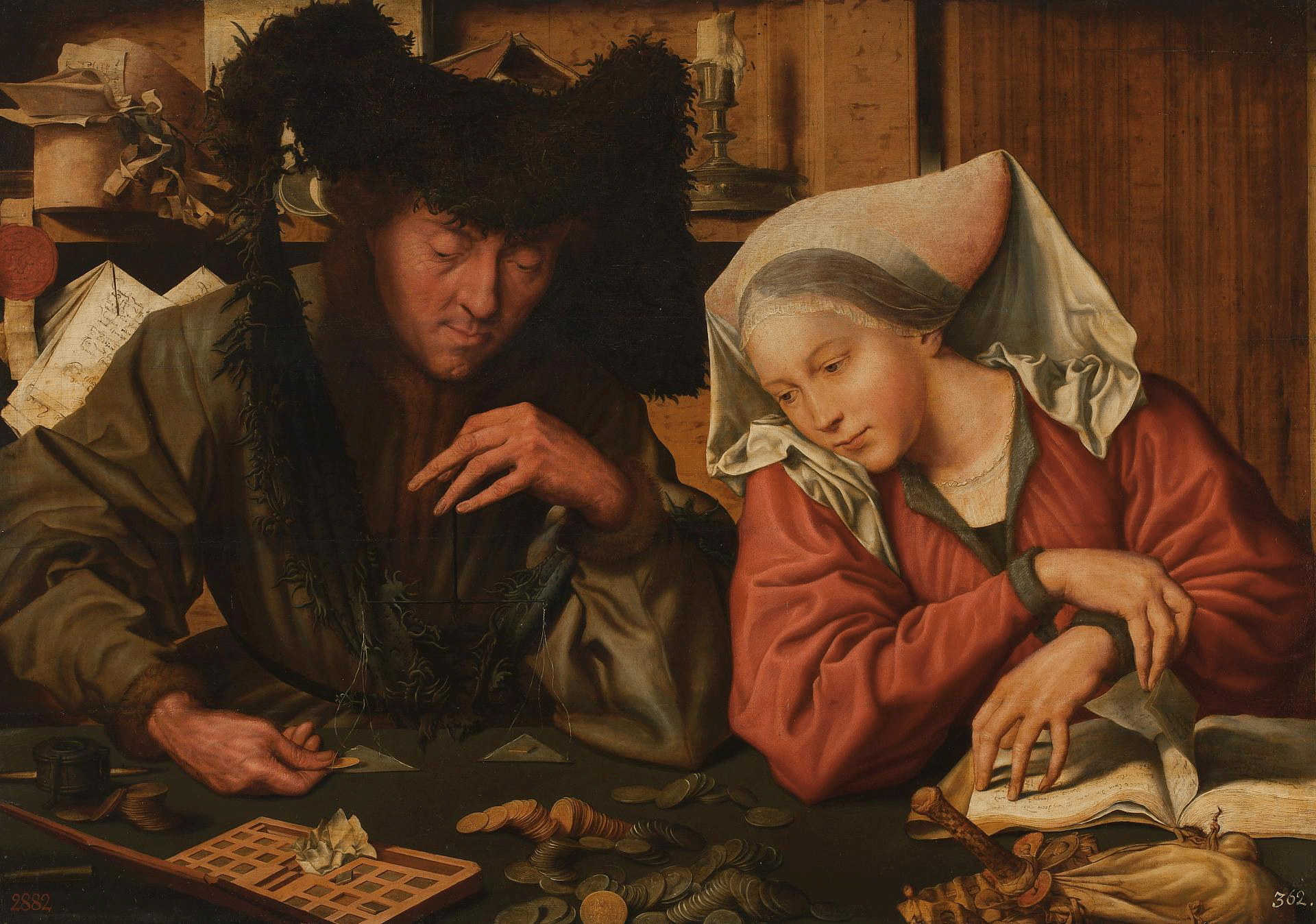
Quentin Massys. «He Changed and His Wife.» 1514.
Quentin Massys rejects medieval demons but intensifies the pressure of objects. The figures of the couple are pushed close to the front edge of the painting, and wooden shelves rise immediately behind them. The narrow depth of the frame is squeezed between two planes—the green tablecloth in the foreground and the shelving unit in the background. Due to this tight frontal composition, the viewer finds themselves almost face-to-face with the characters, and the geometric center of the canvas shifts from the human faces downward—to the surface of the counter.