concept
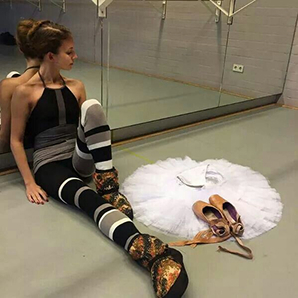
Warm-up is the state in which a ballerina’s body exists before stepping onto the stage—before transforming into the ideal image. Warm-up attire marks the threshold between the mundane and the artistic, between the «personal» body and the «alien» scenario. Investigating this visual layer allows for a fresh perspective on the ballerina—not through the tutu and pointe shoes, but through the gaiters, sweaters, and striped trousers.
In my project, I pay particular attention to the semiotics of stripes—the tradition of ballet gaiters and sweaters, which function as a signifier of insiders and as camouflage.
Relevance

The relevance of this topic is driven by the growth of balletcore aesthetics since 2022. Warm-up and training attire—such as gaiters, thermal trousers, and wrapping cardigans—has transcended mere functionality to become a fashionable cultural code. Commercial data confirms this interest: sales of ballet wear and warmers have surged, particularly among young adults aged 20–30. Ballet is evolving into a lifestyle, and warming up is becoming its visual marker.
Area of study
Research Subject — the warm-up and practice attire of a ballerina.
This is not simply a costume element; it is a distinct layer of visual identity: gaiters, warm trousers, wrap cardigans, retouches, and striped sweaters. These pieces mark the state «before the stage”—a moment when the body is not yet perfected, but is already subject to discipline.
The study examines the functions this clothing performs in cinema: it creates a sense of backstage authenticity and vulnerability, while emphasizing belonging to a closed community.
Research objective
The goal of this research is to identify the role and functions of warm-up attire in constructing the image of the ballerina in 20th and 21st-century cinema.
research objectives
- To examine the history and semiotics of warm-up attire in ballet culture, including the tradition of striped stockings and sweaters.
2. To analyze the representation of warming up and warm-up clothing in key films of the 20th–21st centuries («Red Shoes, ” „White Nights, ” „Black Swan, ” „Swan Lake, ” etc.).
3. To identify the evolution of the ballerina’s image in warm-up attire: from a functional background to the central semantic focus of the frame.
4. To investigate the striped semiotics as a specific visual code of the discipline.
personal interest
My personal interest in this topic stems from my own experience. I studied ballet for ten years, six of which were professionally at the Vaganova Academy of Russian Ballet.
This journey was more than just a hobby; it was a way of life—daily classes, rehearsals, strict discipline, and constant self-overcoming.Warming up before class was not a formality for me, but a necessary part of the ritual—a time when the body gradually transitioned from a state of rest to working readiness, and the warm-up attire became a symbol of this process.
In my view, the warm-up clothing remained a symbol of that state «before the stage”—vulnerable, honest, unpolished, yet already subjected to the gaze and expectations of others.My personal experience allows me to see not only the aesthetics but also the real pain, fatigue, and transformation that lie behind the striped gaiters and fitted cardigans in this field.
Sources
- Smagina S. A. Representation of the Ballerina Image in Domestic Art During the Perestroika Period (Using the Films «Fouetté» and «Myth» as Examples) // Vestnik Academy of Russian Ballet named after A. Ya. Vaganova. 2019. No. 2. pp. 128–140.
2. McLean A. L. Dying Swans and Madmen: Ballet, the Body, and Narrative Cinema. New Brunswick: Rutgers University Press, 2008.
3. A Study on the Medium-Replacement of Dance and Cinema Through the Dance Film «Black Swan» (2010) — Focused on Greimas Semiotics // KCI. 2018.
4. Chazin-Bennahum J. The Lure of Perfection: Fashion and Ballet, 1780–1830. New York: Routledge, 2005.
5. Holt A. Modernizing Costume Design, 1820–1920. London: Routledge, 2019.