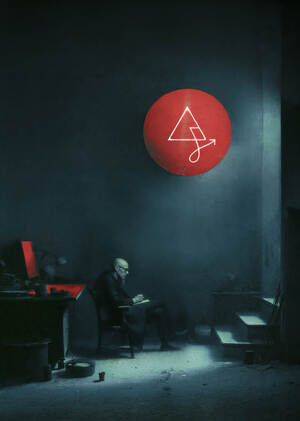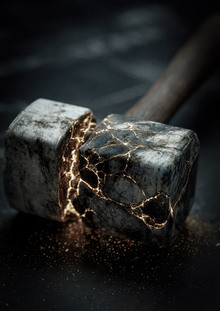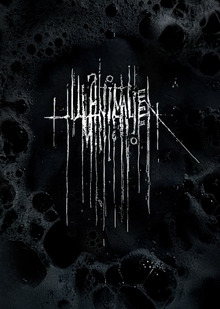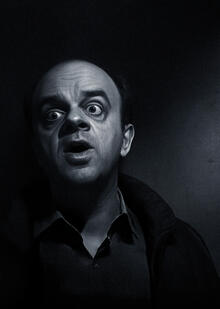
I have a rather practical question: on what basis do I select one image from a multitude of convincing options—and what gives me the right to sign the resulting work with my name?
He left, and we have to draw.
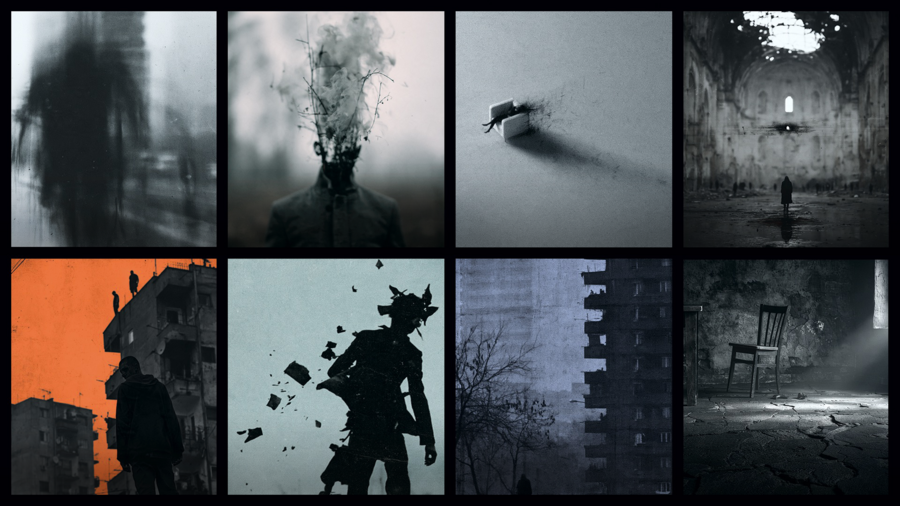
Imagine we need to design a music album about a person who has passed away, leaving behind a familiar sense of domestic order—let’s use this as a hypothetical task to trace how solutions emerge. We have eight possible directions, and each one already has the potential to make an impact.
A familiar situation arises: in one image—or rather, one composition—a detail appears that I hadn’t even considered. I want to combine them. The next generation offers another possibility, and my previous choice suddenly seems premature again. The amount of material keeps growing, while my confidence in the solution diminishes with each new generative iteration.
Technically, everything might look perfectly acceptable, but the difficulty is inevitable where I am required to have a clear understanding of what the image is actually doing—and whether that relates to the problem I intended to solve.
One can endlessly refine the prompt to achieve precision—but first, one must define what specifically I consider to be precision here. Even the initial conception of the problem statement might have been thin, and noticing that shallowness could be prompted by the generated image itself.
Solve sine coagulatione
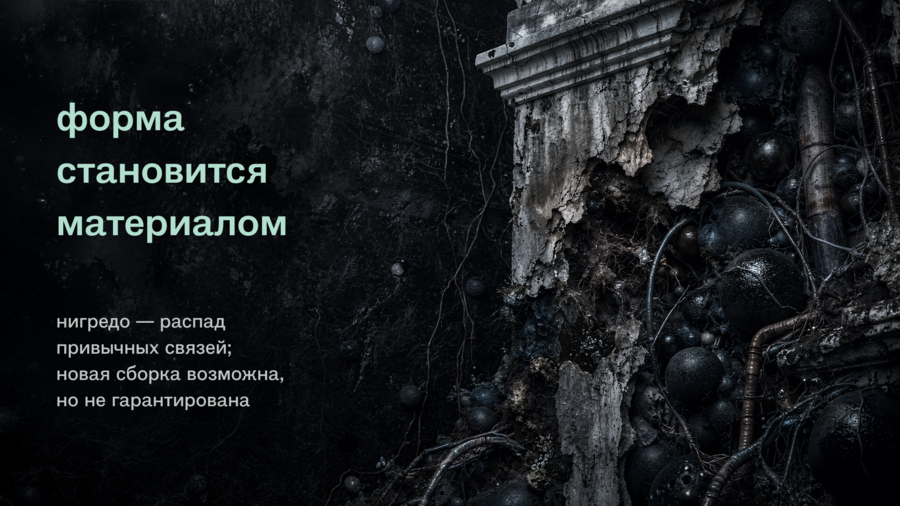
In the alchemical language, the word «nigredo» means «blackening.» This is associated with images of decomposition: the substance loses its former appearance to such an extent that it is difficult to recognize the original material in the resulting mass. Let us transfer this figure onto the creative process to describe the breakdown of our habitual ways of giving shape and considering something our own.
Any completed cultural forms—whether historical or just generated—become material once more. Temple architecture can be combined with insect anatomy; the intended use of a familiar object can be disrupted, and a new whole can be assembled from its parts. Surrealist collage, palimpsest, participatory design—in short, postmodernism pervades every field. Any seemingly incompatible combination might turn out to be more convincing than I expected, although, of course, I still need to determine if it is necessary for my work and whether it solves my problem.
Simultaneously, my professional self-description is decomposing. We are used to considering the path we have taken from intention to result as proof of our authorship, but now part of that path is executed without me by someone or, well, by something possessing agency—that is, the ability to substantially alter the course of the work—and something emerges at the end that I could not foresee. I do not control every operation that makes up the result. I overcome the material’s resistance not only myself, but also something that is not me, yet is becoming the material itself.
Solve does not guarantee coagula—decomposition does not promise that the subsequent synthesis will occur. You can generate an entire folder of striking images and remain trapped in a primitive, empty concept. This calls into question our very confidence in the necessity of the chosen form.
Simply put.
It seems like first I generate, and only then do I select. But of course, the selection process begins much earlier—when I formulate the prompt. From a vague feeling, I have to extract specific wording, rejecting other words—and with them, I already exclude some potential relationships.Consider this: in our scenario, a person left, but the home remained tidy. I can translate this into the prompt «abandoned room”—and without realizing it, swap one concept for another, and then the difference between a place you just left and a long-unoccupied place that has been decaying for ten years disappears.
Here is what such a prompt phrasing suggests: crumbling plaster, ruined setting—the absence of a person is conveyed through the decay of their environment.
This is a quite compelling depiction of abandonment, but the domestic order that survived its occupant is almost entirely gone. The initial task has narrowed to a recognizable atmosphere.
The difference might seem subtle when I describe it. In the image, it completely changes the narrative. To see this more clearly, let’s look at another example where the critical relationship can be shown literally.
Inside and outside
In the final shot of «Nostalgia, ” a Russian village house is located inside a vast temple ruin. Suppose I am interested specifically in this nesting: a close, domestic space contained within something immeasurably larger.The house next to the temple presents a different scenario: one can walk between them, the structures are separated, they exist on the same plane, and the relationship between them is compound rather than complex.
I asked Midjourney v7 to generate this image: a ruined temple with a small Russian house inside (I wrote more about these experiments in the text «Authorship as Severance»). The prompt included the subject, the lighting, and the reference, but the spatial condition was stated separately and unequivocally: the house inside the temple.
What did we achieve? A recognizable atmosphere: a misty space, a solitary figure. In these details, I see Tarkovsky, but the necessary spatial relationship is lost.The general mood may align with our expectations so much that I want to excuse the disappearance of the core meaning. I must note the loss myself—otherwise, I will concede to a substitution of my own objective.
I asked another model (GPT Image 2.5) to illustrate the required relationship as a spatial diagram: a rustic cottage enclosed by the church’s walls, leaving open space around it. This illustration clearly shows exactly what I was trying to achieve. This kind of relationship establishes a stricter condition, and now I can explain why I rejected the aesthetically pleasing option without resorting to vague statements like, «something is off.»
And now, Midjourney version 8.2. It worked! The house is genuinely situated inside the ruin—its walls envelop it, and the overall perspective unites everything into a single space.This new result forces me to reevaluate my own argument. Previous glitches cannot be treated as an inherent property of AI generation, nor can they be relied upon as proof of human exceptionalism.However, fulfilling the spatial condition leaves the meaning of the entire scene open to question. The seated figure faces the warm windows; candles are burning nearby. I read vigilance, almost commemoration, in this. Does this reading satisfy me? Is this the exact scene I wish for?
Let’s return to the cover
In our hypothetical collection, loss must retain a personal, intimate, domestic scale: a person has left, but the objects still hold the memory of their presence.
Yet, in this generation, we see a majestic Gothic ruin. Undeniably, the image makes a powerful impression, and one immediately starts looking for arguments in its favor. But no, it doesn’t work. Why? Because it elevates the event to a monumental scale, where personal loss transforms into a global catastrophe.
In this instance, the world created by me using AI does not save itself through beauty—in other words, the aesthetic merits of the image do not solve the task. If I were to incorporate this ruin, I would be forced to either reframe the objective or admit that the superficial spectacle of one of the generations convinced me to forget what I am even doing and why.
Now, let’s look at the entire grid and name the reasons why other directions also need to be put aside.
The first image returns the person in a ghost-like state, meaning absence is replaced by a strange new presence.
In the adjacent image, the main event becomes bodily transformation, although the task was related to the order of things after the departure.
Another option illustrates the disappearance of the person too literally, whereas I needed to convey the domestic order that survived it. Furthermore, it resembles a Polish poster, which is not what I need right now.
We have already analyzed the ruin—it changes the scale of the loss.
The orange scene with figures on the roof introduces a motif of threat.
The silhouette falling apart suggests decay, not departure.
The cityscape transfers the feeling of loss onto the environment, and we lose the domestic feeling.
Of course, these criticisms are not absolute—they merely explain my refusal within the scope of the chosen task. For a different project, I could accept any of these directions.
But I can work with the chair. For now, it is just a direction that still needs refinement. Importantly, by eliminating several substitutes, I gained, among other things, the opportunity to more precisely formulate the problem’s condition.
Who did you leave us with?