Rejection of the Garden of Gods
2250
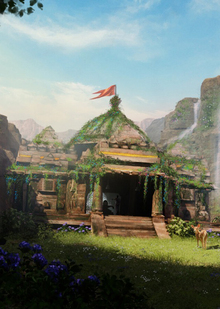
By the year 2250, it becomes unequivocally clear that the lost model of the Garden of Gods cannot be restored. Previous decades have been spent attempting reconstruction—ranging from directly recreating natural conditions to complex technological simulations imitating the ecosystems of the Kami groves. However, none of the approaches yield a sustainable result. The reconstructed structures prove either unstable or lacking what was once perceived as «presence.»
Gradually, this stops being interpreted as a temporary failure or a technological insufficiency. Instead, a realization forms: the very condition of the Kami’s existence has changed. The groves have not disappeared in the conventional sense—rather, they have lost the capacity to be restored in their former form.
It is at this juncture that the approach shifts. Japan completes the formation of a network of mechanical shrines, cementing the transition to a new logic of environmental interaction. Instead of attempting to recover what was lost, a practice of observation emerges—a long-term, continuous observation that need not lead to an explanation.
New Infrastructure:
Mechanical Sanctuaries as Observation Tools
2250–2257
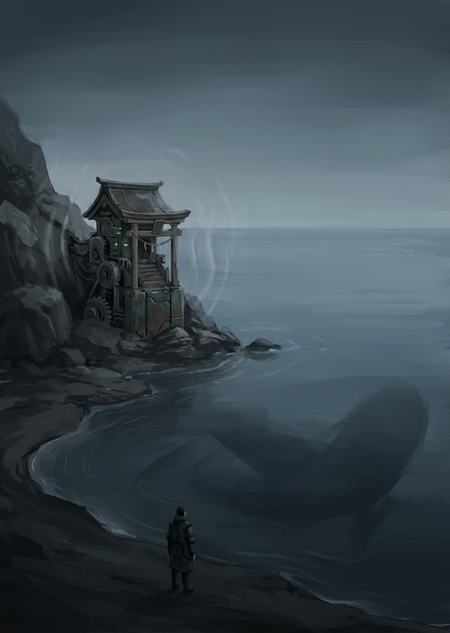
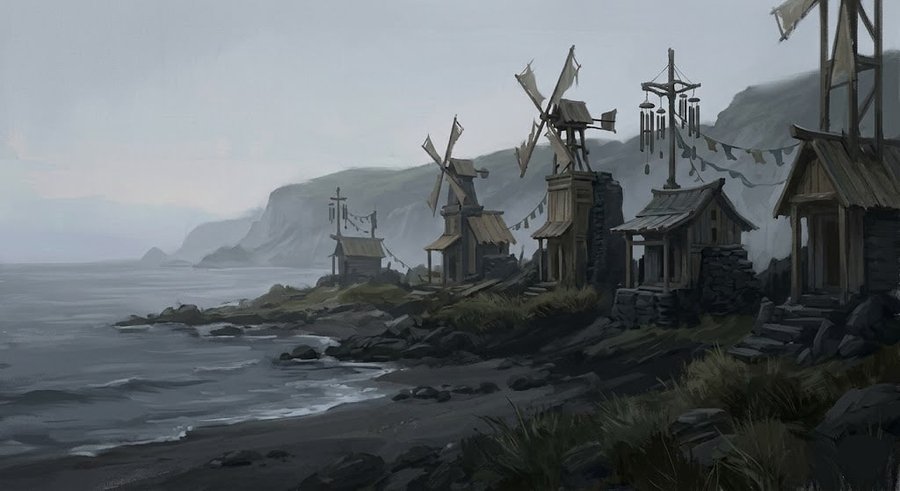
Sanctuaries built along the coast are complex engineering systems, yet they eschew overt technological display. They are integrated into the landscape so that their presence does not disrupt the overall environment. The utilization of wind, water, and geothermal heat makes their operation almost imperceptible—as if they exist under the same conditions as the nature surrounding them.
Functionally, they are highly constrained. The sanctuaries do not transform the environment or extract resources from it. Their purpose is to capture ocean fluctuations, amplify them, and translate them into an acoustic form. This translation does not interpret the data; it merely makes it perceptible.
In the initial years, the system remains almost «silent.» Recordings accumulate, but they do not form stable patterns. This state of uncertainty gradually becomes part of the practice itself: the absence of a clear result is not perceived as an error, but rather as a necessary stage of observation.
Signal Emergence:
The Transition from Noise to Structure
2257
In the year 2257, the first stable sound patterns are recorded. Unlike previous recordings, these patterns repeat and retain an internal structure, although they do not correspond to any known natural processes. This is not a sudden breakthrough, but rather a gradual shift: fragments begin to emerge from the noise that cannot be ignored.
Attempts to explain their origin remain speculative. One hypothesis suggests a link between the signals and the Kami, which vanished after the destruction of the groves. This hypothesis lacks direct confirmation, but it is compelling enough to influence the direction of future research.
From this moment on, the ocean begins to be perceived differently. It is no longer merely a backdrop against which events unfold, but becomes an active medium capable of its own, yet unrecognized, form of organization.
New Practice:
Depth Translators
Year 2265
By the year 2265, a stable practice surrounding the work with sound data has emerged. It belongs neither entirely to science nor to ritual, but draws elements from both approaches. Those engaged in this work are beginning to be called depth interpreters.
Their work demands time and sustained attention. Recordings are matched, re-listened to, and grouped by similarity. However, the result of this work is never fixed as definitive. Any structure identified remains a hypothesis that can be revised with the appearance of new data.
It gradually becomes clear that the interpreter’s task is not so much to decipher the signal as it is to hold it within the field of attention, preventing its reduction to a single interpretation. This changes the very understanding of knowledge: it becomes a process, not a product.
Environmental Change:
The Ocean as an Unstable Form
2273
In the year 2273, observations begin to transcend sound recordings. Large, unclassifiable forms are detected in coastal waters. Their behavior does not align with known biological models, and they lack distinct boundaries themselves.
Sometimes they appear as discrete objects, but prolonged observation reveals they are inseparable from their environment. Their movement syncs with ocean currents, and their form is in constant flux.
Attempts to document these phenomena are hampered by instability. The forms vanish or transform when directly observed, making it impossible to fix them as stable entities. This challenges the very methods of observation and forces a reevaluation of what can be considered observable.
Attempt at Dialogue:
Signal Generation and Its Limits
Year 2281
In 2281, the first attempts are made to move beyond passive observation. Sanctuaries begin to be used as sound sources: recorded patterns are reproduced with an anticipation of a possible response.
In certain cases, changes are indeed recorded in response to these signals. However, they do not repeat or form a sequence. Each response remains an isolated event, incapable of systematization.
It gradually becomes evident that the very idea of dialogue is inapplicable here. The environment does not respond in a form that could be interpreted as a message. The attempt at communication reveals not a connection, but its limits.
Glitch and Distortion:
Speech Without Subject
2289–2297
By 2289, the first serious malfunctions in the shrines are recorded. Resonant overloads caused by external fluctuations lead to the failure of individual stations. This indicates that the observation system is not neutral—it is included in the same dynamics it attempts to record.
In 2297, the situation becomes more complex. Fragments resembling human speech appear in the sound recordings. They emerge spontaneously, do not reproduce, and resist stable interpretation.
These fragments do not allow for definitive conclusions, but they alter the overall perception of events. There is a growing sense that the boundary between the human and the non-human is blurring, although the mechanism of this blurring remains unclear.
Crisis of Interpretation:
Data Growth—Growth of Uncertainty
2023–2013
By 2305, it becomes apparent that the accumulation of data does not lead to clarification. Attempts at systematization lead to the opposite effect: signals overlap one another, forming a dense, indistinct mass.
In 2313, changes in the physical environment are recorded—unstable currents, local shoreline shifts, deviations in climatic processes. These phenomena are initially viewed in isolation but gradually begin to be perceived as parts of a single process.
At this stage, there is a sense that the boundary between observed phenomena and the act of observation itself is blurring. The more data there is, the less defined the picture becomes overall.
New Ontology:
Kami as a Distributed Process
Year 2321
By 2321, a new interpretation takes shape that rejects the notion of kami as discrete entities. It is proposed that upon transition to the oceanic environment, they lose their integrity.
Kami begin to be viewed as processes—distributed, lacking fixed form, and existing through environmental change. They cannot be localized or delineated as separate objects.
This alters the language of description itself. The divine is no longer conceived of as something with which a connection can be established. It manifests only through environmental dynamics, and any attempt to fix it as an object proves futile.
Alternative Experience:
Sea Nomads and Embodied Perception
2329
Engaging with maritime nomadic communities in 2329 introduces a different mode of interaction into this system. Their practice is not based on interpretation or analysis. Instead, they work with their own bodies, altering them as instruments of perception.
This approach is radically distinct from existing methods. It does not seek to explain the environment; rather, it presupposes immersion within it. In this context, the individual ceases to be an external observer and becomes an integral part of the processes unfolding.
This experience becomes the starting point for initial experiments in biological adaptation.