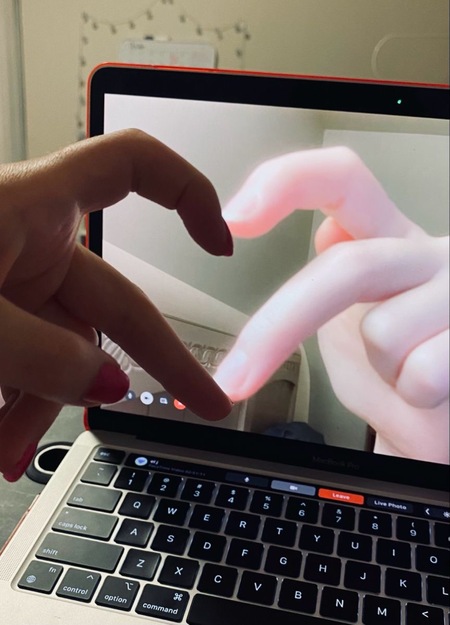
And I want to be near you But every road leads to an end.
— Sufjan Stevens, Death with Dignity
Breach to breathe: the autoethnography of existing in limited spaces
What happens when human relationship is locked away by limitations of spaces, offline and online alike? How do we attempt to breach into spaces that are being torn away from us, struggling for a breath of freedom? What happens to a person when they are forced to exist in a space where the very continuation of their presence might be severed at any moment?
The concept
Humans are beings extremely capable of adaptation. We might take a while to evolve biologically, but cognitively — we are very quick to accept the changing circumstances, or at least get used to them and keep living however we can. But the fact that changes and restrictions are no longer met with surprise does not mean we’re comfortable with them. In my work, I want to explore how limitations of spaces, both physical and digital, affect humans and their relationships and make a record through the lens of my own experiences as well as some of my fellow students.
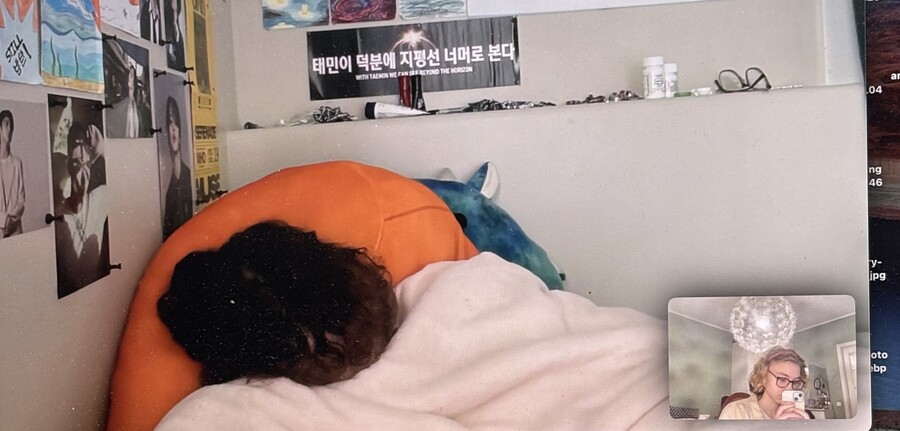
Photo of a video call, personal archive, 2025
Then and there, here and now
We are a generation living in a weird inbetween. We’re used to our physical bodies being devoid of freedom to move as we want, a limitation first brought to life by the global pandemic and then reinforced by politics. Yet we’ve also had a taste of being a part of the free global world, where we could travel to places close and far. Inhabiting some of those spaces again now seems extremely difficult, if not impossible. Thus, the freedom to cross — borders, oceans, life stages — has now been stripped away. We have been to the big outside and seen our older peers freely move to whatever spaces better suited their lives, but doing that ourselves now seems like a mix of a memory and a dream.
Screenshot, personal archive, 2025
That is not to say that things are completely bleak. We are not without our privileges: we were once able to move and travel, and we might be able to do it easily again. It’s just that for now, during what seems like the establishing years of our lives, we are stuck in a space that is uncomfortably less leaveable than before. To use a straightforward analogy — there are no concrete walls around us, but instead a rather tall fence. Sure, there are ways to go around it, but we remember the fenceless world in which getting to the other side didn’t take nearly as much time and effort.
The effects of choice (lessness)
I can’t find a word better suited for this state than static and stagnant. Bodies are only able to move within a wide yet strictly defined space, constantly aware of the external limitation placed on them. People might be adaptive, even more so when they aren’t given a choice in the matter, but losing the privilege to choose leaves us feeling frustrated and powerless. It’s no surprise, then, that these fences have a strong effect on emotional wellbeing. Physically, the space we inhabit has not changed. But now that same space comes with different meanings: the context and connotations of how and why we are in that space are not the same anymore. Before our world grew limits, people had stayed in one space by choice. Now it is precisely because of those limits that places of previous belonging feel forced upon us — we have not been the ones to establish the rules of leaving and coming back, nor can we do anything to affect them. It’s these implications that twist the emotional landscape of staying, turning home into a cage and making the very air feel stale with captivity.
Pinterest, 2025
Screenshot, answer from a questionnaire on long-distance relationships
Bodies impaired of shaping
A body stripped of its ability to do but not the ability to want is forced into an endless loop of inability. A mental space of sorts, one that shapes our perception of the physical space. Losing the choice to leave also obliterates the choice to stay, because the options of to do and not do are tied together inseparably. The phenomenology of being forced to be trapped in instead of inhabit is, in its essence, the far side of another very common space-choice relativity — seeking refuge.
Pinterest, 2025
That problem, although underrepresented, is more visible because it constitutes noticeable change rather than the absence of it. These are also people devoid of choice, but forced to flee from instead of inhabit. In other words, it has an effect on the space we perceive and which bodies exactly inhabit said space. I believe these cases to be more alike than they seem. In both situations, bodies are stripped of their ability to shape the spaces, and you can not call or make a space your own if you’re unable to shape it. In both situations change — or lack thereof — is an external factor. Moreover, these two groups of people are intertwined. A person leaving an unleavable space is now dynamic and fleeing, unlikely to return. A person returning is — unless there’s been change — static and trapped, unlikely to leave. As a society, we are more familiar with the emotional landscape of having left, so I propose to use it as an empathetic anchor to understand a kind of space shaped by choicelessness: a space contaminated by images of a life that could have been if bodies weren’t impaired in their ability to shape it.
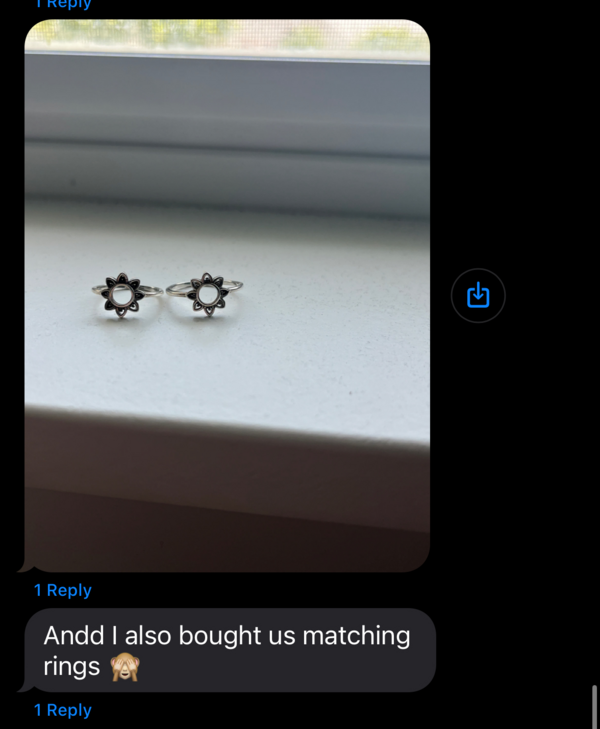
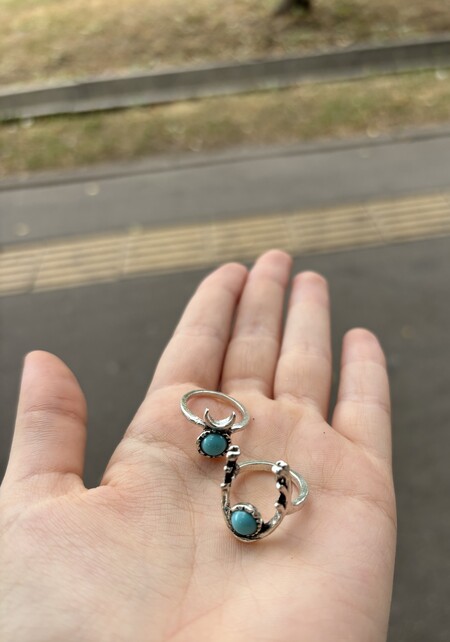
Small ways to connect, personal archive, 2025
The non-problem problem
With the key problem of limits and ability outlined, I can now present my testimonios («Where are we from?») on the matter. For almost a year now, I’ve been in a long-distance relationship, and my partner lives in a country that belongs to the «world beyond the fence». And while that causes all sorts of issues and makes seeing each other extremely difficult, the way I see it, the borders of physical geography are not the key issue that causes us to struggle with current events. While relationships are easier to maintain when two people are physically together, the concept of long-distance relationships is not new. There are plenty of tools and resources that allow us to breach the physical space by going into the digital one instead. So, we do — or I did — the most human thing I could do: I adapted. I could not shape the space, so I accepted its rules and the implications that come with them.
Photo of a video call, personal archive, 2025
Adaptation by shaping another space
Screenshot, statistics from a questionnaire on long-distance relationship
To exist in the limited space, I had to accept that I can only see my partner a couple times a year, and even that is expensive. I had to accept that I can not come home to the person I love, or be with them to provide support when things are hard. I don’t have the power to make a choice, to move my body freely to wherever I want it to be or whoever I want it to be with. And I turn from a space limited to a limitless one. If I can not move, I will want to move. If I can not do, I will hope to do. I’ve snatched my relationship from the cage of the physical world and hid it away within my mental landscape, saving up the impulse to move and do until I have the ability to use them.
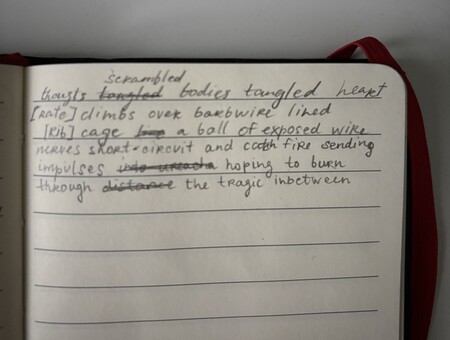
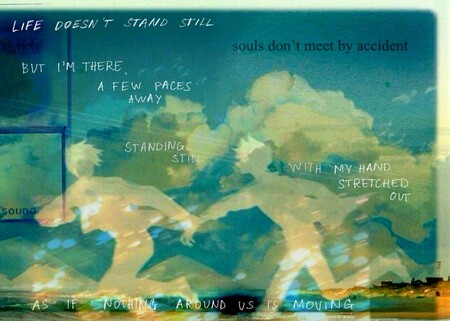
By me. Poems and thoughts, 2025
The emotional turmoil of no movement
Screenshot, statistics from a questionnaire on long-distance relationship
Sara Ahmed writes in her «Queer Phenomenology» of the fact that not all bodies are granted the ability to travel freely, or travel comfortably. Some are limited in their freedom not directly, in that they can in theory get from one place to another. But the experience of those bodies will not be the same as the ones who face no restrictions. For them, getting from one place to another will be turned into something unpleasant because they [are not/do not feel] welcome in spaces they go through along the way. Feeling unwelcome in a space can make you want to leave it as soon as possible, because you understand that place was not created with you in mind. You may have a right to inhabit it, or gain that right slowly, but you need to put in effort where other people simply do not. That is the base phenomenology of bodies unable to travel or inhabit a space. The problems begin when not only are you unwelcome in the spaces of traveling and beyond, but the space you are forced to stay in has not been created with you in mind either. So, the frustration starts to pile up, and you struggle to breach the barrier between yourself and the rest of the world — today, that mostly means escaping through the online.
By me. «Blue», based on a poem by my partner. 2025