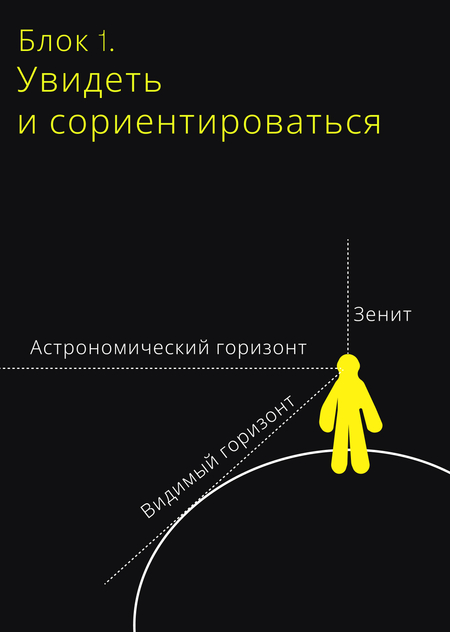
The first module of the course focuses on transitioning from a simple upward gaze to conscious observation.
The night sky feels familiar: stars, the Moon, a few bright points. But to an unprepared observer, all of this exists more as background than as a system.We begin with the most basic question: What am I even seeing when I look at the night sky? And we conclude with the ability to determine direction, find initial landmarks, read a simple star chart, and map it onto the actual sky.

Block Result
After the module, the participant will be able to:
— select a point of observation; — determine what they are looking at; — distinguish major celestial object types; — locate several reliable reference points; — correlate the actual sky with a star chart; — create the first two layers of their own atlas.
LESSON 1.1
WHAT DO WE SEE WHEN WE LOOK UP?
Lesson Question.
How much of the universe are we actually capable of seeing with our own eyes?
Close your eyes and picture the night sky. What is there?
Our brain starts listing: the Moon, stars, comets, meteorites, comets, planets, the Sun. Then another question arises: how do you determine what you are actually seeing? Typically, it turns out that most people can name the objects, but they don’t really understand how to distinguish one from another.
This becomes the starting point of the course.
What is the star here?
Originally, this photo contains over 256 thousand galaxies.
Not everything that shines in the sky is a star
When we look up, visually disparate objects can appear almost identical—like small, glowing points.
But physically, they are entirely different things.
How many stars are there in total?
An intuitive answer is thousands.
In reality, the scale is significantly larger.
The Milky Way contains approximately 100–400 billion stars, yet with the naked eye, a person can only see a few thousand of the most accessible stars across the entire sky.
Therefore, the picture we perceive as the «starry sky» is only an extremely small visible sample of our own Galaxy.
We can only perceive 0,000002% of the Milky Way’s stars.
NASA estimates that there could be up to $10^{24}$ stars in the universe—a number with 24 zeros.This number is practically impossible to grasp intuitively.The human brain struggles to process cosmic scales without comparisons. So, here is how to understand the number of stars…
In the universe of stars, there are more than grains of sand on Earth.
Can you view another galaxy with your eyes? — Yes
On a sufficiently dark night, a person can see the Andromeda Galaxy—M31—with the naked eye.
It does not look like the impressive spiral seen in telescope photographs, but rather as a faint, blurred patch.
It is approximately 2.5 million light-years away. NASA refers to Andromeda as the nearest large galaxy to the Milky Way and notes that it is visible to the naked eye in dark skies.
Why is the sky different for two people?
Now, we return from the Universe back to Earth. The experience a person will have this evening is determined by several factors.
How to observe properly?
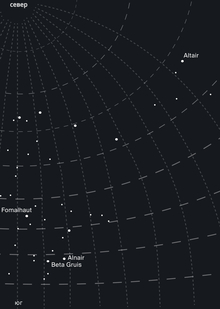
Before our first independent outing, we introduce the main rule of the course: First, we observe. Then, we verify. We do not start with Stellarium. Otherwise, instead of learning to read the sky, students will learn to read a phone screen. The sequence is: SEEN ↓ RECORDED ↓ HYPOTHESIZED ↓ VERIFIED
FIRST INDEPENDENT OBSERVATION
The participant selects a permanent location they can visit several more times.They record:location date time direction weather conditionsThen, they observe the sky for 10–15 minutes without using the app.On the map, they mark:— the brightest points; — dimmer points; — noticeable clusters; — moving objects; — the horizon line.Accuracy is not being assessed at this time.
LESSON 1.2
SKY AS A MAP