Essay
At the Msta station, amidst the quiet landscapes of the Udomelsky District, stands an old water tower. It was erected here in 1870, when the railroad was only beginning to become a familiar part of life in the country. More than one and a half centuries have passed since then, yet the brick structure continues to rise over the station, preserving the memory of a time when every passing train was part of a major technological breakthrough.
Today, the tower might seem like a peculiar or even incomprehensible structure. It doesn’t resemble a residential building, nor does it evoke a church bell tower. But once, it was difficult to imagine the operation of the railway without it.
In the 19th century, steam locomotives required vast amounts of water. Special elevated reservoirs were installed at stations for this purpose. The water flowed to the refueling point by its own weight, allowing the locomotive tank to be quickly filled during a stop. The Msta tower was part of this system: invisible to passengers, it ensured the smooth movement of trains and helped the railway operate without delays.
The structure was built according to a standard design, similar to those used across various railways. The drawing album by I. I. Volgunov, published in 1872, features analogous constructions employed on lines such as the Tambov–Saransk Railway. The Msta tower was not an arbitrary architectural experiment; it belonged to an entire generation of engineering structures created according to common principles.
Time has treated the fate of these structures differently. Many have disappeared, giving way to new technologies and station buildings. The tower at Msta has retained its original forms and proportions, allowing it today to be viewed almost as a diagram brought to life in brick and stone.
If you stand nearby and look closely at the structure, it becomes easier to imagine the railroads of the past. A train slows down, the steam locomotive needs water, and the station bustles with activity. The tower, which now seems a silent monument, was once part of everyday life. Its significance lay not in beauty or novelty, but in simple necessity—to ensure movement.
Nevertheless, there is a certain expressiveness in its strict form. It lacks superfluous ornamentation, possessing only proportions, a well-conceived design, and material built for longevity. Perhaps this is why it has not lost its appeal after so many years.
Udomelsky Krai is known for its lakes and forests, but its history is not solely preserved in nature. Sometimes it is discovered in old brick structures near railway tracks. The tower at Msta Station reminds us of the first decades of railway development and the people who created the infrastructure of the future.
Trains continue their journeys, technologies change, and new stations emerge. Yet, the tower remains in its original spot. It once helped steam locomotives move forward, and now it itself has become a quiet witness to an era in which even a purely functional building managed to survive its original purpose and gain a new life in the memory of people.
Legend. The Tower on Msta: the water they return from
In the year that railway tracks were laid through the forests and lakes of the Udomelsky region, a tower was decided upon for the siding near the swift water. The locomotives drank a great deal, and without water, the road would stand still like a wagon without wheels. The location was named after the river—Mstoy. Around stood a damp forest, lakes glittered beyond the trees, and in the mornings, a fog hung over the tracks so thick that the signalman walked the lines with a lantern even during the day. Master Prokhor, a gray-haired bricklayer with heavy hands, took on the construction. With him came his apprentice, Ignat, sixteen years old, who knew how to estimate bricks by eye and could not tolerate careless masonry. They arrived by wagon: on it lay a box of tools, a sack of lime, and a bundle of bread. On the first morning, Prokhor spread out a standard blueprint on the planks, secured the corners with four cobblestones, and handed Ignat a rope.
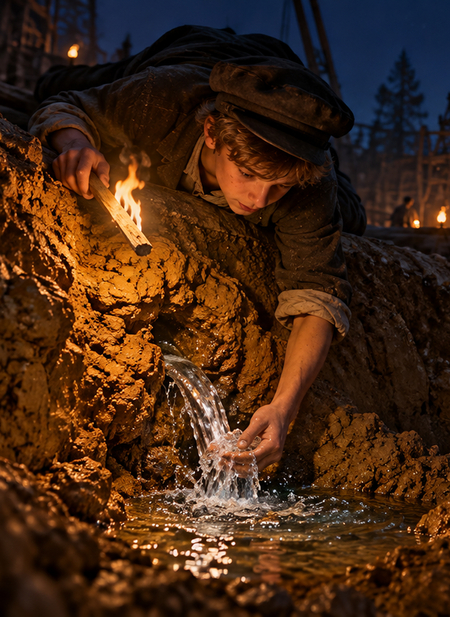
— Drive the stake in. Measure the circle according to the blueprint. Ignat drove a pole into the ground, tied a rope, walked around the circle, leaving a furrow in the earth, and called the workers to dig. By noon, the foundation pit was up to waist height. By morning, it was filled with icy water. Ignat bailed it out with buckets and lined the bottom with boards. In the morning, the water returned. — Don’t fight it, don’t argue, — Prokhor said, looking into the pit. — The water here is older than us. Don’t fight it; negotiate with it. That night, Ignat stayed by the pit with a ladle. He leaned over the edge, hung his head down, and listened. Something was murmuring quietly beneath the yellow clay. He went down, cleared the clay with his palms, and felt a cold stream striking from the bottom. He scooped some up and tasted it: the water was sweet, without a swampy taste. In the morning, he brought Prokhor over. — There’s a spring here. If we cover it up, it will run under the masonry and wash it away. If we leave it… — We’ll leave it, — Prokhor nodded. They laid a ring of boulders around the spring and drove oak piles, while leaving a low arch with a trough in the wall of the future tower: so the water could flow out. Then they began laying brick. Prokhor showed him how to mix the mortar with lime and egg white so that it wouldn’t fear water or frost, and how to lay every row according to a taut rope, allowing for zero error.
The tower rose slowly. Workers built scaffolding from thin logs and hauled bricks up in wooden buckets suspended by ropes. Ignat followed Prokhor in a circuit, checking the plumb line and leveling each course with a straightedge. In the fall, the first tier was laid; in the winter, the masonry was covered with straw, and a brazier was fired inside to keep the mortar from freezing. Ignat laid course after course. On the final ring, he took a tin token stamped with the year from his pocket, hid it under a brick bearing the master’s seal, and covered it with mortar. «What is this for?» Prokhor asked. «So the tower remembers who built it.» Prokhor snorted and turned away, but Ignat noticed the old man smiling.
The tower rose tall and severe, red against the gray sky. Prokhor wiped his hands on his apron, took off his cap, and said only, «Alright, stand.» That night, before the launch, Ignat didn’t sleep. He climbed the stairs, tightened the nuts on the tank, walked around the lamp, and peered into every seam. Then he went downstairs and sat by the arch until dawn, listening to the key rolling beneath the ground. In the morning, a stern inspector arrived at the rail yard, followed by residents from neighboring villages arriving by cart. The inspector walked around the masonry, tapped the wall with his cane, and took out his watch. «The first train in ten minutes. If the water doesn’t come out—the tower will have to be rebuilt.» Ignat ran to the valve and turned it all the way. At first, a hum sounded, then a stream gushed out from the arch, clear as glass. The steam locomotive approached, shrouding the platform in mist. The engineer jumped down, held a mug under the stream, took a sip, and burst out laughing: «Sweet! Where did you get something like this in these parts?» Passengers spilled out of the cars with mugs and kettles. A girl in a red kerchief squeezed toward the arch, scooped up water with her palms, and said loudly across the platform, «From the forest!» The inspector stood, frowned, then also reached out his hand, and he was poured some. He drank it to the bottom and silently tucked his watch into his pocket.
Prokhor spotted Ignat in the crowd, placed his well-worn mallet with a wooden handle in his palm, and headed toward the cart without looking back. The steam locomotive moved on, and a year later, the station began to recognize those who had returned. The station master invented giving each person who had drunk from the arch a tin token stamped with «Revenge"—a token for the journey and for returning. The tokens were cast immediately in a small mold, and the reverse side was left blank: let each person scratch in their own mark.
Years passed. Ignat turned gray and heavy, just like Prokhor once was. Every spring, when the snow melted, he would go to the tower, run his hand over the warm brick, and check if the seal was still there. One day, a stranger approached the archway with a suitcase. He filled a mug, drank from it, took an old token from his pocket, and handed it to Ignat. «I took this twenty years ago, ” he said. „I decided to come back.“ Ignat simply nodded and poured him more. Since then, people on Mst say: whoever drinks water from the tower has a shorter road back.