
Concept
Ayaga is a thematic extension of my thesis project, «Abdar"—an online medium for self-study of the Buryat language. Abdar is a chest where Buryats kept their most valuable possessions, and where grandmothers hid candy for their grandchildren. Chasha continues this concept: it is an object around which families gather for tea and through which the warmth of home is passed on.
Six ornaments from the project’s identity grace the bowl. Each is connected to a specific meaning: the warmth of the hearth, the sun, the eternal sky, purity, ancestral roots, and nature. The ornaments are rendered in relief and revealed through the glaze—they must not only be seen but also felt by touch.

Six ornaments from the «Abdar» project identity
I chose ceramics because it retains the mark of the hand. Language is also passed from hand to hand, from elders to the young. Ayaga becomes a tactile symbol of the project—a reminder of home that you can return to, even if you live far from Buryatia.
Connection to Degree
«Abdar» helps Buryats who grew up outside a language environment rediscover their native tongue. Aya translates the project’s identity into a tangible object: the same six ornaments and six meanings found in the website’s interface. It is a physical manifestation of the brand—something that can be given as a gift, placed on a desk, or used at offline community events.
Why Ayaga
Ayaga — a traditional Buryat bowl without a handle, used for drinking tea with milk.
Tea — the heart of Buryat hospitality: the guest is first offered the ayaga with two hands.
Tea Ceremony — a family ritual where generations meet and the language resonates.
Why Ceramics
Ceramics retains the trace of the hand—the pressure of the fingers, the imperfections. It is a living material, like a living language. I mold a bowl from a single lump of clay. Each piece is unique; only the hands determine its form.
Form and Sketches
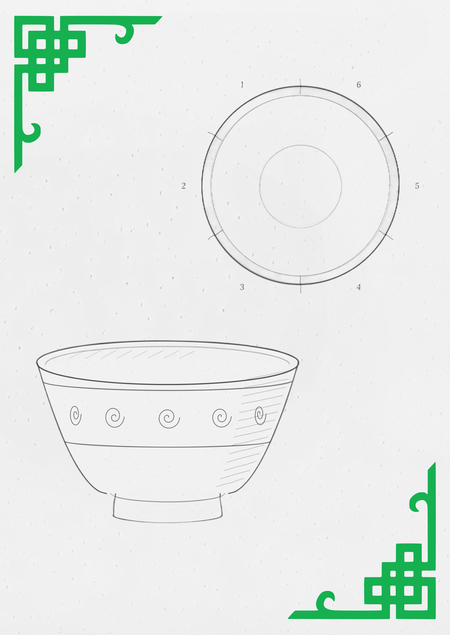
Form: A cup without a handle set on a low saucer; the walls gently flare outward toward the top. The form draws inspiration from traditional Buryat pottery while giving it a contemporary edge.Dimensions after firing:
— Height: approximately 7 cm (with saucer)
— Rim diameter: approximately 12 cm
— Saucer: diameter approximately 5 cm, height approximately 1 cm
— Wall thickness: 5–6 mm
— Volume: approximately 250–300 mlThe initial piece should be approximately 10% larger to account for shrinkage: height approximately 8 cm, diameter approximately 13.5 cm.Ornamentation: Six sections encircled around the exterior of the cup.
Hand sketch of the form and ornaments
Technical sketch with dimensions
Material and Technology
Clay Body: Schneider, white stoneware clay, high-fire, fired at 1250 °C.Why this clay:
— After firing at 1250 °C, the ware is dense and barely absorbs water. This makes it suitable for everyday tableware;
— The white color of the clay allows glaze colors to remain clean and vibrant.Forming: Hand-built from a lump (pinch pot technique).Glazing: Fully glazed, food-safe inside, high-fire, suitable for up to 1250 °C.
What’s Next (Module 2)
Molding the bowl from a lump → drying → marking six sections → hand-sculpting the relief → attaching the tray base → slow drying → bisque firing → glazing → glaze firing → photoshoot → final longread.