Navigation
1. Concept 2. Superfluous (Suprematism) 3. Geometric Networks and Architectural Utopia (Constructivism) 4. Spatial Form (Proun) 5. Conclusion 6. Information Sources
Concept
Constructivism, Suprematism, and Proun emerged in the early 20th century and established the core principles that continue to influence contemporary art. The primary focus centers on geometric abstraction, spatial thinking, and utopian ideals. Every artist, in one way or another, engages with the Russian avant-garde—specifically Constructivism, Suprematism, and Proun—but reinterprets these movements to transform their work to address what society is currently concerned with and what it needs.
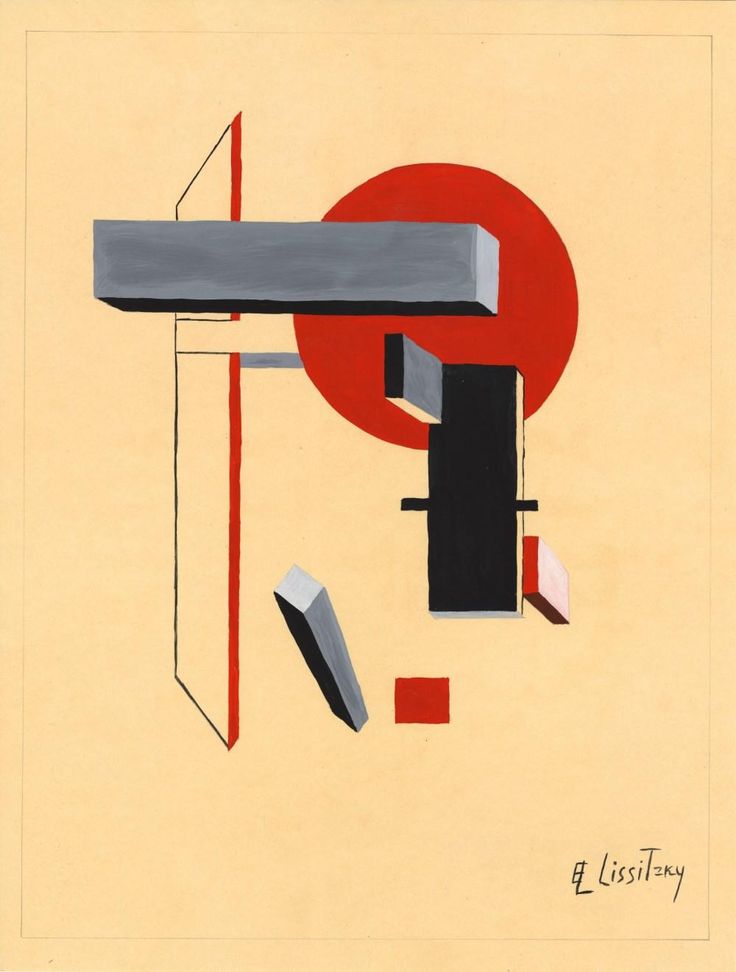
Kazimir Malevich, the founder of Suprematism, created a revolutionary approach to art based on pure abstraction and the use of basic geometric forms. His famous works demonstrated a rejection of representational art in favor of pure artistic sensibility. El Lissitzky, who worked at the intersection of Suprematism and Constructivism, created the «Proun» series, which unified architecture and painting, thereby forming a different spatial perception. In both cases, form detaches itself from materiality and begins to exist as a separate visual language, revealing a new reality and a radical view of space. Constructivism, in turn (specifically, I will discuss Tatlin’s «Tower III of the International» project and some works by Yakov Chernikov further), presents a utopian world in art: art must exist in life, in the city, in the future.
Contemporary artists and architects have managed to develop this kind of vision in our digital and immersive environments. They base their work on generative algorithms, the use of light, data, and architectural forms that interact with the viewer in some way. Visually, they often draw from the same structures as the avant-garde, yet they augment these with a bodily and interactive experience—meaning the ideas of «living in art» and «rebuilding the world» are brought into real life. My visual research concept is to demonstrate how Russian avant-garde has influenced contemporary art, specifically in digital and immersive architecture. I want to show what some contemporary artists reference when creating their works and how they adapt avant-garde ideas to modern realities. I also aim to draw attention to the spatial thinking and utopian aspirations of artists who transform the surrounding world through digital technologies. I have divided each chapter into themes where I drew parallels between Russian avant-garde figures and contemporary artists. Every artist mentioned utilizes the style and ideas of the avant-garde in some way, thereby creating a new vision of art in the modern world.
All the excess (Suprematism)
Kasimir Malevich’s «Black Square» caused a sensation, becoming a symbol of the break from the traditional understanding of art. This work initiated a new aesthetic—art detached from the objective world.
By reducing the image to a «zero form”—to pure geometry, color, and the canvas space—he rejected the conventional depiction of reality. Kasimir Malevich „challenged“ the established canon of painting, which held that people received information solely through visuals.
By rendering reality in a different manner, the artist dismantled long-held notions of art, compelling the viewer not merely to look at the painting, but to engage with it and become „a part of it.“
Black Suprematist Square. 1915. GTG
«Black Square» became an «icon of a new era» and was presented at the famous avant-garde exhibition «0,10» in the «red corner» as an icon of the new age. In addition, paintings such as «Red Square,» «Black Cross,» «Suprematism: Pictorial Realism of a Football Player (Color Masses in the Fourth Dimension),» «Black Circle,» and others were shown. His works, as well as the works of other artists, demonstrated that the connection with past art was breaking, and a new vision of the surrounding world was taking its place. People must abandon formal thinking and traditional painting and move toward abstract forms—toward art independent of the object world.
A corner featuring Kazimir Malevich’s works, with «Black Square» in the corner. Exhibition «0.10.» 1915
Kazimir Malevich Black Square. 1915
Kazimir Malevich. Black Square. 1915.
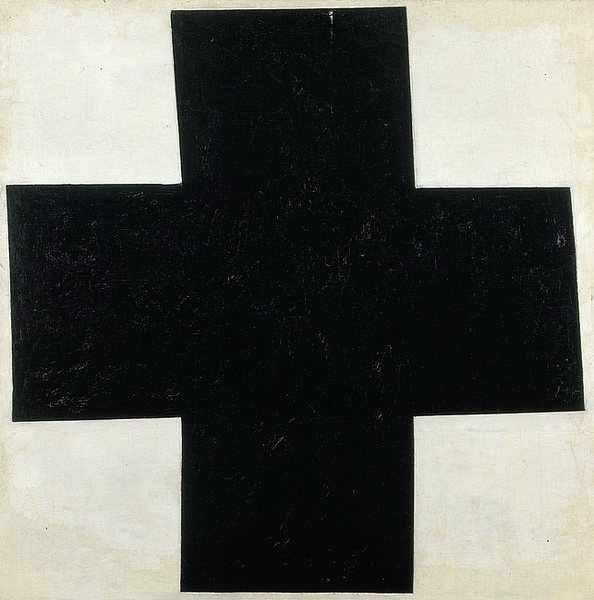
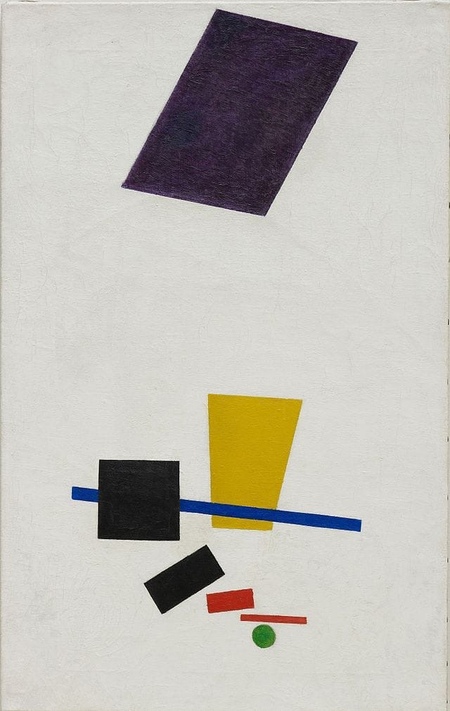
K.S. Malevich Black Cross. 1915// Kazimir Malevich «Suprematism. Painterly Realism of a Futbol Player, Colorful Masses in the 4th Dimension» 1915
When comparing him to contemporary artists, I want to highlight Olafur Eliasson. His installations are designed to affect the viewer, placing them inside the form. Each of his spaces is constructed from pure lines, light, and rhythm, allowing observers to become part of the composition and «interact» within it.
Room for One Color
Room for One Color, 1997 Malmö Konsthall, Sweden, 2005 Photo: Jens Ziehe
Olaf Eliasson notes that monochromatic light compels the viewer to recognize—that the perception of reality is determined by sensory organs, not by objective reality. It elicits an emotional response in people who visit the installation. The longer visitors remain in the space, the better they begin to perceive the colors and shades of the surrounding light. After leaving, for a moment, they retain a «bluish afterimage.» By altering the lighting conditions, he changes how the viewer perceives the world once they are inside the installation.
Room for One Color, 1997 21st Century Museum of Contemporary Art, Kanazawa, Japan, 2009 Photo: Studio Olafur Eliasson
Room for One Color, 1997 PinchukArtCentre, Kyiv, 2011 Photo: Dmitry Baranov
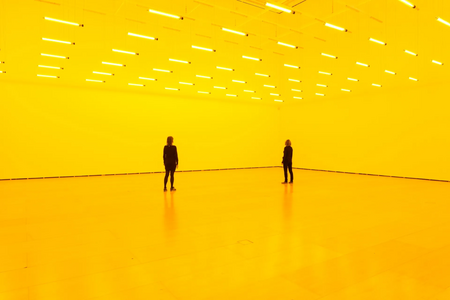
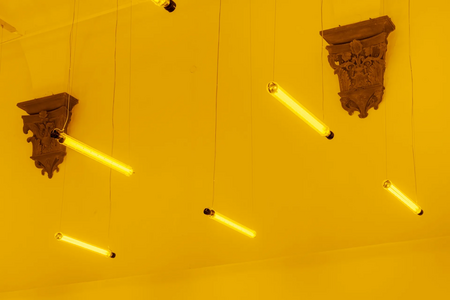
Room for one color, 1997 Guggenheim Museum Bilbao — 2020 Photo: Erika Ede // Room for one color, 1997 Fondazione Palazzo Strozzi, Florence — 2022 Photo: Ela Bialkowska, OKNO Studio. Courtesy Fondazio
Your Uncertain Shadow
Your Uncertain Shadow (Color), 2010 Martin-Gropius-Bau, Berlin, 2010 Photo: Jens Ziehe
Another installation by Olaf Eliassson, which incorporates five colored spotlights and the use of a white wall. This work is similarly geared toward viewer interaction. When a visitor enters the space, their projected shadow—overlapping each color light from a different angle—appears on the wall as an array of five differently colored silhouettes. The shadow in this installation is something mutable, dependent on the circumstances, prompting the viewer to consider the multiplicity of identity and the subjectivity of perception.
Your Uncertain Shadow (Color), 2010 Prince Eugene of Savoy Winter Palace, Vienna, 2015 Photo: Anders Sune Berg
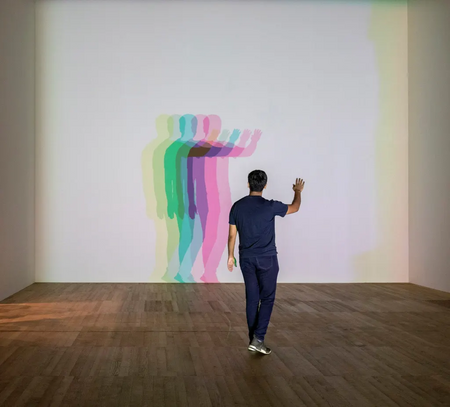
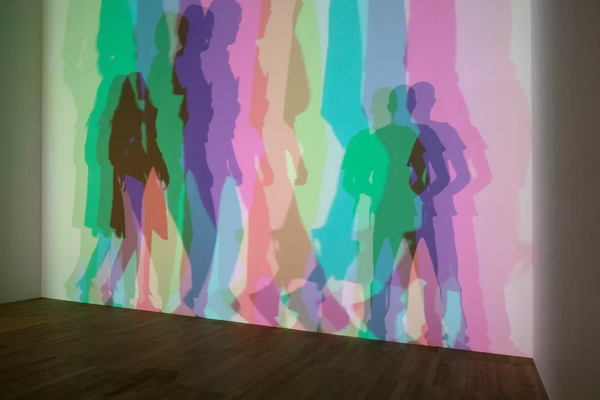
Your Uncertain Shadow (Colour), 2010 Tate Modern, London — 2019 Photo: Anders Sune Berg // Your Uncertain Shadow (Colour), 2010 Tate Modern, London — 2019 Photo: Anders Sune Berg
Geometric Networks and Architectural Utopia (Constructivism)
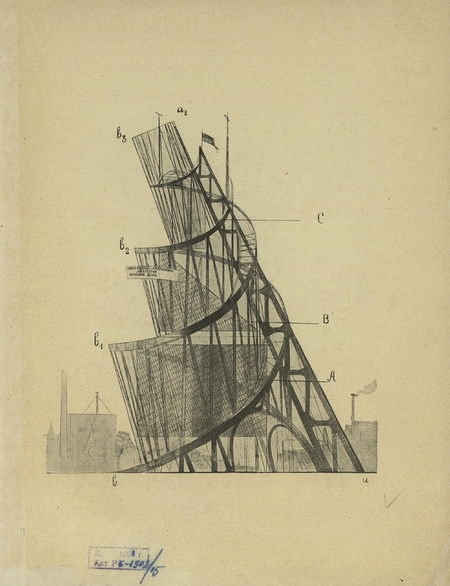
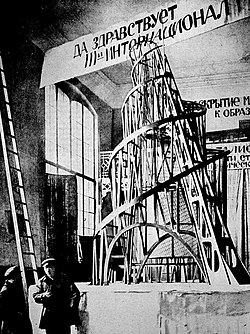
Monument to the Third International. 1919 // Vladimir Tatlin and the model of his Monument to the Third International, 1920
Unlike artists of previous eras, Vladimir Tatlin did not strive to create beautiful images; rather, he developed functional, material objects that could serve society. He believed that art should leave the museums and become part of daily life. He was the one who laid the foundations for a movement such as Constructivism.
One example is the Monument to the Third International. It was not merely a monument, but a functional structure of glass and steel, where every component served a practical purpose. This edifice symbolized a new industrial and revolutionary society. The tower’s spiral form represented forward motion and the ascent toward a bright, new future.