Concept
Images no longer necessarily prove reality.
For a long time, photography was intrinsically linked to reality. To capture a photograph, a physical object—a person, a place, an item, or an event—had to be in front of the camera.
Generative artificial intelligence is changing this sequence.
Today, an image can appear before the object it represents. It is possible to create a face of a person who never existed, a photograph of a non-existent location, a reconstruction of an event that did not occur, or an object that cannot be produced physically.
Consequently, the image ceases to be solely a means of recording the surrounding world.
It becomes an independent object—one that can be created, altered, copied, distributed, and interpreted irrespective of physical reality.
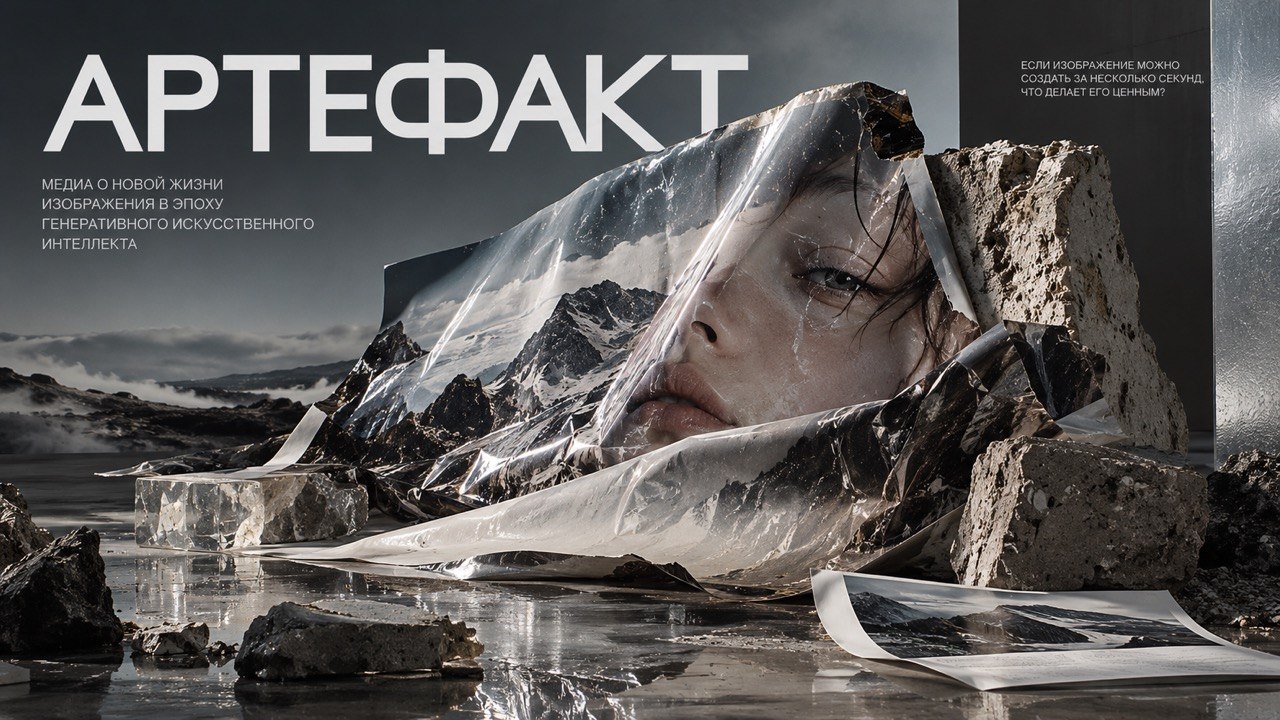
ARTEFACT is a media platform exploring the new nature of the image and how generative AI is transforming our perceptions of reality, authorship, originality, and visual evidence.
Core Idea
Previously, the object existed first, and then its image appeared. Today, the image can appear first.
Problem
We are accustomed to trusting images faster than we verify them.
An image possesses a unique persuasiveness. We process a photograph more quickly than text, and we often perceive it as evidence that something actually happened.
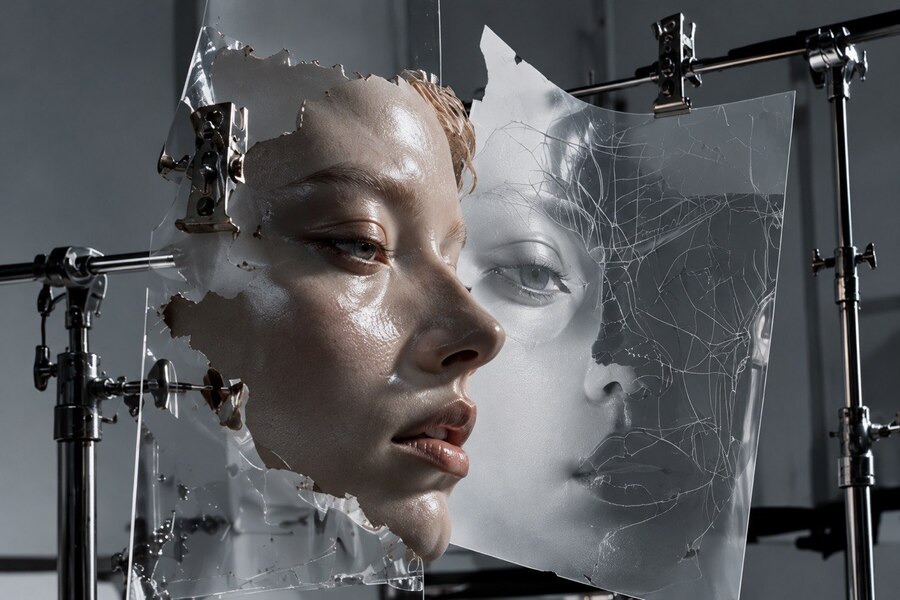
Generative models are blurring this relationship. A modern image can appear documentary even if no physical event occurred to support it.
But the problem isn’t limited to fakes. The very culture of image production is changing.
A photographer no longer needs to be present in a specific location. For an advertising campaign, it is not necessary to create a physical object. A model can be virtual. An archive can contain images of events that never took place.
We are transitioning from a world where an image captures reality to a world where an image generates possible reality.
The media question is this:
If an image no longer guarantees the existence of what is depicted, what exactly do we trust when we look at it?
Media Goal
Making visual literacy a part of interacting with artificial intelligence.
The goal of ARTEFACT is to help individuals understand the new nature of imagery and consciously perceive visual content created with generative technologies.
The media should enable the reader to:
— understand how an AI image is created and what stages lead to its emergence; — recognize visual signs of synthetic imagery; — differentiate between documentary photography and visual reconstruction; — grasp why artificial imagery might be perceived as real; — explore the impact of AI on photography, fashion, advertising, design, and art; — re-evaluate the concepts of original, copy, authorship, and evidence; — learn to perceive an image not merely as a picture, but as a cultural object.
The value of the media is that one does not need to search for information on neural networks, photography, visual culture, and authorship separately—ARTEFACT gathers all of this around one object: the image.
Segment and Niche Topic
Segment: Educational digital media concerning visual culture, technology, and contemporary design.Intersection:
AI × Visual Culture × Design × MediaArtifact Focus Topic:
Generative imagery and its impact on the perception of reality.This media is not an encyclopedia of neural networks, nor does it teach the use of specific tools. Its focus is the image itself: how it is created, why it appears real, what happens to it after publication, and how its cultural value changes.Core Areas:— AI Photography
— Virtual Humans and Models
— Synthetic Advertising
— Generative Fashion
— Non-existent Spaces
— Artificial Archives
— AI in Contemporary Art
— Visual Errors and Artifacts
— Authorship and Originality
— Transforming Digital Imagery into Physical ObjectsProject Formula:The objective is not to study AI for AI’s sake—it is to study what AI has done to the image.
Editorial System
To prevent media from becoming a collection of random AI materials, all content is structured around six core themes.
01 — SYNTHESIS How an AI image comes to be: from an idea and a text prompt to a finished visual result. Material example: «Why does a neural network create a convincing face if that person never existed?»
02 — EVIDENCE The boundary between a photograph as testimony and an image as simulation. Example: «What makes a photograph convincing today?»
03 — DOUBLE Comparing a physical object with its artificial interpretation. Example: «A real model versus its AI version: what do we perceive as genuine?»
04 — ARCHIVE Visual evidence of events, places, and people that have never existed. Example: «The archive of a city that never was.»
05 — ARTIFACT What happens when a digital image transcends the screen and becomes a physical object. Example: «Can an object that exists only within a neural network be made tangible?»
06 — AFTER The life of an image after publication: copying, alteration, remixing, and the loss of original context. Example: «What happens to an image once it has no original?»
System Logic: Image × Technology × Reality.
Editorial Logic
To prevent the six disciplines from existing in isolation, each material examines a single image from various perspectives.
The Formula:
IMAGE × TECHNOLOGY × REALITY
For example, we take a virtual model created by generative AI:
SYNTHESIS → How the neural network creates its face EVIDENCE → Why we perceive this face as real TWIN → How the virtual model differs from a real human ARCHIVE → Can we create a convincing «biography» for it? ARTIFACT → How to use its image in advertising or fashion AFTERMATH → What happens to this image after publication and reproduction?
Thus, ARTIFACT does not become an encyclopedia of technologies. One visual object becomes an entry point into diverse questions about reality, authorship, and image culture.
Competitor Analysis
We examine not only projects directly about AI but also media that intersect design, photography, art, and technology.
Analysis Criteria:
- Positioning — what the project is about and who it exists for.
- Thematic Scope — what issues it addresses.
- Platform — website, Telegram, social media, digital platforms.
- Formats — news, articles, research, visual narratives, reviews.
- Visual Language — how the project works with imagery.
- Tone of Voice — how complex or accessible the language is.
- User Value — why the audience should return to this media.
- Unoccupied Niche — what is still missing among existing projects.
The Main Question of Analysis:
If there are already many media outlets about technology and many media outlets about visual culture—what is missing between them?
Direct Competitors
Indirect Competitors
What matters to ARTEFACT:
These projects demonstrate three distinct ways to engage with a complex topic:
GOOD ON YOU → explaining a system RBC STYLE → exploring cultural context ROSKACHESTVO → testing and proving
ARTEFACT unites these approaches around a different object—the image.
It is not simply about showing an image. It is about explaining why we believe it.
Potential Competitors
These are projects that don’t currently occupy the same niche but have the potential to enter it because they already possess an audience, the necessary technologies, or the infrastructure for working with imagery.
CONCLUSION
Potential competitors possess either technology, an audience, or visual infrastructure.
But they lack a singular, cohesive specialization:
investigating the image as an independent object of culture in the era of generative AI.
This is precisely the unique niche of ARTEFACT.
Competitive Analysis Findings