INDEX
Concept
Historical Context
Categories of Technological Relics
Artistic Strategies
Interpretations of a Ruined Future
Conclusion
00. RESEARCH CONCEPT
The phenomenon of the «ruined future» holds a significant place in science fiction. Images of broken technologies, which once symbolized progress but now exist as fragments, often become a metaphor for modernity. Through these imagined ruins of what is to come, authors invite us to view our present and its anxieties from a new perspective—as if the future has already happened and had time to decay, leaving behind traces that can be studied as artifacts. Motifs of decay help us contemplate the passage of time: how it operates, what it erases, and how the future is inscribed in the present.
Traditionally, science fiction depicts human expansion and infinite progress; however, the aesthetics of a ruined future offer a different perspective.
It showcases moments when complex systems cease to function, when technologies become vulnerable, forgotten, or consumed by time. Through these images, science fiction forms a distinct space for reflection—on the fragility of reality, the illusion of stability, and the cyclicity of growth and decay.
This study compiles visual representations of the future and its technologies that have been abandoned, ruined, or exist as peculiar «technological artifacts.» It examines not only books and literature but also cinema, animation, video games, and illustrations from various countries—from Japan to the USSR and European cultures. This broad range of sources allows for tracing how universal motifs of a ruined future manifest across different visual traditions. Using the works of various creators as examples, it will explore why science fiction writers so frequently depict the future as already past, and how visual language captures this paradox by transforming illusory constructs of what is to come into tangible traces.

Andrew Stanton, «WALL•E, ” 2008
It is hypothesized that depictions of ruined technologies in science fiction serve not only as visual details of the future world but also as reflections of social anxieties, cultural expectations, and the contemplation of the passage of time.
The research structure consists of four main chapters (not including the introduction and conclusions). The first chapter is devoted to the historical context of the emergence of technological decay imagery. Subsequently, using examples from literature, film, games, and illustration, various categories of «technological relics» will be examined: ruined megastructures, debris from space stations, deformed infrastructure, and visual narratives depicting the collision of nature with artificial future systems.
Following an analysis of these areas, a separate chapter will address artistic strategies—how authors portray the decline of technology, what techniques they employ, what they show explicitly versus what they leave off-screen, and how the visual language evokes a sense of time passed through the structure.
The final chapter will present interpretations explaining why humanity feels the need to envision a ruined future. This chapter explores the fear of uncontrollable progress; the transformation of future technologies into a threat or a reminder of our own limitations; the theme of the acceleration of time and the impossibility of «catching up» to build a perfect future; ecological pessimism and technological ruins as a warning about the fragility of our civilization; as well as the phenomenon of nostalgia for a future that was promised but never realized. These interpretations allow one to see in the ruined future not only a frightening picture of collapse but also humanity’s attempt to make sense of its own expectations and anxieties.
Thus, examining the traces of the future through visual imagery of ruined technologies in science fiction allows one not only to gather key visual examples and highlight the aesthetic features of the «technological ruin» motif but also to understand the social fears, doubts, and hopes hidden behind the theme of decay.
This turns a broken future from merely a stylistic choice into a reflection of the collective experience, anxieties, and aspirations of modern humanity.
01. HISTORICAL CONTEXT
Science fiction has always reflected not only the technological achievements of its time but also the cultural and social sentiments of that era. The history of destroyed future imagery is closely intertwined with historical events, shifts in the perception of progress, and the acceleration of technological cycles. Visual representations of the future have evolved from the optimistic and high-tech visions of retrofuturism to post-apocalyptic landscapes, where progress appears illusory, and technology—is vulnerable and temporary.
01.01. Retrofuturism — optimistic and technological
During the period from the late 19th century to the mid-20th century, the future was depicted as a space of infinite progress. Illustrators and artists, such as David A. Hardy and Chris Foss, created vibrant, detailed cities featuring flying cars, automated homes, and space stations. These images emphasized a belief in technological optimism: progress was viewed as a tool for societal refinement, and science and technology were symbols of hope. In retrofuturism, the decay and obsolescence of technology were virtually nonexistent, as the future was imagined as perfect and dynamically advancing.
David A. Hardy, «For Marshall Cavendish, ” 1984
Chris Fros, «The Culture of the Übermensch, ” 1972
February 1st «The Death of Progress»
After the 1970s, attitudes toward technological progress and visions of the future in science fiction changed dramatically. This shift was tied to a series of historical, political, and social events that shaped the mass consciousness.
The Cold War was one of the key factors: the constant threat of nuclear conflict and the arms race created a sense that technological progress could turn into catastrophe. Nuclear weapon tests, incidents like accidents at nuclear facilities, and tension between superpowers fostered a feeling that scientific advancements do not necessarily lead to an improved quality of life—they could destroy civilization.
During this same period, ecological and energy crises unfolded: the 1973 oil shock, the first major reports on the threat of global warming, pollution, and resource depletion. Depictions of the future began to incorporate the planet’s finite nature and the fragility of civilization. Futurists and artists recognized that progress is not infinite, and its consequences could be devastating.
The historical context also included post-war technologies and industrial remnants: abandoned industrial complexes, stations, and atomic sites built in the 1950s and 1960s that were already partially obsolete by the 1970s. These sites transformed into visual symbols of the finiteness of progress and technological decay.
In artistic representations, this era manifests through post-apocalyptic cities, ruined megastructures, and deserted space stations. The theme of «the death of progress» becomes central: technology ceases to be a guarantee of happiness and stability; instead, it can become obsolete, fall apart, or pose a threat.
«Akira, ” Neo-Tokyo Destruction, 1987
03/01. Accelerated obsolescence of real technologies
At the turn of the 20th century, the acceleration of technological cycles became a key factor influencing visions of the future. New developments rapidly replace old ones, and obsolete technologies turn into «relics, ” vividly demonstrating the impermanence of progress. In science fiction, this is expressed through imagery of abandoned stations, broken robots, outdated interfaces, and machines that once seemed cutting-edge. Such motifs illustrate that technological progress simultaneously creates new things while leaving traces of the past that shape a distinct aesthetic of a ruined future.
02. CATEGORIES OF TECHNOLOGICAL RELICS
In science fiction, images of ruined technologies and abandoned structures can be classified into several categories. Each category reflects different aspects of the interaction between humanity, technology, and time—ranging from large-scale engineering feats to forgotten devices and systems that were once considered cutting-edge. Analyzing these categories helps us understand the visual and conceptual strategies authors employ to depict the decay, obsolescence, and degradation of the technological world.
02.01. Ruinous megastructures and infrastructure
This category includes giant structures of the future: tower cities, domed complexes, orbital elevators, and industrial zones. Visual representations of these constructions illustrate how massive technological achievements can become obsolete, deteriorate, or be abandoned. They serve as a symbol of technological grandeur and, simultaneously, their vulnerability to the passage of time, social shifts, and environmental change.
Jean Miro (Mobius), «Planet, ” 1970s. Planetary infrastructure is in the process of decay.
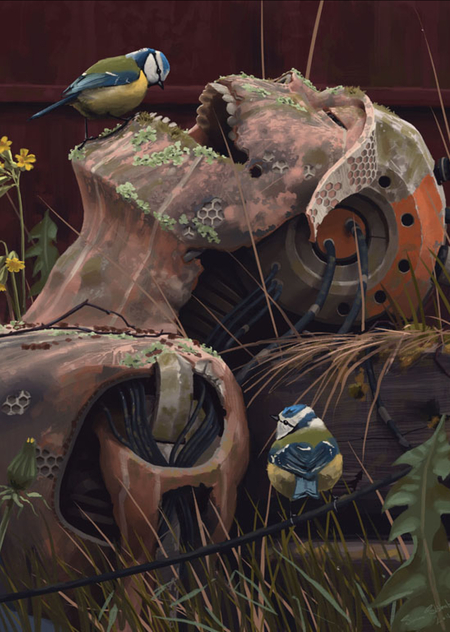
Simon Stelenhag, «Stories from the Series, ” 2014
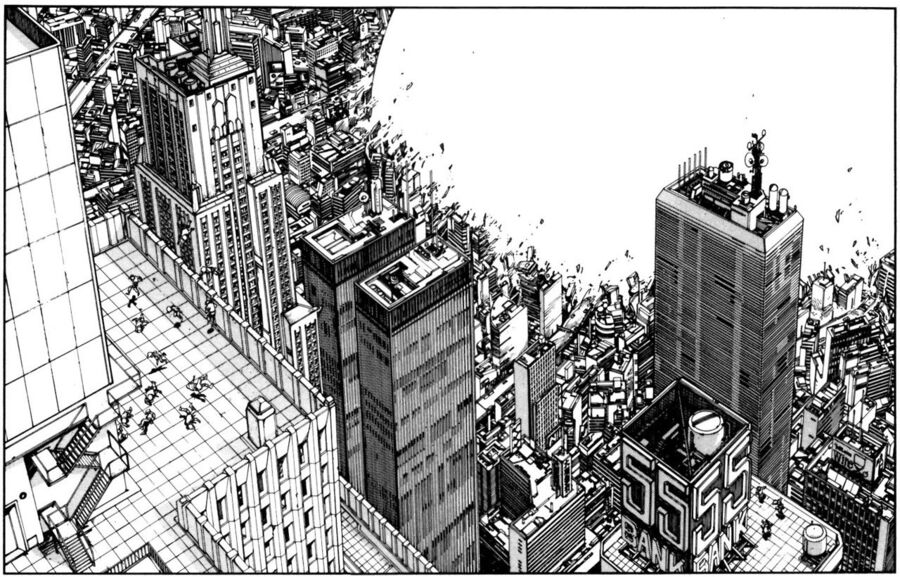

Katsuhiro Otomo, «Akira,» The Destruction of Neo-Tokyo, 1982
02.02. Space stations and debris
The cosmic sphere in science fiction often becomes a setting for displaying ruin: abandoned orbital stations, remnants of research vessels, or destroyed bases on the Moon or Mars. These objects visually emphasize the isolation of technology, its fragility and finite nature, while also evoking a sense of emptiness and the passage of time across the structure.