Sections:
- Concept
- Early Parisian Period
- The Golden Age of Art Nouveau
- Use of Photography
- American Period and Pedagogy
- Late Period
- Conclusion
Concept
The creativity of Czech artist Alphonse Mucha became the quintessence of the Art Nouveau (Modern) style, and his female figures, known as La Femme Muchas, forged a unique visual canon of beauty at the turn of the 19th and 20th centuries.
Mucha was one of the first to realize that to sell a product, you must sell an image. By examining his approach to the human form, we will study the origins of modern advertising and the standards of beauty found in glossy media. He transformed woman into the era’s primary visual trigger.
The evolution of female figures in the work of Alphonse Mucha represents not merely a shift in artistic preferences, but a continuous transformation in the understanding of female anatomy as a plastic tool—one that adapted to changing demands, from commercial graphics to national epic narratives.
The relevance of this work stems from the necessity of tracing how technical techniques of body deformation and stylization within the Art Nouveau movement laid the foundation for contemporary visual language. The central hypothesis proposes that the «Moth Woman» evolved from a realistic biological entity into a decorative schema, and subsequently into a monumental symbol.
As part of the first section of my research, I will analyze the artist’s early illustrative cycles, where the anatomical construction of figures strictly adheres to nineteenth-century academic canons, and compare them to the turning point of the emergence of the poster style, when natural proportions begin to be intentionally distorted to achieve decorative rhythm. I particularly wish to focus on the methodology of analyzing the «whip line» and the S-curve, which in the mid-1890s began to dictate a specific—often anatomically impossible but aesthetically flawless—pose for the heroine’s body, transforming the woman into the central element of an ornamental composition. I plan to examine in detail how Mucha justifies his departure from deep chiaroscuro modeling in favor of contour line in his works, and how this decision affects the perception of female corporeality, rendering it flat and iconic, much like a Byzantine icon or stained glass.
A significant research vector will also be identifying the connections between the use of photographic references during the Paris period and their subsequent transformation in later works, where the camera helped capture complex angles that were then subjected to intense stylization.
The second part of my work will focus on identifying the reasons for the departure from the conventional «Mukhin» canon toward a heavy, physiologically emphasized anatomy in the Slavic cycle. Here, ethereal nymphs give way to intentional figures with pronounced musculature and earthly stability, a shift that necessitates a separate comparative analysis of proportions and gesture. By comparing visual sequences from different years, I aim to prove that Mukhin’s anatomy functions as a mutable code: in his posters, it serves to attract attention and market a lifestyle, whereas in his later paintings, it becomes a vessel for historical memory and spiritual meaning.
Early Parisian Period
The early Parisian period (1887–1894) was a time of «survival» and the formation of Mucha as a professional. Before becoming an icon of Art Nouveau, he transitioned from a poor student at the Academies of Julian and Colarossi to one of Paris’s most sought-after illustrators.
In his early portraits and illustrations, Mucha emerges as a master of academic psychologism. For him at this time, women were not decorative symbols, but living individuals with character.
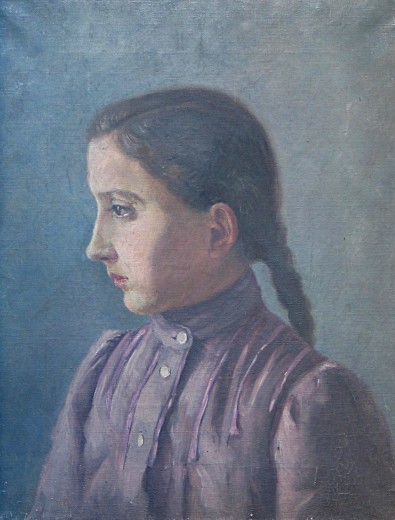
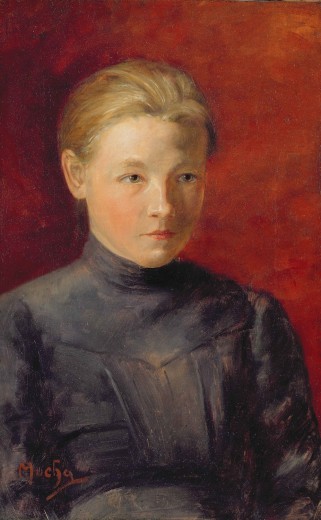
Alphonse Mucha «Portrait of Angela, Artist’s Sister» 1880 / Alphonse Mucha «Portrait of Anna, Artist’s Sister» 1885
Muha’s portraits adhere to academic precision. We can discern individual features: Anna’s subtle facial asymmetry, Angela’s specific cheekbone structure. Anatomy here is merely a biological fact.
Alphonse Mucha, «Spirit of Spring» 1894
Unlike her future, «ethereal» nymphs, the women of the early period possess real physical weight. The artist meticulously renders the bone structure and muscular definition. If the heroine is standing, we feel the support through her foot; if she is seated, the weight of her body is palpable. This is «biological» anatomy, not mere ornamentation.
The Golden Age of Art Nouveau
The period of the «Golden Age» (1895–1904) was when Alphonse Mucha established his unique visual canon, which became the defining face of an entire era. During these years, the depiction of the female form in his work underwent a radical transformation: she ceased to be a biological reality and was transformed into a decorative form.
Mouche was one of hundreds of talented but lesser-known Montmartre artists. Everything changed on Christmas Eve when Sarah Bernhardt urgently needed a poster for the play «Gismonda,» and all the in-house artists were on vacation.
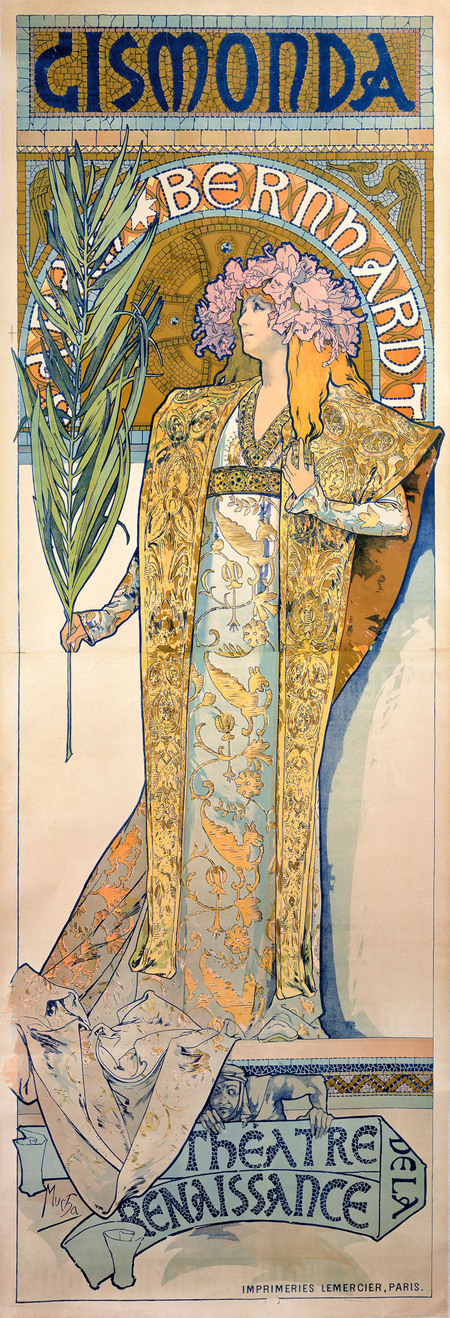
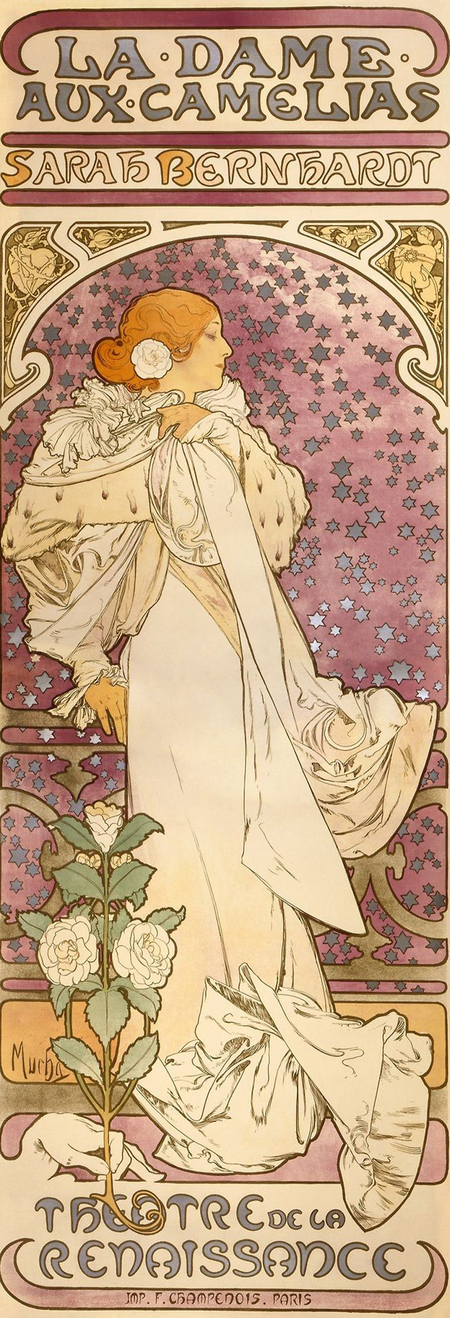
Alphonse Mucha, «Gismonda» 1894 / Alphonse Mucha, «The Lady with the Camellias» 1896
«Zhismonda» and «The Lady with the Camellias» became a point of no return for Mucha, where he ceased being merely a draftsman and became the founder of a new type of femininity. In these works, the body stops being a set of muscles and bones, transforming instead into a kind of architectural structure subordinated to the stage persona of Sarah Bernhardt. The artist chose an elongated format, lengthened the neck, stretched the limbs, and extended the garments to achieve even greater figure elongation.
Alphonse Mucha, «Lorenzaccio, ” 1896 (fragment)
The female figures of this period adhere to a flowing rhythm. The foundation of the pose is an S-curve of the spine, which art historians term the «whiplash line.» This renders the body visually supple, soft, and free of skeletal structure.
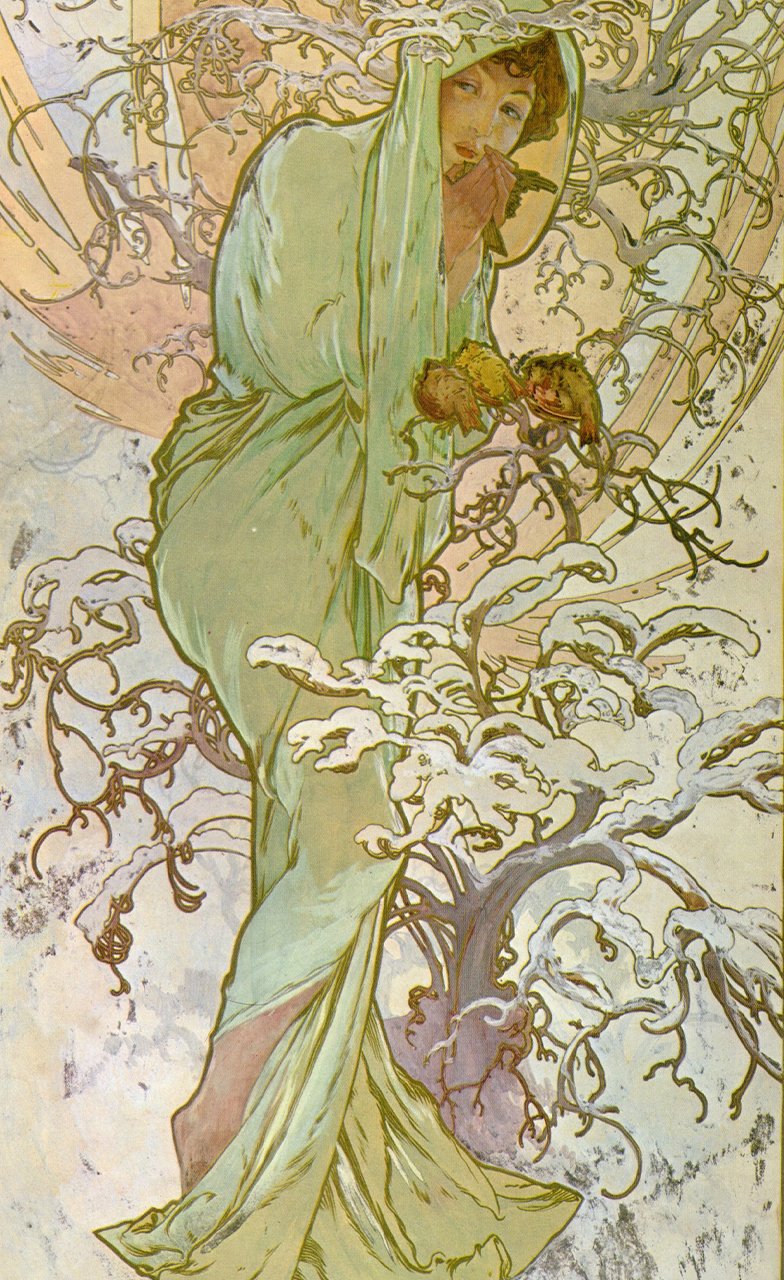
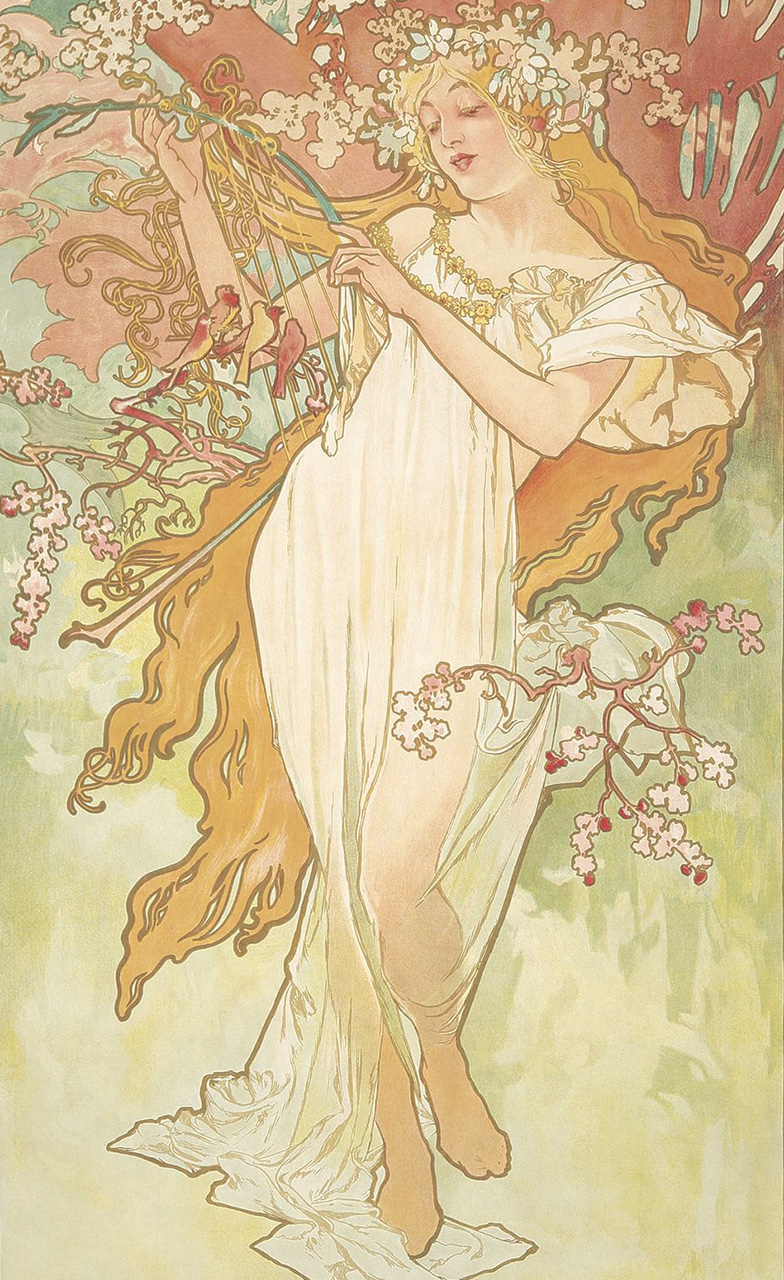
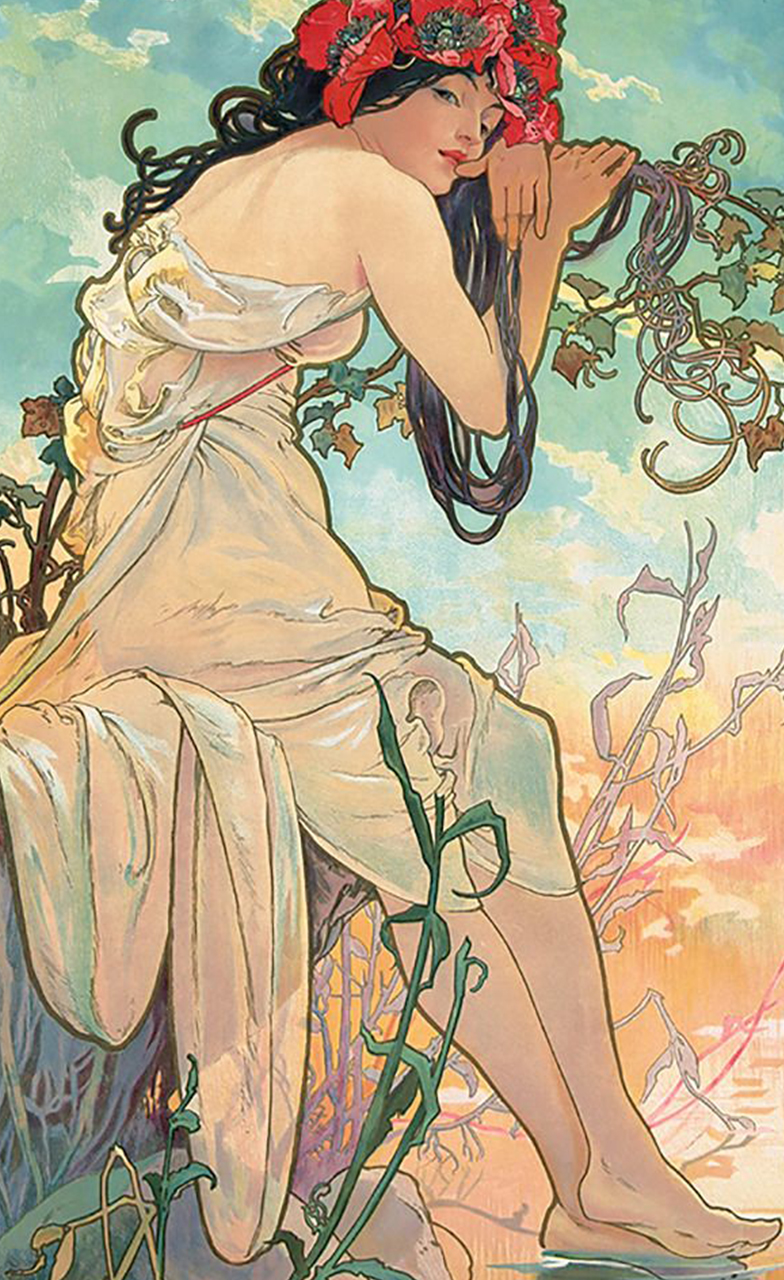
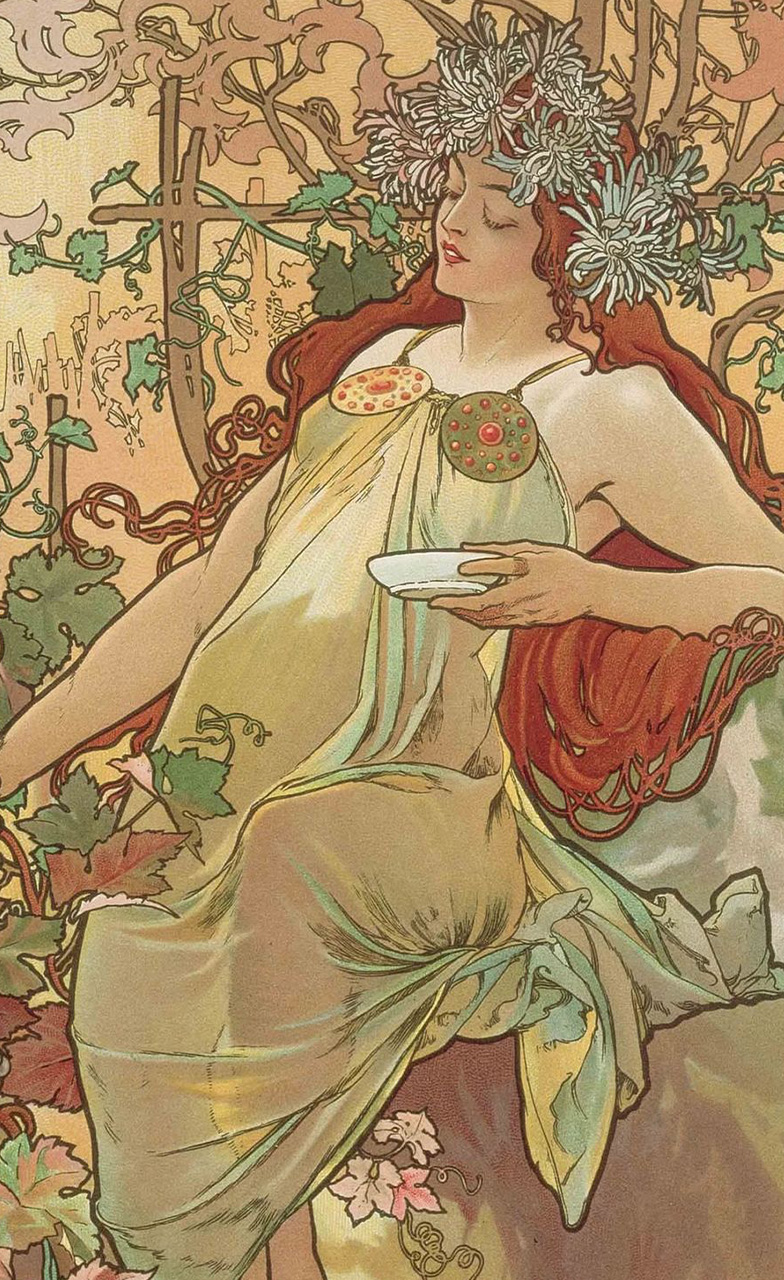
Alphonse Mucha, «The Seasons» 1996 (fragments): «Spring,» «Summer,» «Autumn,» «Winter»
The series «Seasons» profoundly influenced the formation of the style. In «Spring,» we see an emphasis on lightness and an almost delicate, girl-like fragility. The limbs appear weightless, and the pose lacks stability, underscoring awakening and ethereal quality. In the painting «Summer,» the woman becomes more languid and relaxed. The curves of the body are intentionally accentuated to evoke the midday heat, while heavy eyelids and soft lines create an image of physical abundance. In «Autumn» and «Winter,» the artist experiments with more closed, defensive poses and sharp angles; the figure «curls up, ” submitting to the cold or the cycle of decay.
The main impact of this series on Muha’s subsequent work was his ability to «incorporate» the human figure into botanical ornamentation. In these works, the woman is a stem, her hair is foliage, and her arms are flexible branches. It was here that the characteristic flowing contour line was refined—the one that flattens the body and makes it decorative, transforming it into a part of a pattern on wallpaper or stained glass. After «Seasons, ” anatomy in Muha’s works ceased to aspire to realism; it became a conveyor of mood.
Using Photography
During his time in Paris, Mucha transformed his studio into a photographic laboratory. Photography allowed him to capture complex angles and limb positions that a live model could not sustain for long: sharp turns of the head, hands raised in an exotic gesture, or a dynamic torso lean. At this stage, the camera served as a guarantee of anatomical believability, helping him avoid a «wooden» quality in the pose.
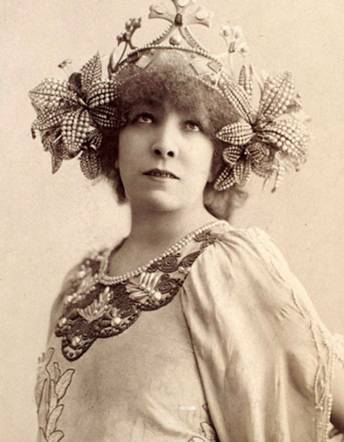
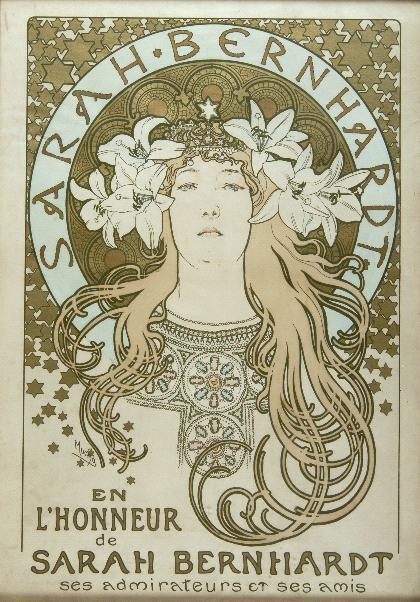
Photo of Sara Bernard, 1895 (by Alphonse Mucha) / Alphonse Mucha, «In Honor of Sara Bernard, ” 1896