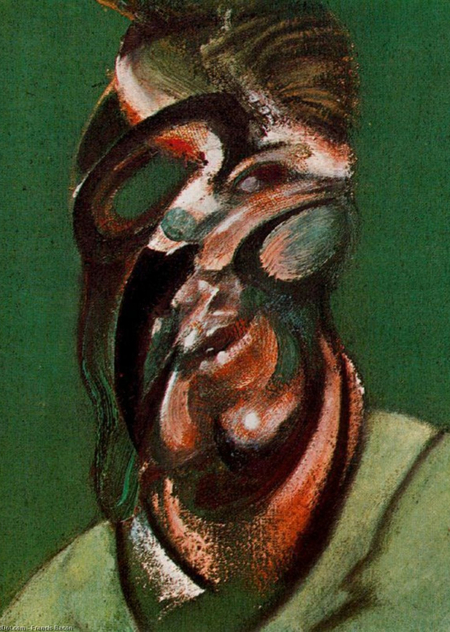
Concept
The research examines the painting of Francis Bacon, specifically his portrait series and triptychs from the 1960s and 1970s, where the artist portrays anxiety through facial distortion.
Bacon employs several techniques simultaneously: shifting facial features, blurring contours, constructing a color palette around flesh tones, and repeating the image across multiple panels. The portrait’s function changes as a result—the task of external resemblance recedes, and the focus shifts to internal states: tension, decay, and psychological instability.
In Bacon’s portraits, the face remains recognizable just enough to still be called a face. Eyes, nose, mouth, the line of the head—everything is in place, yet displaced. Contours diverge, and the surface becomes taut flesh.
This incompleteness generates anxiety: before the viewer, it is still a portrait, but already something else. The face is recognizable, but one cannot fix their gaze upon it; it seems to be continuing to disintegrate. It is within this instability that the image of a person losing their internal foundation is built.
What visual techniques does Francis Bacon use to create a sense of anxiety through facial distortion?
The question concerns the structure of the image: how the face changes within the pictorial form, how features shift, how the contour is disrupted, how the flesh tone intensifies, and how repetition in a series destabilizes the image. Anxiety is examined as a visual effect composed of the totality of the artist’s decisions—composition, perspective, brushwork, color, background, and panel sequencing.
From a unified whole to a face in a state of decay
In traditional portraiture, the face serves as the focal point of the complete human image. The gaze, nose, mouth, contour of the head, and body posture—all combine to form a recognizable structure through which personality and character are conveyed. Such a portrait strives for cohesion.
In 20th-century art, the portrait increasingly moves beyond a quiet depiction of appearance. The face becomes a site of rupture, distortion, and psychological tension. Artists begin to transmit the instability of time itself through it.
Francis Bacon works within this logic, but pushes it to its extreme. Deformation ceases to be a decorative solution in his work. The face transforms into a zone of internal pressure through which anxiety is conveyed.
The tension in Bacon’s portraits stems from the fact that the face remains recognizable. One can discern the eyes, nose, and mouth, and sometimes even the model’s individual features.
Series Format: One Subject in Three States
Francis Bacon. Three Studies for a Self-Portrait (triptych, oil on canvas, 1967)
In Bacon’s portrait series, one face is repeated in three variations. The repetition does not fix the image—each piece presents a different version of the same face, with a different head tilt, a different set of features, and a different degree of distortion. Bacon’s triptych becomes a system of states.
Francis Bacon. Three Studies for a Self-Portrait (triptych, oil on canvas, 1967). Analytical Scheme
The composition of the triptych is built as a mirror system of perspectives: the left and right panels relate to each other, while the center panel becomes the axis. However, this structure does not make the image stable. On the contrary, against the backdrop of compositional coherence, the distortion of the face is perceived even more acutely.
Francis Bacon. Three Studies for Portrait of George Dyer (triptych, oil on canvas, 1963)
The Bacon piece does not offer the viewer a single dominant image of the model. Each of the three panels presents a different version of the face: the perspective shifts, symmetry dissolves, and the form either compresses into a dense mass or elongates and disintegrates.
The portrait is assembled in the space between the panels. The viewer compares them and notices the divergence—the same individual appears each time in a different, temporal state.
Francis Bacon. Three Studies for Portrait of George Dyer (triptych, oil on canvas, 1963). Analytical Diagram
In this triptych, Bacon stages distortion as a progressive process. In the left panel, the face retains a relative integrity: the features are shifted, but the head is perceived as a single form. In the center panel, the image becomes less stable: the face blurs, and the features begin to shift and lose definition. In the right panel, the distortion reaches its limit. The face is no longer held as a cohesive portrait; the profile fractures, the features fragment, and separate parts of the head seem to drift apart, losing overall cohesion. Thus, the triptych does not present the repetition of a single face, but the gradual intensification of its dissolution.
Francis Bacon. Three Studies of Lucian Freud (triptych, oil on canvas, 1969)
In Three Studies of Lucian Freud, deformation is no longer confined to the face. The figure is constructed through the relationship between the head, posture, and space: the figure sits within a closed structure, the body is tense, and the face is incorporated into the overall rhythm of distortion.
The triptych demonstrates that Bacon’s anxiety stems from more than just distorted features. The face becomes part of a broader system—the body, the chair, the background, and the spatial frame together create a sense of isolation and internal pressure.
Francis Bacon. Three Studies of Lucian Freud (fragment, triptych, oil on canvas, 1969)
In Bacon’s triptychs, repetition functions differently than in traditional portraiture. The same person appears in multiple states: the perspective shifts, features distort, and in large compositions, the tension transfers to the body and the space around it. The triptych becomes a field of comparison. Each image is assembled differently: displacement, deformation, disintegration.
Feature Shift: How Bacon Deconstructs the Anatomical Axis of the Face
Fragments from portrait works by Francis Bacon, 1963–1976
In traditional portraiture, the face is typically constructed around an anatomical axis: the eyes relate to each other, the nose and mouth anchor the center, and the outline of the head completes the form. This structure helps the viewer perceive the face as a cohesive and stable image.
In Bacon’s portraits, the features remain recognizable, yet they cease to correspond with one another. The eyes, nose, mouth, and outline exist as if in different planes, at varying levels of displacement. The inner discordance of the face creates a sense of anxiety.
Francis Bacon. Study for Head of George Dyer (1967). Facial Feature Displacement Scheme
The face remains recognizable: the eye area, nose, mouth, and the contour of the head are still readable as parts of a human figure. However, they no longer assemble around a single anatomical axis. Features are preserved, but their connection is disrupted.
The line of the eyes tilts, the nose and mouth shift forward, and the lower part of the face moves away from the expected center. The portrait gets stuck between likeness and disintegration—the face is recognizable, but it no longer possesses a stable structure.
Francis Bacon. Self-Portrait (Autoportrait) (oil on canvas, 1971)
In European portraiture, the eyes typically become the main point of psychological contact: through a gaze, the viewer reads the model’s presence and internal state.
In this 1971 self-portrait, this center is disrupted. One eye is shifted and partially submerged in shadow; the line of the eyes does not form a stable horizontal, the right side of the face is distorted and deviates from the implied axis. The gaze fails to coalesce the face into a unified image. The portrait is recognizable, but the visual contact has dissolved. This is what creates a feeling of anxious instability.