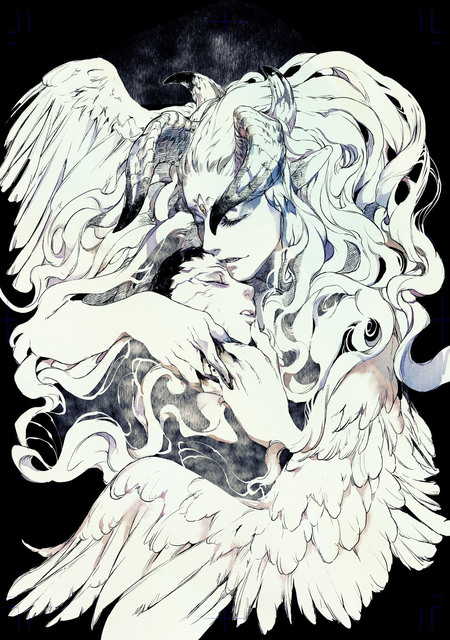
Effective character design is grounded in the narrative, possessing a logical foundation derived from the hero’s history, and it should also allow for development as the character evolves throughout the story.
Re Sumiesi, a Japanese mangaka born in 1988, completed specialized training as a game graphic designer. Thanks to his versatile education, he is an excellent concept artist who articulates the connection between the narrative of an imaginary world and character design, basing this on game scripting approaches to design preferences. Game designers are taught to logically justify every word in documentation, whether it pertains to mathematical calculations or the creative aspects.
Re Sumiesi’s thinking is global in scope—he views the comic’s plot as a whole, seeing the interconnected relationships that drive the story. This is why I find his work fascinating to follow, as it allows for deep analysis.
Since my visual research is unprecedented, I did not use any textual sources other than the original manga and the available complete Vietnamese translation throughout the project. Each of the presented character designs is unique; the figures within the crowd are even more individualistic and would require more than a single analysis. Therefore, I focused on key characters who change as the manga progresses, detailing their physical appearances, their prototypes, temporal transformations, and the narrative’s influence on their final characterization.
Can the character design of Re Sumieshi in the work MADK communicate more about the plot to the reader than the actions or dialogue? I believe that every—even the tiniest part of a character’s body—carries weight for the overall narrative, representing the character’s background or serving as a hint for fans regarding future plot twists. To provide context for this analysis, I have attached an introduction to the content of the MADK manga.
Japanese schoolboy Makoto Tachibana suffers from negative deviance. He is drawn to themes of murder, violence, and bloody scenes involving animals or people—in general, things that, when a predisposition is identified, lead «special» individuals to be isolated from society in psychiatric clinics, to avoid tragic consequences, or to attempt to turn sick fantasies into reality. The boy grows tired of living with such thoughts in his head, so he decides to summon a demon to grant his wish in exchange for his soul. Afterward, he enters the afterlife, becomes an accomplice to the most powerful Archduke Jay, and independently seizes power in hell.
Makoto Tachibana | «M» | The Man Who Became a Demon
A typical Japanese student. Living in the Heisei era, which began in 1989 and continues to the present day. The visual research shows the greatest metamorphosis and redesign specifically in Makoto.
The eyes are the mirror of the soul
When Makoto still retains his humanity, he has a surname, but after his transformation, he loses it—just as he loses his moral principles.
No resident of Hell knows where he comes from or whose son he is.
Re Sumiesy, MADK, 2017
When «M» recalls his past and the words of loved ones about his abnormality, the mangaka uses gray screentones to convey the character’s convoluted thoughts, self-doubt, and uncertainty about the possibility of a peaceful life.
Re Sumiesi, MADK, 2017
Tachibana’s gaze appears «dimmed» due to the lines around the iris, which lend it haziness. This visual technique is frequently used when depicting malevolent entities in various works. Sometimes the iris loses its color, and the character becomes a single mass.
On page 20 of Chapter 1, Makoto’s drawing is analogous to the character design of Junji Ito: lifted corners of the mouth in a self-satisfied smirk, white eye sockets without irises, and an arrogant demeanor.
Junji Ito, Junji Ito Horror Collection: Crossroad Man, 1987 Re Sumieshi, MADK, 2017
Junji Ito, Junji Ito Horror Collection: Crossroad Man, 1987
Tachibana’s eyes are in ecstasy at being allowed to be himself. In this moment, the character turns to the dark side, crossing the threshold of human identity.
Re Sumiesy, MADK, 2017
Makoto cries; his human journey is ending. He is in shock from the realization of his new identity and is ready to abandon the past. Pay attention to his eyes. They are drawn in close-up with sharp outlines for the first time, because the character has emerged from oblivion. His connection to the world of the living is severed.
Re Sumiesi, MADK, 2017
Makoto’s dark eye sockets reflect that he sold his soul to a demon.
Body Transformations
Makoto, with his dog-like body, symbolically represents his role in Jay’s life as a guardian dog.
Re Sumiesi, MADK, 2017
«M» gains a new form at Jay’s request.
The artist illustrates the initial size difference between Mako-chan and Jay to show M’s evolution into a demon—specifically, the progression of increasing size, along with the acquisition of wings and a tail.
Re Sumiesy, MADK, 2017
«Second Skin»
If you look closely, it becomes clear that Jay dressed Tachibana in the same ruffled shirt that he himself wears, which may suggest his desire to make Makoto his successor.
Jay gifts Makoto a new piece of clothing from his former mentor, whom he personally destroyed. The intention is clear: Jonathan hints at his desire to be killed by his disciple.
Re Sumiesi, MADK, 2017
«M» is dressed in Chinese attire, evoking themes of a servant to a wealthy lord or lady, or representing the stereotypical vision of the undead in China.
His status has diminished, as being an archduke’s student and a brothel worker are completely different positions.