Concept
Project Concept
«AKT» is a media outlet dedicated to documenting the evolution of contemporary theater. It features performances that push beyond the conventional stage, incorporate digital technologies, experiment with space, and transform the spectator from a passive observer into an active participant.
The focus is on immersive and interactive theater, site-specific productions, VR and AR, artificial intelligence, digital scenography, and interdisciplinary artistic projects.
«AKT» does more than just report on premieres—it explains what a specific performance offers that is new, how it is structured, and why it is changing the traditional concept of theater.
Mission
To make contemporary experimental theater accessible and engaging for a broad cultural audience, helping viewers discover new forms of stage art and consciously choose unique theatrical experiences.Objective
Launch the media outlet «ACT» on the Yandex Zen platform within six months, cultivate a stable audience, and attract at least 1,000 subscribers, maintaining an average article reach of at least 30% of the subscriber base.Plan
Month 1. November — «The Theater is No Longer a Stage»
Goal: to explain what a new theater is and to engage an audience accustomed to traditional performances.
— What is contemporary experimental theater?
— Immersive theater: why the audience ends up inside the performance.
— Interactive theater: can the audience change the plot?
— Site-specific: why perform a play in a factory or an apartment?
— Five signs that you are watching a new format performance.
— How does a performance differ from a traditional theater production.
End-of-month outcome: the reader understands the core themes of «ACT» and familiarizes themselves with its vocabulary.
Month 2: December — «The Audience Within the Action»
Audience Experience
Objective: To examine how the relationship between the public, the actor, and the performance changes.
— Why is it sometimes impossible to simply sit in a chair during a performance?
— What happens when the audience chooses their own route?
— Can the audience be considered a co-creator of the production?
— Personal boundaries in interactive theater: is participation mandatory?
— How are walking performances structured.
— Analysis of a production where the space becomes part of the narrative.
Monthly Outcome: The audience begins to perceive the spectator as an integral part of the theatrical experience.
Month 3. January — «Technologies on Stage»
Digital Theater Objective: To clearly explain the technical solutions used in contemporary performance. — VR in Theater: How a production is structured in virtual reality. — AR on Stage: What digital objects add to the physical space. — AI as a tool for the director and playwright. — Projections instead of scenery: How stage design is changing. — How sound and light can direct the audience’s attention. — Where the technological effect ends and the art begins. Monthly Outcome: The reader understands the possibilities and limitations of theatrical technologies.Month 4. February — «Theater Goes to the City»
Space
Objective: to explore new sites for theatrical performance.
— Why theaters are becoming interested in factories, apartments, and museums.
— Performance-route: the city as a theatrical stage.
— How architecture influences dramaturgy.
— Can a performance be staged in a public space?
— How the perception of history changes in a real setting.
— How artists work with found objects and urban sounds.
Monthly outcome: the audience discovers theater beyond the traditional building.
Month 5. March — «How a New Theater is Created»
People and Experiments
Goal: To reveal the inner workings of experimental projects.
— Who is working on a performance incorporating digital technologies.
— An interview with the director about searching for a new theatrical form.
— How a designer creates digital scenography.
— What happens during rehearsals for an interactive performance.
— Theater, video games, and cinema: what they borrow from each other.
— How work with errors and unpredictability on stage is managed.
Monthly Outcome: The reader sees the people behind the technology and artistic form.
Month 6. April — «The Theatre of the Future»
Summary and Development
Goal: To synthesize the phenomena studied and involve the audience in a discussion about the future of theatre.
— What might theatre look like in ten years?
— Can artificial intelligence become a full co-author of a performance?
— Which technological experiments are truly transforming the theatrical experience?
— Five projects expanding the concept of theatre.
— What a beginner should choose: a guide to contemporary theatrical formats.
— Half-year review: which new forms proved most engaging for readers.
Monthly outcome: establishing a recognizable editorial stance and a thematic base for the next season.
Publication Samples
SECTION: NEW FORMS
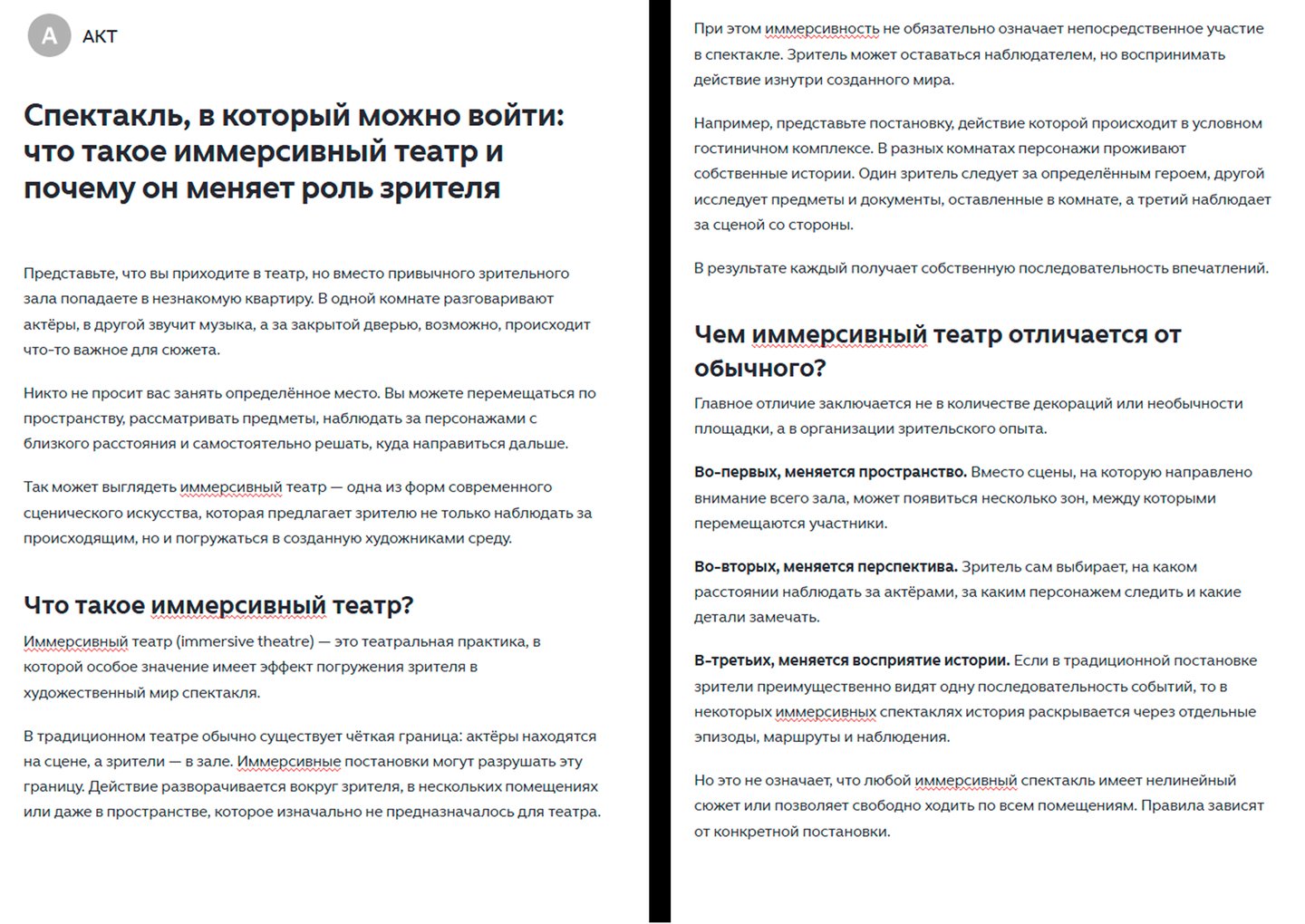
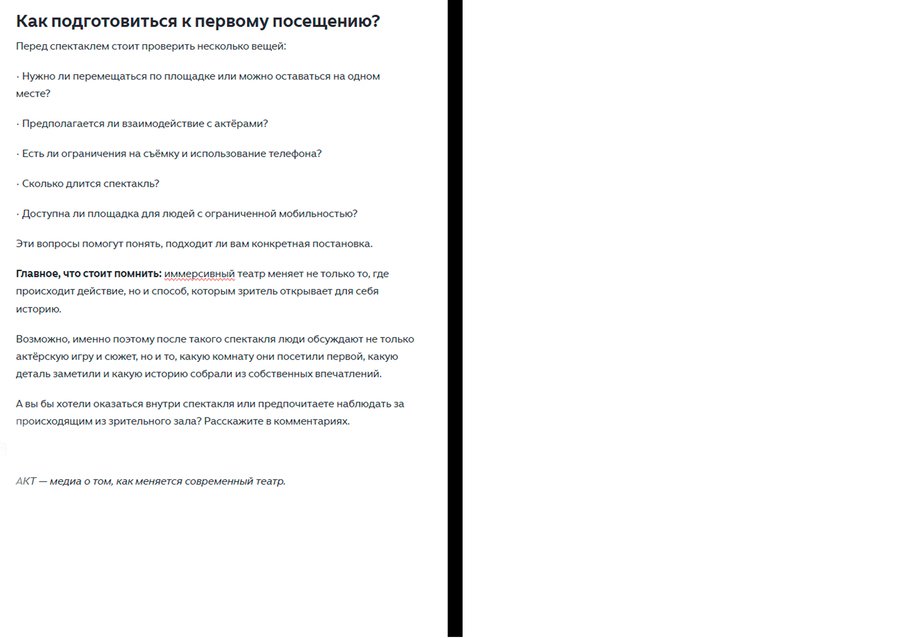
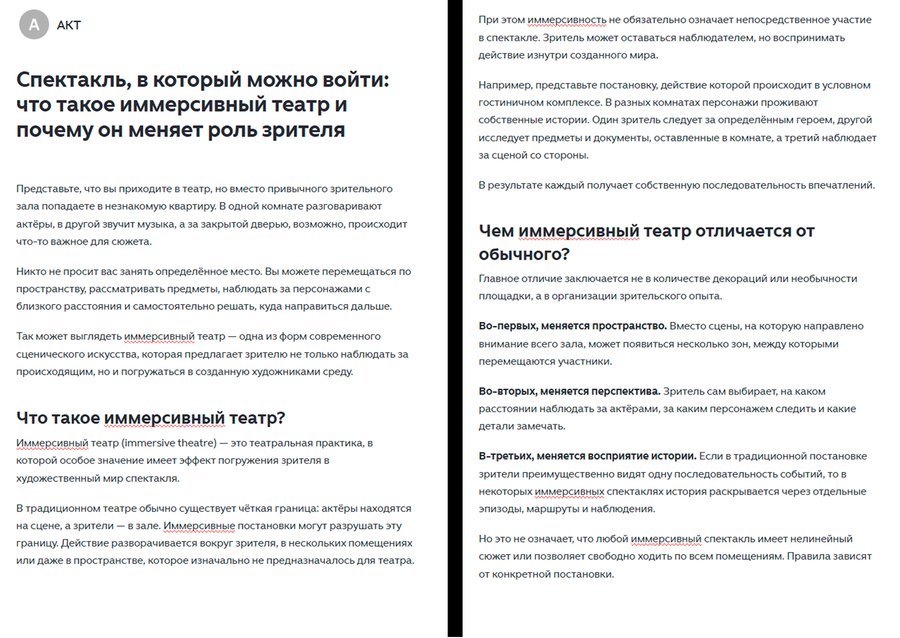
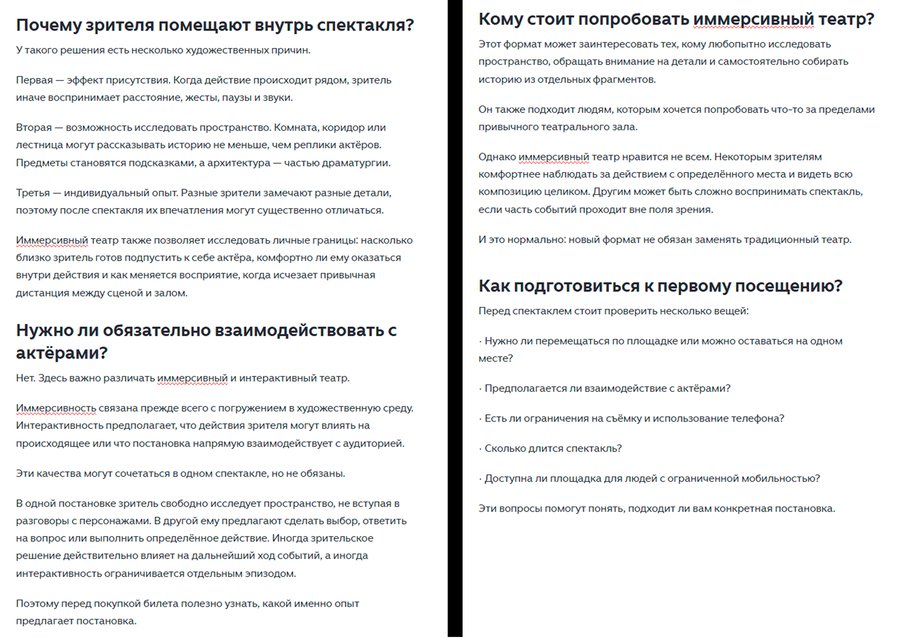
A Play You Can Enter: What is Immersive Theater and How is it Changing the Role of the Audience?
Format: longread with photographs
Goal: to introduce the audience to one of the most prominent contemporary theatrical practices.
1/3