Idea
As an artist, it is deeply distressing to watch how people’s work—work imbued with hours of labor and years of experience—is repurposed by neural networks, often violating copyright. These same neural networks are then used in advertising, which, in theory, should showcase the effort a producer puts forth to appeal to a buyer. People invest in greeting cards and hire designers and artists precisely to demonstrate that they care; they are investing in the product. Art is the most fundamentally human thing, yet in the end, it is reduced to fodder for a procedural machine.
Therefore, I do not want to appropriate artists' work for the dataset. The dataset for training the model was compiled from the AI itself—specifically, older AI dating back to 2022. It was in those models that the distinct vibe remained—something strange, artificial, and not entirely grasping reality. The aesthetics of early neural network anime are particularly captivating.
It strikes me that this fascination stems from the fact that the AI itself does not understand what it is drawing—it’s like trying to explain what a dog is to someone who has never seen one, and then asking them to draw it. The result looks familiar, but the information is incomplete, so the brain (in this case, the model) fills in the missing pieces on its own. What truly fascinates me is the concept that the neural network in this project is literally «feeding» itself—it is learning from the output of another generative model, rather than from human art.
Source images for training
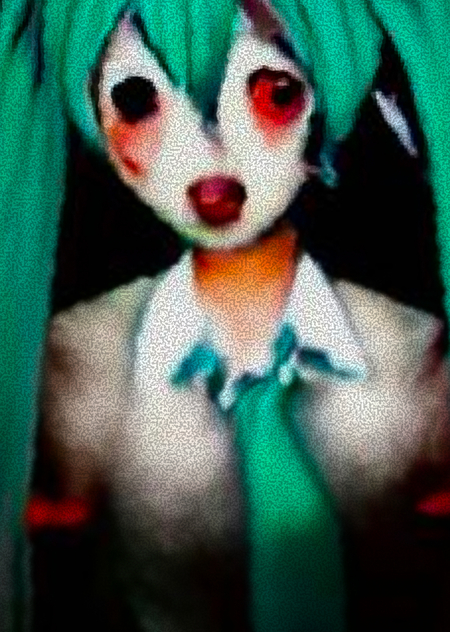
The dataset was compiled from 18 neuro-art pieces from arthub.ai (materials are dated prior to 2022) and images found via Pinterest. All images have been standardized to a square format (1:1).
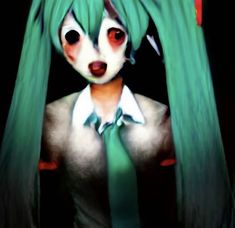
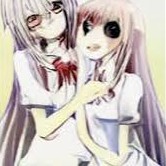
Source images from the dataset
Program Description
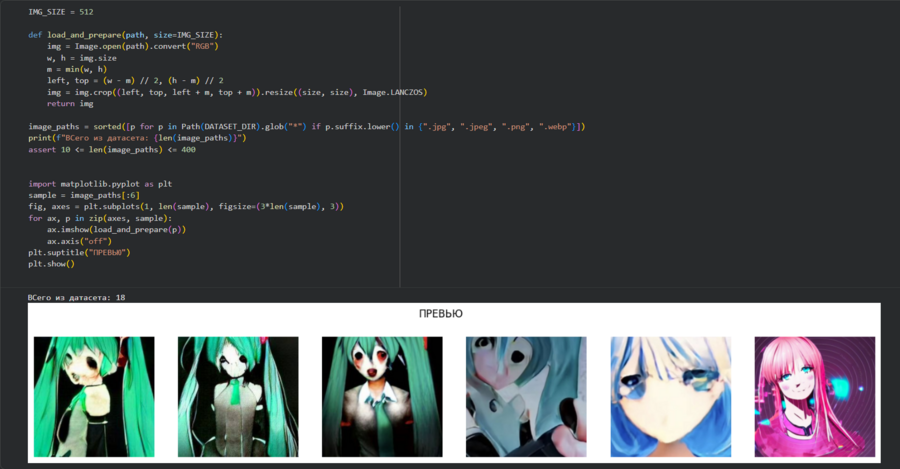
Dataset Preview
Stable Diffusion was used for training; the method involved LoRA layered over a base model tuned toward anime styling (hakurei/waifu-diffusion) so that the model did not have to learn anime from scratch using only 18 images.
Image resizing to 512×512
The first experiment using random prompts without Hakurei/Waifu-Diffusion produced poorly generated images that leaned toward realism—quite unlike the intended vision. Following this, the prompts were rewritten to explicitly call for anime aesthetics (incorporating keywords like «glitch» and «uncanny»), which successfully steered the results in the right direction.
LoRA Learning Track
Series of images obtained
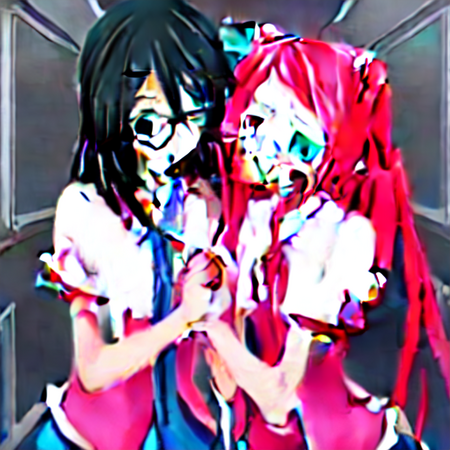
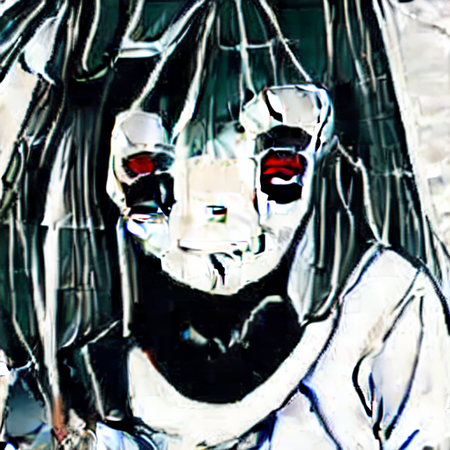
«two anime girls holding hands in a hallway, glitch artifacts» / «anime girl portrait smiling, warped face, off-eyes, eerie»
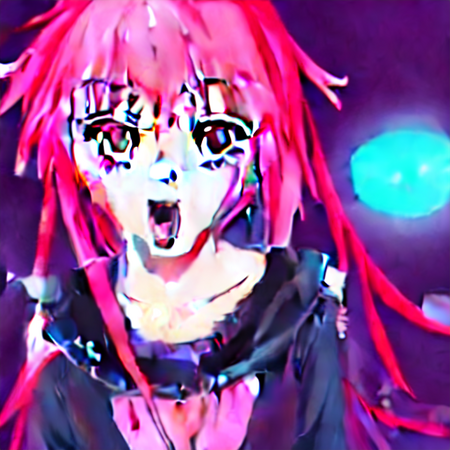
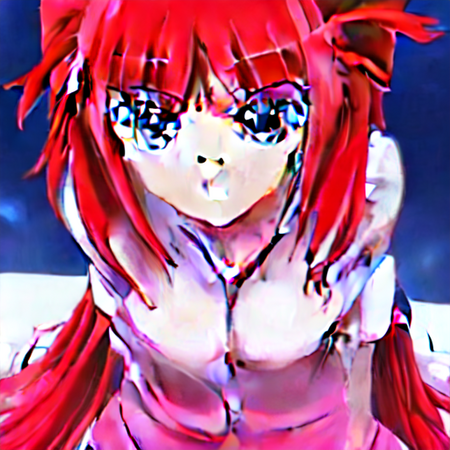
«anime girl looking at viewer, scary, aesthetic» / «anime schoolgirl sitting, flickering lighting, unsettling atmosphere»
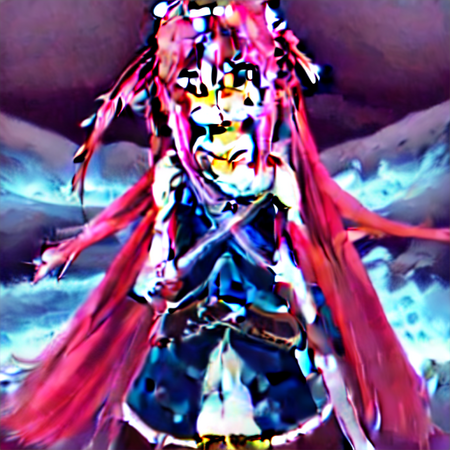
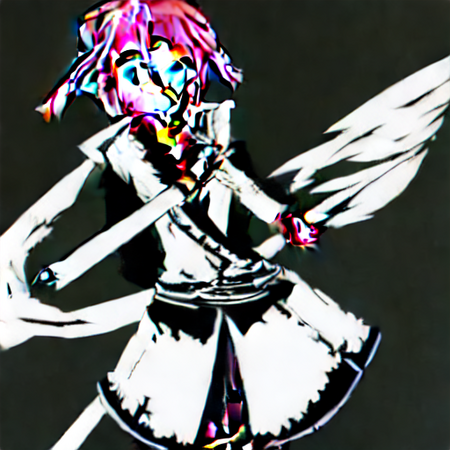
«anime girl standing in a dark forest, distorted proportions, uncanny, glitchy» / «simple anime art, black background, bloody eyes»
Ripped contours, pink-neon tones—the most unstable area is the eyes (asymmetry, double vision, metallic glints instead of a cornea).
The result ranges from anime with glitches to horror. Essentially, self-consumption looks gruesome.