1. Media Goal
Artificial intelligence is rapidly becoming integrated into everyday life. People are already using AI for information retrieval, writing, studying, working, and creating. Yet, the potential of modern tools extends much further: AI can assist with planning, household tasks, decision-making, organization, and bringing personal ideas to fruition.
However, a significant gap persists between AI’s capabilities and its actual application by people. Many are aware of the existence of AI tools, but they only use them for a handful of obvious tasks. People often simply do not know what they can delegate to AI in their own lives.
Information about new possibilities and useful scenarios, however, is scattered across various platforms and formats. To find a truly valuable application, an individual must search for it independently, understand it, and adapt it to their specific situation.
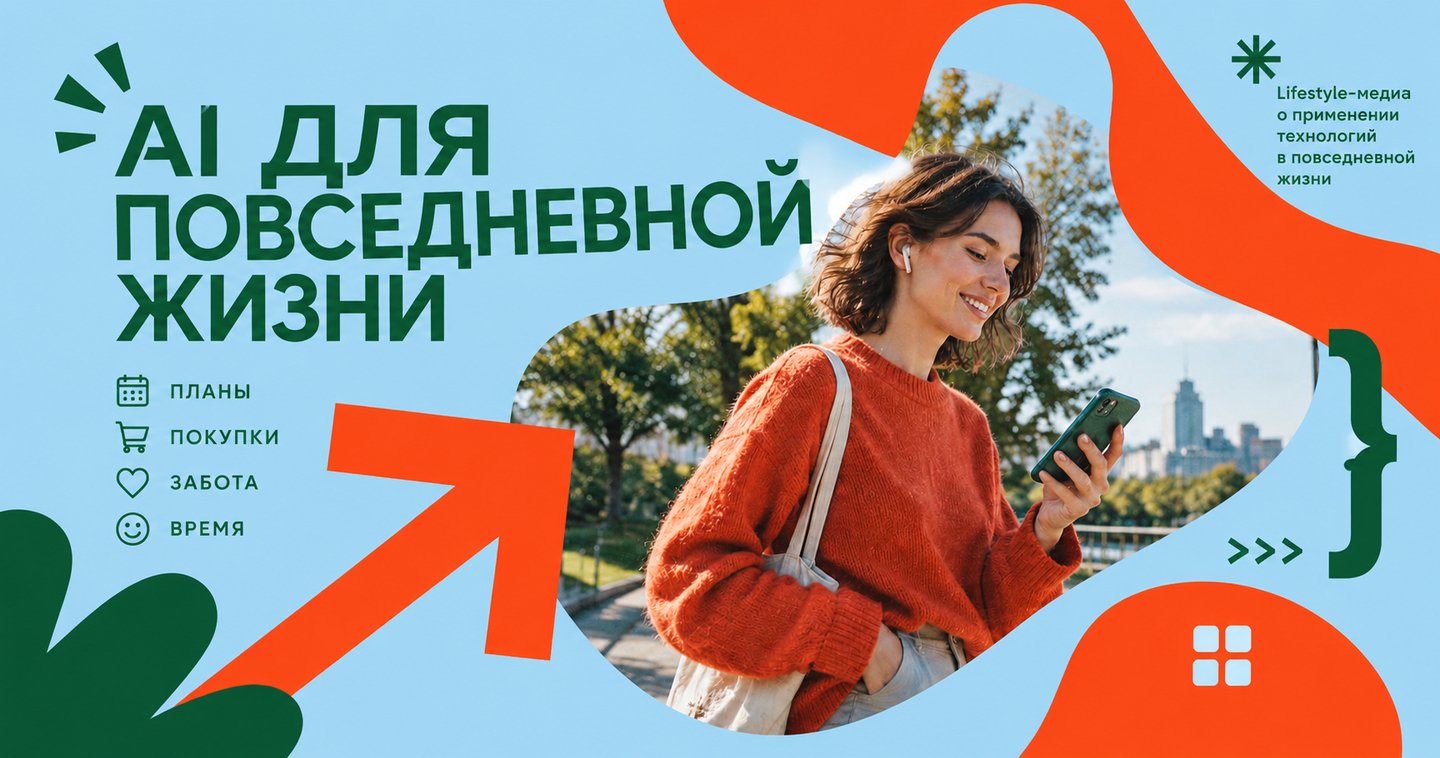
The goal of the media is to help people understand precisely what they can delegate to AI in their daily lives, teaching them to use it not for the sake of technology, but for their own time, convenience, and possibilities.
2. Media Themes
Using AI Technologies to Simplify Daily Tasks
Segment: Artificial Intelligence and Technology
Niche Topic: Using AI in daily life through specific examples
Content unit — not an AI tool, but a human life task.
Media demonstrates how artificial intelligence can assist humans in real-life situations, such as:
AI as a home assistant—inventing dinner from ingredients on hand; creating a shopping list; explaining how to fix a simple object.
AI as an organizer—planning a week, mapping out a trip itinerary, or preparing a to-do list before a move or vacation.
AI as a study aid—explaining a complex topic in simple terms, developing an exam preparation plan, or practicing a foreign language.
AI as a work assistant—analyzing a large document, structuring a presentation, or systematizing information.
AI as a creative tool—suggesting a gift, developing a project concept, creating a visual idea, or helping to write copy.
AI as a decision-making partner—comparing products, finding the best option for specific needs, or compiling a list of buying criteria.
3. Competitors and Their Analysis
To define the competitive landscape of media, we examined three groups: direct, indirect, and potential competitors. Within each group, we selected media outlets that were sufficiently large and thematically similar but employed different approaches.Direct Competitors focus directly on the topic of AI and demonstrate practical applications of the technology.Indirect Competitors address the same need—helping people save time, organize their lives, and solve daily problems—but they do not necessarily use AI.Potential Competitors already possess an audience and expertise in AI and may, in the future, capture the niche of practical artificial intelligence application in everyday life.It is important to note that competitor research was conducted using Yandex, within Telegram itself via keywords, and with the assistance of ChatGPT.
Criteria for Competitor Analysis: 1. Platforms—where the content is published, and its adaptability across different media. 2. Visual Style—photography, video, screen recordings, motion graphics, memes, cards, etc. 3. Tone of Voice—the character of the material delivery and audience interaction. 4. Topics/Scenarios—what is specifically discussed and what user needs are being addressed. 5. Formats and Tools—posts, Reels/Shorts, Stories, tutorials, prompts, collections, case studies, quizzes, etc. 6. Audience Response—followers, reach, engagement, comments, reactions.
3.1. Direct Competitors
Direct Competitor 1. «Neurobase»

Telegram channel with AI «life hacks.» The channel positions itself as a source of practical AI tips that «save time, simplify work and life.» («Practical AI life hacks that save time, simplify work and life, and deliver results today 🤖, ” — channel description). At the time of review, it has about 74 thousand subscribers; Telemetr shows about 74.3 thousand and an engagement rate of about 4,6%. *organization banned in the Russian Federation.
The main platform is Telegram. Additionally, the channel has an affiliated website/educational product.
The primary unit of content is the Telegram post. The content is specifically designed for in-channel consumption: a brief introduction, a specific life hack, a prompt, or a scenario. Links to courses and guides are also used.
The visual style incorporates images, short videos, and screenshots. Currently, the channel has over 900 photos and about 350 videos posted on Telegram.
The Tone of Voice is friendly and energetic, occasionally becoming promotional and provocative. It frequently uses outcome-oriented language, such as «save time, ” „achieve results, ” or „life hack.“
Channel topics include ChatGPT, neural networks, prompts, automation, and work/daily life scenarios.
The formats used in the channel include life hacks, ready-made prompts, instructions, deep dives, live streams, and videos. There is also an educational component.
According to public statistics, the channel reaches approximately 74 thousand subscribers, with an average post reach of about 3.4 thousand, and an ER (Engagement Rate) of about 4,6%.
Key strengths to leverage include the „one post—one task—one result“ format (a brief introduction followed immediately by value); the outcome-oriented language (e.g., „you will save 30 minutes, ” „done in 5 minutes“); and ready-made, one-click-copy prompts. However, it is advisable to avoid the overly promotional and provocative tone and clickbait—it alienates a more cautious audience. Furthermore, frequent references to paid courses and guides can make the media platform look like a sales funnel.
Direct competitor 2. ChatGPT, help!

Telegram channel «ChatGPT, help me.»
This is an even larger direct competitor, with about 515 thousand subscribers. The channel description itself is «AI for everyday life: life hacks, prompts, and news.» The description explicitly states that it offers life hacks, prompts, and news. The content includes practical scenarios—for instance, how to create a phone wallpaper using AI—as well as more informational material, industry news, and announcements about artificial intelligence events.
The main platform is Telegram.
The content is built for Telegram: short posts, images, videos, links, and reactions.
There is a high volume of visual posts and videos. The feed utilizes images, short videos, and interactive reactions, though there isn’t a unified visual style.
The Tone of Voice is conversational, simple, and mass-market oriented. The channel’s name already suggests an assistant, rather than a technology media outlet.
Regarding the topic, a key difference from «NeuroBase» is that the content is broader. While there are prompts and practical tips, there is also plenty of AI news, experiments, and tech events.
The channel formats include: prompts, news, explanations, experiments, images, videos, and interactive reactions.
The open services currently have about 515K subscribers, an average post reach of around 13–15K, and an ER of approximately 2.7–3%.
What can be taken: the positioning of a «helper» rather than a technology media outlet; simple, mass-market language and interactive reactions that engage without effort; and highly visual posts where the result is immediately apparent (for example, a ready-made phone wallpaper). What to avoid: mixing industry news, announcements, and advice—this blurs the focus and dilutes the usefulness of the content in the feed.
Direct Competitor 3. NeuroLena

The Telegram channel describes itself as «an author’s channel about ChatGPT, neural networks, and AI in daily life and work,» and lists prompts, guides, ideas, and hacks as its main types of content. The channel currently has about 16.7 thousand subscribers. In addition to Telegram, the author mentions a TikTok account with over 45 thousand followers and a personal website.
The primary platform is Telegram, though the author also maintains a TikTok presence and a personal website.
The content is adapted for different platforms: TikTok features short videos and demonstrations, while Telegram hosts more detailed prompts, instructions, and supplementary materials. There are cross-promotions leading from TikTok to Telegram.
The visual style centers on AI-generated images, videos, screenshots, and result demonstrations. There is no single, rigid visual style; the presentation varies depending on the specific material.
Tone of Voice is friendly, informal, and authorial. The author frequently shares their personal experience using neural networks and discusses the results of their experiments.
The channel’s thematic scope is broader than just prompts: it covers AI for work and daily life, image and video creation, useful AI tools, earning income with neural networks, and various practical scenarios.
Key formats include prompts, guides, tutorials, collections, experiments, videos, and user submissions. There are specific audience engagement mechanics, such as featuring AI creations submitted by subscribers.
According to public statistics, there are approximately 16.7 thousand subscribers. Reach metrics differ depending on the analytics service: TG.ME reports about 4.1 thousand views per post, while Telemetr reports about 1.6 thousand.
Recommendations: Utilize the platform linkage—a short video on TikTok leading to a detailed guide in Telegram; feature subscriber artwork as an engagement mechanism. Avoid: «earning money with neural networks» topics, as they detract from everyday utility and can decrease trust; sections based on the author’s interests rather than the reader’s needs; and a design scheme that changes from one post to the next.
Analysis of direct competitors shows that the core of AI media revolves around neural networks, prompts, life hacks, and news. Practical content is already in demand: competitors are actively showcasing ready-made solutions and results from using AI.
For our media, we can draw the following conclusions to stand out and look competitive against rivals:
Make the content as practical as possible. Do not showcase AI capabilities in isolation, but rather the concrete result: the task—the use of the neural network—and the finished solution.
Build content around real-life scenarios. In addition to work and content creation, utilize everyday situations: travel, shopping, studying, planning, cooking, organizing tasks, and personal projects.
Show the results visually. Maintain a unified visual style that can also become a distinguishing feature of the media. Use screenshots, short videos, «before/after» examples, and demonstrations of the neural network at work.
Adapt content for different platforms. Use short videos on YouTube and VK Shorts to attract attention, while using Telegram for detailed instructions, prompts, and saving valuable content.
Use a simple and friendly Tone of Voice. Avoid overloading the text with technical jargon; instead, explain AI through tasks that are understandable to anyone.
Encourage user participation. Introduce challenges, experiments, and feature subscriber results—this allows the audience not only to read but also to try AI themselves.
Do not compete solely on the quantity of AI tools. Most competitors have many different neural networks, prompts, and news updates. Therefore, our focus should not be «just another AI channel, ” but rather a media outlet focused on „what real-life tasks a person can delegate to artificial intelligence.“
3.2. Indirect Competitors
Indirect competitors address the same need—saving time and solving everyday tasks—but they do so without incorporating AI or only mention AI as one of many topics. When a person has the question, «What can I cook with what I have?» or «How do I plan a move?», they go to those solutions.
Indirect Competitor 1. Lifehacker
Screenshot from Lifehacker
A major media outlet focused on practical solutions for everyday problems. The motto is «We figured it all out so you don’t have to, ” featuring over 40 sections, ranging from recipes and shopping to health and technology.
Platforms include a website as the main hub, Telegram (with around 67k subscribers), VKontakte, YouTube, and Pinterest. Long-form articles on the website are converted into short announcements and cards for social media.
Visual style: recognizable editorial illustrations, photography, infographics, and short videos. Tone of Voice: simple, optimistic, humorous, non-patronizing, and grounded in science.
Topics cover all aspects of daily life. Regarding AI, we have a special project, „70+ Best Neural Networks, ” but it is structured as an instrument catalog by type (text, images, video, audio, code), rather than by real-life tasks.
Formats include tutorials, collections, checklists, quizzes, podcasts, and videos.
Audience feedback shows that „how-to“ materials are highly saved and shared—this is the benchmark for practical content.
What makes us effective: a language that says, „We explain it so you don’t have to figure it out yourself, ” clear instruction structures, and a unified illustrative style. Where we excel: while Lifehacker groups neural networks by tool type, we group them by the user’s specific task.
Indirect Competitor 2. T–Zh