Categories
— Concept — When Picasso saw the masks — Portrait of Gertrude Stein — Self-Portrait — Les Demoiselles d’Avignon — African Period — New Expressiveness — Analytical Cubism — Synthetic Cubism — Conclusion
Concept
By the late 19th century, thousands of African artifacts—such as masks, sculptures, and totemic figures—began arriving in Europe. «Tribal art» inspired the Western world, and the adoption of African visual culture became so widespread that it acquired a specific term: primitivism. Artists explored the techniques used in the creation of masks and imitated them.
African art in Europe was regarded not as a work of art, but as artifacts of colonial conquests, possessing virtually no economic value. However, at the beginning of the 20th century, thanks to Picasso, the aesthetics of African art became a source of profound inspiration for the Parisian school, which sought radically new ways of representation. Picasso perceived depth and ritualistic meaning in African figuration—a realization that both astonished and moved him. The bold use of planes and sharp contours was unlike anything he had seen before.
Some articles criticize Picasso for ignoring the culture and history of African tribes, raising the issue of whether he was indifferent to the very sources from which he drew inspiration. While I believe he did not exploit African art, but rather transformed it through his own vision, I was struck by his quote—
«Inspiration exists, but it must catch you while you are working.»
I believe this approach is brilliant for the artist. Drawing inspiration progressively from one’s own work is a productive path because it can become an inexhaustible source of energy, entirely controlled by the individual. Pablo Picasso painted numerous pictures and went through various life stages, each marked by distinct artistic periods. Picasso’s «African» period lasted a year; one cannot say that he built his career as a great artist on it, just as one cannot conclude that African masks dictated the visual art of the Western art world. However, it can be said that the artist reinterpreted these very masks, which allowed him later to arrive at analytical Cubism.
Pablo Picasso began working with the simplification of forms, using primitive, distorted, and crude features for faces on his canvases. This period marked a gradual transition to analytical Cubism, which in turn continues to influence popular culture. Nothing comes from nowhere—everything is inspired by what has already been created—but only some individuals possess the talent and artistic vision to transform it and present it to the world from a different perspective.
In this visual investigation, I aim to trace the relationship between the works of creators from different continents—African masters working on their tribal masks, and Pablo Picasso, who resided in France.
When Picasso saw the masks
In the spring of 1907, Henri Matisse purchased the African figurine, Willy, from the collector and writer Gertrude Stein. Picasso became interested after seeing it at a friend’s home. Max Jacob writes about this:
«Matisse took a black wooden figurine from the table and showed it to Picasso. He didn’t let it go the entire evening. The next morning, I came to his studio—the entire floor was piled high with sheets of paper. On every sheet, almost the same thing was drawn: a female face with one eye and a very long nose that flowed into the mouth, a lock of hair on the shoulder. Thus, Cubism was born.»
African Willi figurine. Late 19th century.
By observing the changes in the artist’s works, we can emphasize that Picasso was inspired by the use of planes and sharp contours in African art. Below is an example of how the style of his painting changed from 1906 to 1907.
Pablo Picasso, «Self-Portrait with Palette, ” 1906; Pablo Picasso, „Self-Portrait, ” 1907.
A few days later, after the artist saw the Willi figurine, he visited the Trocadéro Museum.
«The smell of mold and desolation choked me. I felt such melancholy that I wanted to leave immediately. But I forced myself to stay to look at these masks, all these objects that people created with a sacred and magical purpose—to serve as intermediaries between them and the hostile forces surrounding them. In this way, they tried to conquer fear by giving it shape and color. And that is when I understood what painting was. It isn’t aesthetics—it is the magic standing between us and the hostile universe. It is a way to gain power, to give form to fears and desires. On that day, I found my path.»
— Pablo PicassoTrocadero Palace, the Trocadero Ethnographic Museum building, in the 1890s
Portrait of Gertrude Stein
Pablo Picasso, «Portrait of Gertrude Stein, ” 1906.
«Everyone has the right to change, even artists» — Pablo Picasso
Gertrude Stein’s portrait is transitional in Picasso’s painting. It still retains characteristic features of the «Rose» period, such as a matte, warm palette and the absence of harsh shadows. A calm and formal pose was chosen for the American writer, which is typical of this period. The heroine’s expression and posture convey intellectual concentration, yet her face begins to incorporate new characteristics—it becomes flat and angular, already reminiscent of African masks. The artist moves away from a realistic style; we see a body with simplified geometry, causing form to begin overriding naturalism.
Self-Portrait
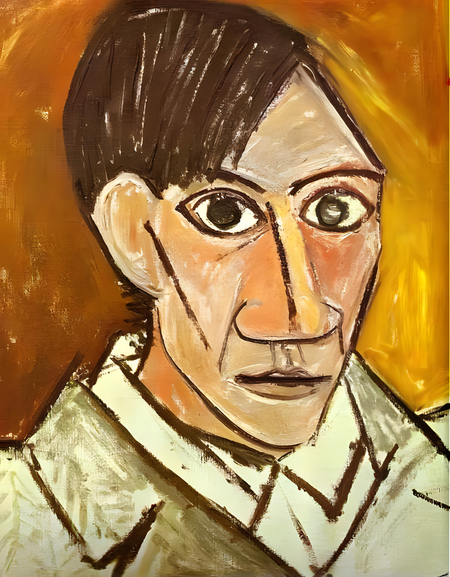
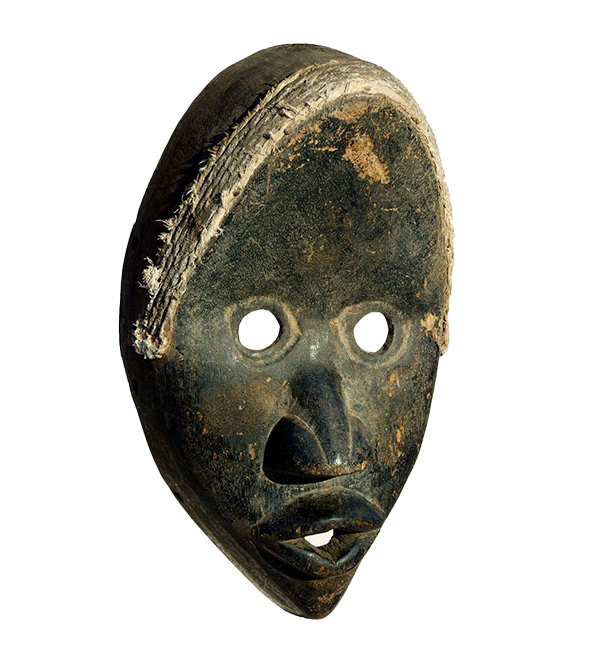
Pablo Picasso, «Self-Portrait,» 1907; Dan People’s Mask, date unknown. Origin: Liberia, Africa
In his renowned self-portrait, Picasso continues his work on simplification, modeling the face with planes and outlining them with contrasting lines. Two large pupils set the rhythm; because they are expanded, they command attention. The structure of the mask consists of simple geometric forms. This idea becomes a resource for the artist.
The people of Dan inhabit areas near the Ivory Coast. Their masks are ritualistic and sacred—they do not symbolize spirits; they are considered spirits themselves. The masks are used in ceremonies pertaining to the cosmic order and the community’s social life. The appearance of the mask corresponds to its function; for instance, guard masks were crafted with large eyes to observe events. The mask associated with the portrait was intended for the proper use of fire in the kitchen, meaning its functions were didactic and instructive. The rhythm is established by the smooth circular eyes, and the dynamism by the broad nose wings and sharply angled cheekbones that terminate in a pointed chin. We trace these features in the self-portrait as well. I believe this expressiveness is precisely what Picasso sought to infuse into his painting by drawing inspiration from African masks.
Avignon Maidens
Photograph from a 20th-century brothel.
In the sketch for the canvas, we see a clearly expressed rhythm of figures. However, in the final piece, the silhouettes of the girls merge with the space because the distinction between them and the background is not sharply defined. The artist will continue to experiment with this in Cubism.
Pablo Picasso, Sketch for Les Demoiselles d’Avignon, 1907.
Pablo Picasso, Les Demoiselles d’Avignon, 1907