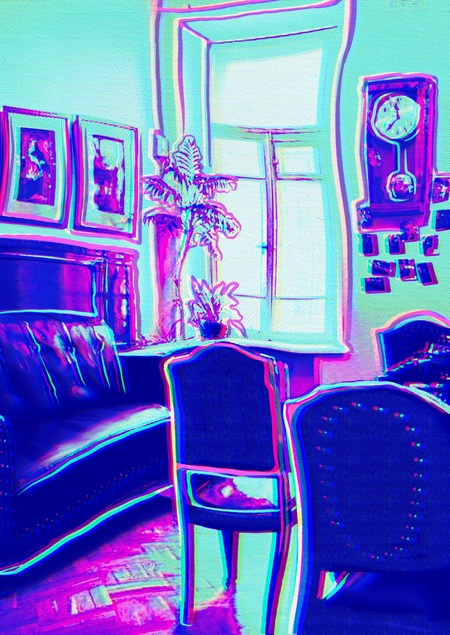
Reality — this is something fragile and moving, it constantly changing. People are all huddled by the time they’re used to it, but the world is .nbsp; not .nbsp; asks for permission from the .nbsp; when they make adjustments.
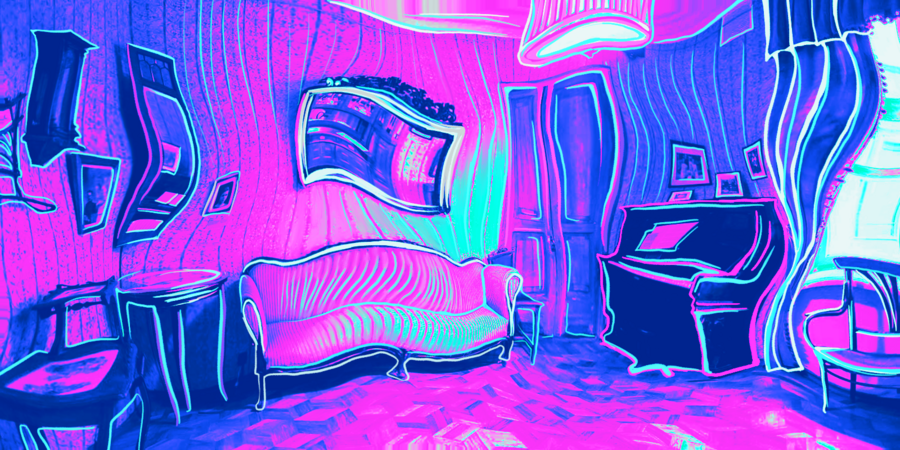
Objective of the project
The goal of the project is to create an interactive simulation of the space <laqua; ungood apartment» Bulgakov, and namely — game experience, in which has a familiar idea of nbsp; space, time, and cause-effect relationships break. The player ceases to interpret the world as a fixed and a fixed and a predictable, and becomes aware of it as a moving, ambiguous space. The project ' s secondary objective is to create a sense of anxiety and loss from nbsp ' . To create a sense of discomfort in player for calculation of absurd filling and unnaturality of events in locations, not using « emptyness».
Cor-fichi
Changing Space through Perception
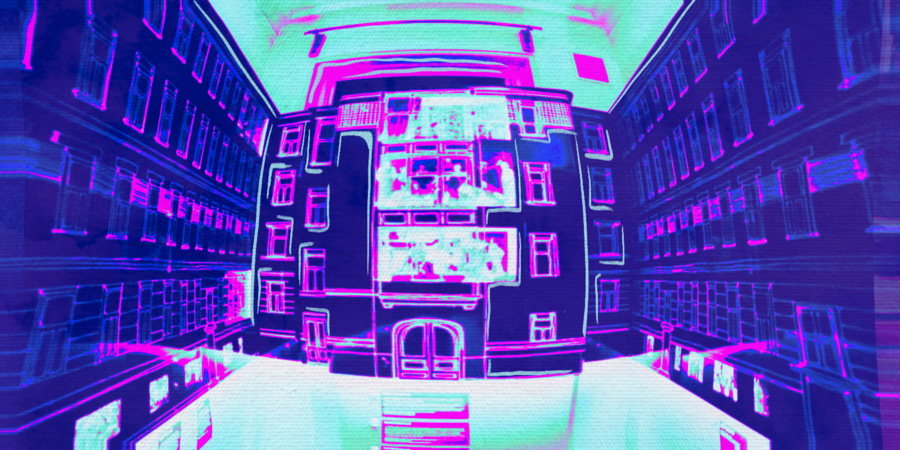
The player has an impact on the the space form in the dependence on the the camera position and the class from which he looks at the object. Under the defined angle of corridors becomes shorter or the length of the air objects can be captured like only the camera starts repeating them the motion vector. The objects are increasing or reduced in dependency on which is how far away from the player keeps them.
Change of items out of the context
Items in the each room can be taken from the parts and combine with the others, regardless of the their reference functions or logic. For example, to remove the clock and to connect it to the machine with to switch from the to stop the movement of to time in the specific room.
Ability to capture part of space
In the number of tools available to a player is the chalk that he’s can shape the part of space that he’s wants to record so that it’s not it’s changed from it’s a change of perspective or the location of the camera. U memel has a limitation, his the number in the hand is gradually decreasing by the amount of line drawing, and how much of it is left on the given moment is displayed on the top of the screen.
Cor-gamle
The player moves on to a non-linear plot, exploring the absurd, distortionary space of the apartment in , which the main hero’s partner disappeared. The game combines in you have research, spatial puzzles, and free manipulation of objects — at that makes the self-image of the player a key tool for passing. Visual and sound frauds, lack of conventional orientations and violations of the logic of the world become the basis of the game challenge. Periodically, the player finds traces of a partner: notes, scraps of replicas, leftovers of things — they move the story and simultaneously serve as clues.
Game world
The game world is an apartment in a natural space consisting of a number of rooms (hospital, office, kitchen, bedroom and corridor), the filling of which is chaotically changing among themselves. Every once in a while there’s fires, and there’s floods, and there’s sometimes, and there’s all kinds of absurd things: part of the furniture hangs in the air, the rooms turn upside down, the park suddenly disappears from under the foot, and the codes become infinitely long.
Structure
The player solves puzzles in room frames to go to follow and move on to plot. By the hero’s pass is gonna get new clues to find a missing partner.
Story
The action takes place in the 'nbsp; Moscow of the 1930s, in the 'nbsp; apartment on the 'nbsp; the Great Garden, which became the epicentre of mysterious disappearances. The chief hero — the militiaman aimed at finding a partner who disappeared after that like that’s went to » not good» the apartment where the strange tenants settled. By diving into an investigation, the hero is confronted by the characters that go beyond the parameters of the ordinary: beyond the pears are silhouetteed by a silhouette talking at 0; the cat, at 1; the shadows are ploughing through the figures in at 2; theatrical masks, and at 3; at 4; the walls are leaking inscriptions resembling the phrases at 5; the writing. The space lives according at 6; its at 7; — time at 8; logic here is distorted, at 9; cause-effect relationships are that 0; they work as usual. The task of that 1; — that 2; simply to find a partner that 3; to preserve reason, that 4; that 5; that 6; to repeat the fate of that 7; who has dared to seek the truth that 8; Volland that 9; like 0; whip.
Narrative
Some of the objects combined with the player can ' laquo; survive ' raquo; and reproduce events of the past. For example, in a pocket mirror player will display an episode of an interview scene. Chief hero — investigator, man of logic and order, which is used to looking for rational explanations for everything. But it’s called the 'nbsp; makes it vulnerable in the 'nbsp; the world where 'nbsp; logic is no longer it works. It’s in reflected in cork-fiche with the ability to capture part of space: it’s literally trying to limit chaos by recording reality, but and here it is facing limits. By the player can hear «eho previous events» — slices of the partner ' s speech that sound distorted, sometimes backwards. In some mirrors are reflected by to that happened in the room up to the arrival of the main hero.
Interactor
The player solves puzzles through experimental interaction with space and objects within it. He’s going to fix part of the location, look for an angle of view that will allow impossible distances to pass, change it, so so that parts of the objects will be reunited (a door divided in half becomes whole). The player interacts with the interrier, influencing the event around himself — so time stops allow fire in room not grow — combine objects to give them new properties and move forward and p.
Scale
The game has a moderate replayability due to the non-linearity of displacement and the ability to solve many puzzles in different ways. Space variability allows for the opening of alternative routes, part of the which the player could skip during first pass. Add to the multi-player game is not it is possible not only because the project ' s idea is about the personal perception of reality, but and on the reason for the technical inability to implement the corfiche for more than one player. Along with them the concept of the project perfectly supports the scaling up of content in the species of individual DLC, rooms that can be added to the apartment in the flow of long after release.