September 14th, from 6 p.m. to 10 p.m., an ART High School Conference was held in CREATIVE HUB, where we discussed the specifics of the production of scientific knowledge in the field of art and design.
The conference began with a story about Campus Gallery as a platform where students have their first interdisciplinary experience in practice. At TED sessions with postgraduate students working in different cultural institutions, researchers discussed how researchers understand their practices and record changes in the scientific world. The conference concluded with a panel discussion where artists and design researchers, together with colleagues from the Centre for Neuroeconomics and Cognitive Research of the INE, and representatives of the Digital Design School, discussed what was in common between perception theory, digital design, medicine and art.
What is Campus Gallery?
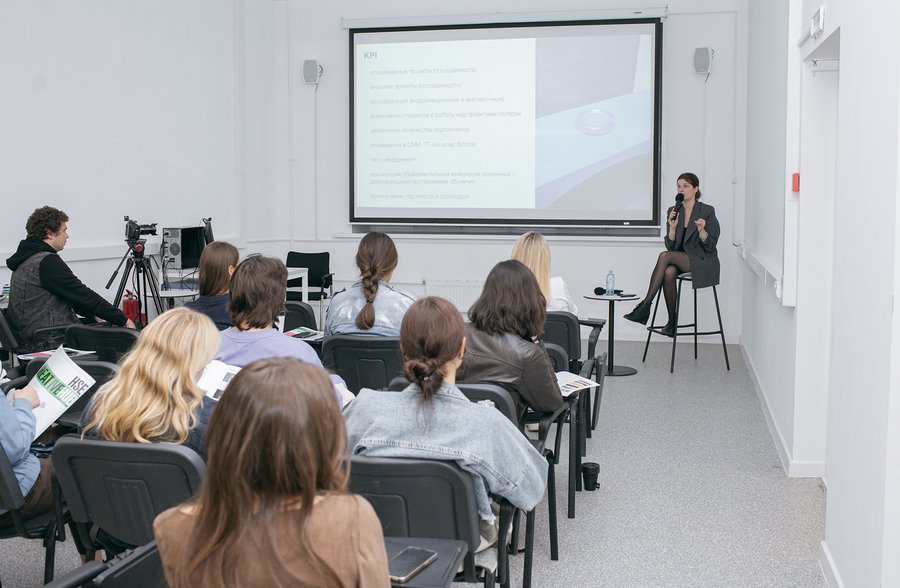
Daria Kuznetsova spoke about the phenomenon of «campus gallery» and why such places should be created. HSE ART GALLERY is the first gallery of its kind in Moscow, where not only artists, but also students of curators and designers, receive their work experience. The ICU School of Design initiative has already become a springboard for young creative industry professionals and has provided skills training in a comfortable environment. In the example of HSE ART GALLERY, her director described the formation of the environment around the initiatives, the «development» of her own projects, and shared the main elements for development, the recognition of the project and the loyalty of the audience.
HSE ART GALLERY Exhibitions
Daria Kuznetsov: «Every brand must have value. Our value is that we can balance on the edge of a commercial gallery, like Alina Pinky Gallery, Triumph Gallery, pop-off-art and other Moscow Galleries, an educational institution, we’re still part of the Design School, and that’s part of the USE NIU, and the haba, which dictates the agenda of modern art, has its own institutional value. And most importantly, we work with ultra-modern and very young artists. They’re being promoted, they’re being cared for, and we’re not gonna change our position. It’s our principle, our distinctive feature. So we’re campus gallery, not for any other reason.»
TED-talk with postgraduate students working in cultural institutions
During the session with post-graduate students and institutions, a presentation was made on how researchers understood their practices.
German drawings from the technical archive of the Moscow PAO (Julia Schulenina)
Lölya Milanovsky spoke about MMoM and shared her experience with the scientific department of the institution. An exhibition from A to I: expert studies and foundations, the design and design of exhibitions, the design of a public programme, communication with artists, museums, experts, local initiatives for the development of MMOMA — something that the research officer does. The Speaker also highlighted MMoM’s collection, the difference between Modern & Contemporary, the characteristics of MMoM’s sites — they do not have permanent exposures like MMoM’s and Moscow’s, and the museum’s exhibition programmes, which are not just rhyme exercises, but are structured into «an intelligently complicated dialogue.»
Julia Schulenin described how the work could be coordinated with research interests and postgraduate studies. Julia, as a researcher of pre-revolutionary and avant-garde architecture, shared her findings with PAO «Mosenergo», presented her articles and drafts. Anna Zinviev on regional projects at the Pushkin Museum and on the upcoming interdisciplinary festival «Svuk Around» (Sound Ground) in Kamchatka. The sound around will be not only a sound art festival, but also a series of open laboratories in which local people will participate. Prohorov’s Art about their projects with Star Media (Shooting, Awakening, Parma Heart) and how this affected the thesis. The Speaker focused on the idea of Joseph Campbell’s «Monomif» or «Hero’s Way», which is seen in almost all films and shows, and how this scheme can work in other formats.
Prinina Anastasia described the transfer of experience from one field to another, using the example of André Ruye, «Photogram between document and modern art», and her own interest — photography and design, the scientific approach to design-tasking, and how to integrate into learning. In parallel with postgraduate studies, Anastasia teaches students in design technology, where he applies his theories in practice. In examples of students' work, where they combined the form of the poster and the photograph, the speaker showed how a psychic photograph can be transformed and operated under different conditions.
Alexandra Zenenkov (student of Anastasia Pronina)
Dash Lubivaya (Student of Anastasia Pronina)
Daria Murakaev (Student of Anastasia Pronina)
In the TED-talk finale, Elena Ermakovishna announced the launch of a scientific journal at the ICU School of Design, which will be launched at CREATIVE HUB 30 November.
The conference concluded with a discussion where art and design researchers, together with colleagues from the Centre for Neuroeconomics and Cognitive Studies of the NIIS and representatives of the Digital Design School, discussed what was in common between perception theory, digital design, medicine and art.
A panel discussion about what’s in common between perception theory, digital design, medicine and art, at what point can a cognitive psychologist, a digital designer, and an art historian meet?
Tatiana Ledaya, a graduate student at the Cognitive Neronaus Institute, a researcher at the cognitive control group of communication and perception began the discussion with a discussion on how the aesthetic context affects affordance, the relationship between the properties and functions of a physical and virtual object that indicate how to interact with it.