Concept
Ingmar Bergman’s cinema occupies a unique place in the history of 20th-century auteur filmmaking. His visual language, which blends theatricality, psychological depth, and philosophical richness, constitutes a distinct form of existential expression. The choice of research topic stems from a desire to understand how visual elements—space, light, embodiment, natural and object metaphors—become, in Bergman’s work, not merely decoration, but the primary instrument of artistic thought. His films address profound human states—fear, faith, loneliness, intimacy, death—and render them visible and physically palpable. This study is based on an analysis of five key films: The Seventh Seal (1957), Wild Strawberries (1957), The Virgin Spring (1960), Persona (1966), and Cries and Whispers (1972). These films cover a critical period in the director’s oeuvre—from the mid-1950s to the late 1960s—and vividly demonstrate the evolution of his visual language, his handling of symbols and spaces, and the human face as a expressive surface for internal conflict.
The principle of the research’s categorization is based on visual motifs that recur across various films, which become carriers of the author’s intonation and philosophy.
The work is structured around seven thematic blocks: space, trees, animals, light and shadow, death and faith, people, and theatricality. For theoretical analysis, texts by film critics and researchers who reflect on the later legacy of Bergman and his place in film history were utilized. These include Alexey German’s reflections on the fundamental nature of Bergman’s directorial work, the director’s own commentary on «The Seventh Seal”—in which he explains his ambivalent stance regarding faith—and a critical article by Daniil Smolev, which emphasizes the metaphorical and irrational core of Bergman’s visual language. These texts allow for a correlation between visual analysis and a broader critical and autobiographical context, including the author’s internal reflection.

«Persona» (1966)
The key question driving this research is formulated as follows: how does Ingmar Bergman’s visual language—his engagement with space, light, embodiment, and theatrical form—transform philosophical and psychological states into visible, embodied, and emotionally charged images? The core hypothesis is that for Bergman, visuality is not merely an aesthetic strategy, but a means of articulating ultimate concerns: death, faith, suffering, the impossibility of connection with the other, and the impossibility of solitude. Bergman makes these states corporeal, transmuting metaphysics into image. He works with the elements of the environment and the human body as carriers of meaning, endowing trees, animals, light, the character’s face, and hands with a semantic weight that in other cinema would be reserved for dialogue. As Mikhail Yampolsky keenly observes: «Bergman possessed a different ability—to transform the theatrical, the external, the buffoonish, the Gothic into something essential, something profound and psychological» (Yampolsky, 2007). This very internal transformation of form becomes the subject of inquiry: how, through the accumulation of stones, empty space, the silhouette of a tree, or the gesture of a hand, does the director articulate what cannot be said any other way?
Spaces
«Wolf Hour» (1968) / «Strawberry Field» (1957) / «The Seventh Seal» (1957) / «Persona» (1966)
Confined spaces—empty rooms, narrow corridors—are organized in a way that forces the protagonist into a restricted, resonant void. Such locations create a sense of isolation, emphasize the character’s detachment from the outside world, and often—from themselves. They are filled with silence and stasis, where air, light, and sound function not as background, but as active participants in an internal conflict. Even a small partition—a transparent curtain or thin fabric—becomes a symbol of division, a boundary that cannot be crossed. This boundary is simultaneously fragile and insurmountable: it does not prevent sight, but it prevents being.
«Strawberry Meadow» (1957) / «The Seventh Seal» (1957)
«Maiden Spring» (1960) / «Strawberry Meadow» (1957)
Another characteristic technique is visually framing the character within the shot—behind the bars of a bed, the railing of a staircase, or between wooden columns. These framing elements create a distinctive cage, emphasizing the motifs of isolation, lost freedom, and unbearable loneliness. Even within «open» spaces, characters find themselves confined—within the architecture, within their own bodies, within the frame. The space itself begins to take on the role of a jail cell.
«Strawberry Meadow» (1957)
The external spaces in Bergman’s work are no less significant. Asphalt roads crossing empty landscapes become a metaphor for moving through time, loneliness, and following the unknown. The space offers no anchor—it is deserted, sprawling, and promises no arrival.
«Strawberry Field» (1957) / «Persona» (1966)
«The Maiden’s Spring» (1960) / «Wolf’s Hour» (1968) / «Strawberry Meadow» (1957) / «The Seventh Seal» (1957)
Small cottages, solitary structures on remote plots—near the woods, on the seashore, or deep in the countryside. These houses appear modest, even cozy, but inside them, psychological tension is almost always hidden. The house turns out to be a place of attraction and repulsion simultaneously. It seems it should offer protection, but it never does. The house becomes a space of uncertainty—it doesn’t save, it exposes.
«Wolf Hour» (1968) / «Strawberry Field» (1957) / «Seventh Seal» (1957) / «Maiden Spring» (1960)
«Maiden Spring» (1960) / «Strawberry Meadow» (1957) / «The Seventh Seal» (1957)
The natural space in Bergmann’s work is organized not as a decorative landscape, but as a kind of spiritual field. The forest—dark, deep, and filled with unpredictability and fear. It never appears cozy or tranquil. Liminal states occur here—encounters with death, with God, and with one’s own shadow. The fields, conversely, open and seemingly safe, are often used for contrast: drama unfolds across their bright plains. The space of the field suggests simplicity and serenity, but this is far from always true, because evil is not confined to darkness.
«Hour of the Wolf» (1968) / «Persona» (1966) / «The Seventh Seal» (1957)
The sea in Bergman’s films is a separate space. It is not confined, but its infinity offers no solace. The rocky shore where the characters stand underscores their smallness and helplessness. The sea is almost always cold, gray, and indifferent; it does not pulse with life, but serves as a reminder of existence’s indifference. The coastline is a boundary to something else—to that which lies beyond human comprehension. The sea offers no support; it gives no answers. It is eternal, but man is not.
Trees
«Strawberry Meadow» (1957) / «Wolf’s Hour» (1968) / «The Seventh Seal» (1957) / «Persona» (1966)
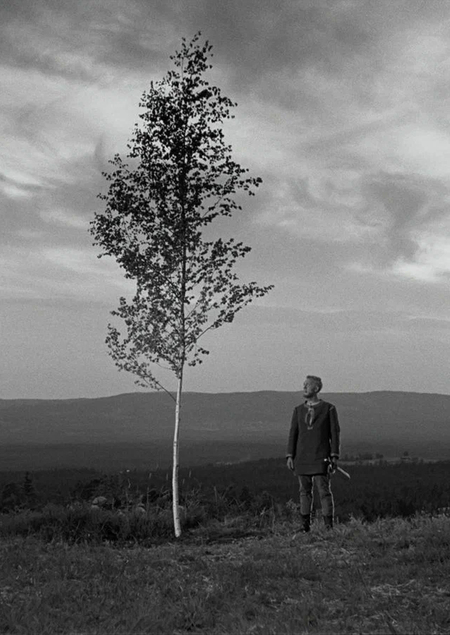
Bergman often places trees in the depth of the frame, in the background, creating an environment around the character that seems to silently observe their inner state. This is not mere background—the trees shape the atmosphere of the scene, lending it density and a sense of «habitability.» They do not interfere, but they are present, as if carrying the memory of the past or readiness to embrace the future.
«Seventh Seal» (1957) / «Wolf Hour» (1968)
In Bergman’s imagery, the tree is closely tied to life, salvation, and love. When a character sits with their back to a tree or is simply near one, the effect created is that of a source of support—a silent witness before whom one can reveal oneself. In such scenes, the character is often in a moment of contemplation, solitude, or on the threshold of making a life-altering decision. The tree serves as a symbol of love and memory, becoming an anchor that connects the past with the present.
«Maiden Source» (1960) / «Wolf’s Hour» (1968) / «Seventh Seal» (1957) / «Persona» (1966)
«Strawberry Glade» (1957) / «The Seventh Seal» (1957) / «Maiden’s Spring» (1960)
«The Maiden’s Source» (1960)