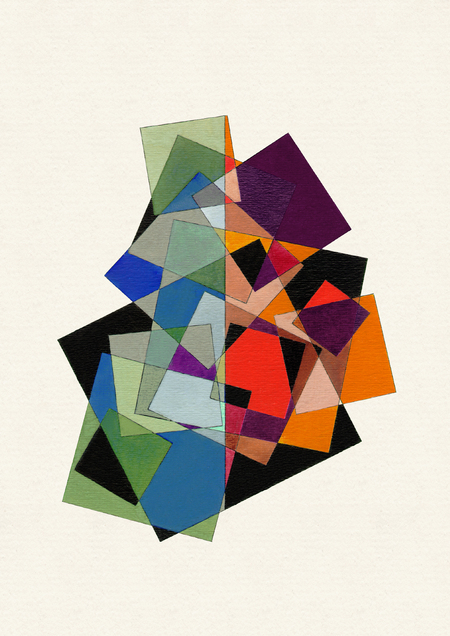
COLOR COMPOSITION
Alongside «Exprematism,» Yakov Chernikov began working on the «Aristography» cycle (from the Greek word aristo—most beautiful, most elegant), which was a continuation of «Exprematism,» but focused on the compositional structure of color. «Both Exrematism and Aristography primarily deal with non-objective imagery or render objects in stylized forms, widely utilizing all the possibilities of abstraction and conciseness in drawing.»
Suprematism grants complete freedom to express any idea through figurative forms, liberating the artist from established conventions and rules of object rendering.
Aristography utilizes not only graphic but also luminous and colorful constructions that serve as «a means of intensifying certain features of composition, structure, and form.» The conveyance of spatiality is achieved through the combination and new relationships of color and tone, resulting in «spatial compositions reaching maximum expression in aristography.»
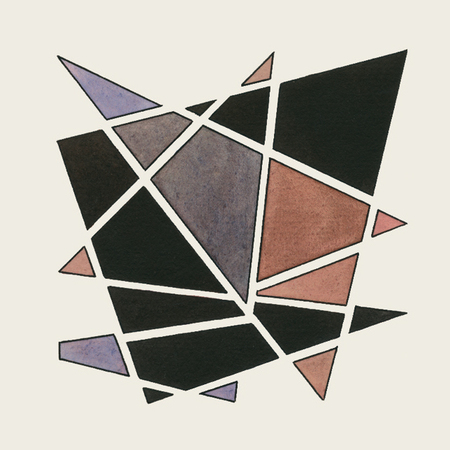
It has been established that the selection of colors and their tonal harmony can closely align with auditory sensations from music. Through tonal variations in color, the relief of an image is best revealed. Tone and color, working in complete concert with each other, create the musical harmonies of graphic composition—through which we cultivate the highest and finest principles of visual art in humanity.
Exploring the patterns of graphic constructions that reveal the intrinsic nature of an object, Yakov Chernihov reinterpreted Suprematist concepts of abstract form composition in his cycles «Exprematism» and «Aristography.» He considered the indispensable task of Suprematism to be «the creation of a composition of colors—a harmonious combination of line, plane, and volume, and the rhythm of the composed elements, which enhances the dynamic properties of non-objective compositions.»
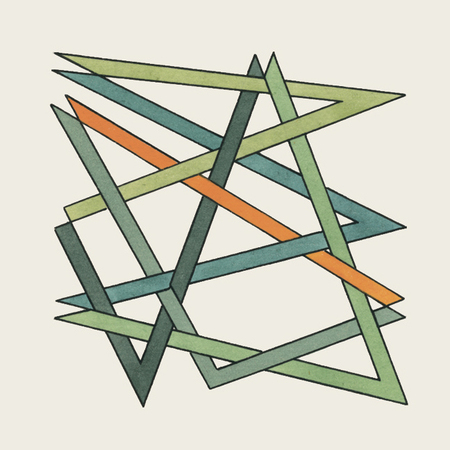
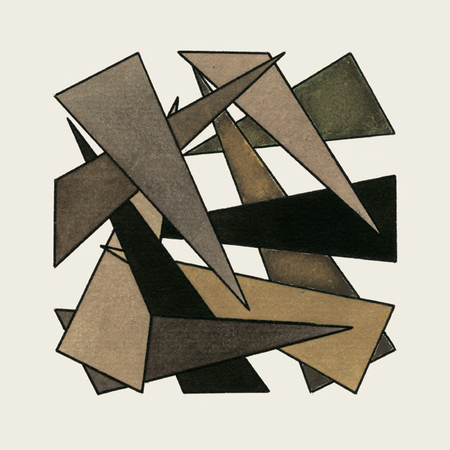
Broadly utilizing principles of non-objectivity, Chernikhov noted the limitations of «classical» Suprematism in terms of combinatorial possibilities, observing that its «somber» ideology lacked the dynamic qualities and creative energy so necessary for the process of form creation.
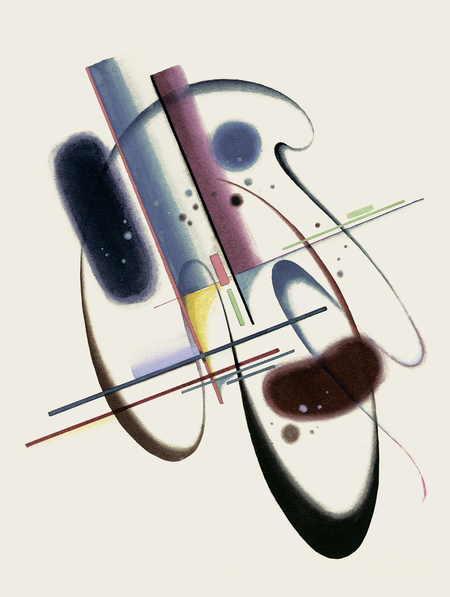
He viewed Suprematism more as the maternal womb from which a new art was emerging, rather than as an autonomous art form in itself—more as an intellectual and philosophical phenomenon than an artistic one. Being a «terrestrial» fantasist in his thinking and perception, Yakov Chernikhov preferred the tangible forces at play in «grounded» architecture to the ethereal space of cosmic «planets.» Kazimir Malevich also addressed the issue of objectifying Suprematism, developing the idea of creating a «Suprematist Order» as the new tectonic foundation for future architecture and the direction of «Supremo-Constructivism.» While Malevich ultimately sought to create a universal philosophy of the non-objective, Chernikhov revealed non-objectivity through his work as a potential basis for artistic and graphic modeling. By adopting Suprematism as the foundation for a modern vision, he imbued Suprematist structures with a sensory quality that allowed them to overcome the «innate anemism» of Suprematism.
Developing graphideological problems of Suprematism, Chernikhov presents it as a higher and more complex level of spatial organization, which subsequently dictated the continuation of these experiments within purely architectural disciplines.
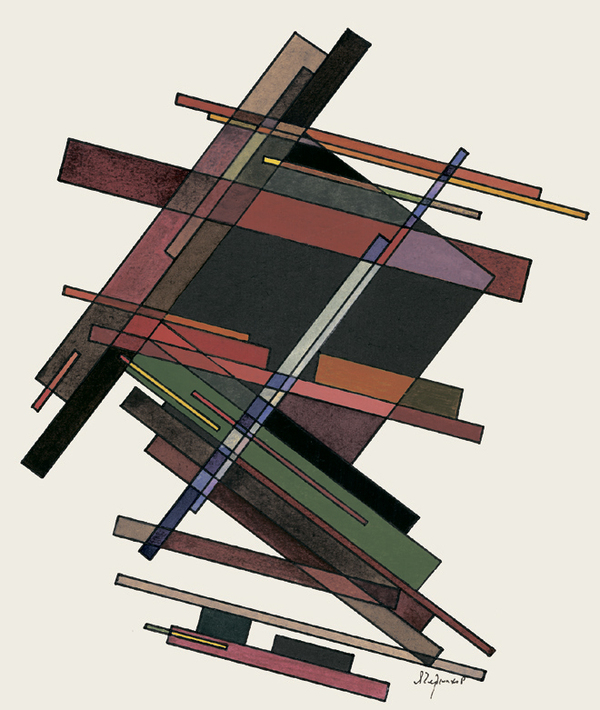
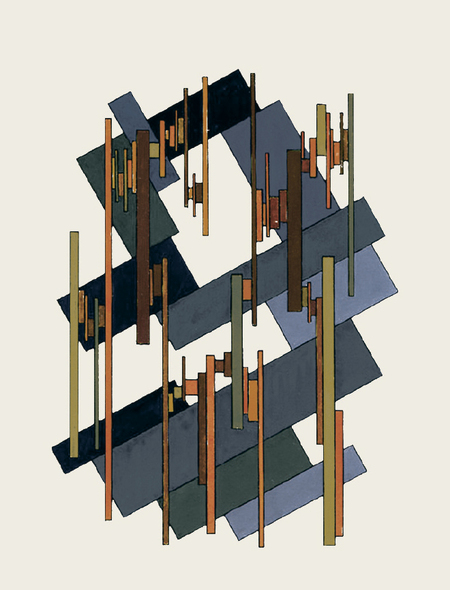
The fundamentals of the Suprematist approach to resolving graphic compositions were laid out by Chernikhov in the book «The Art of Drawing,» which served as a manifesto for non-objective graphics (Academy of Arts Publishing House, 1927). The book’s release was accompanied by a massive exhibition of works (about 3,000 pieces) from the «Exprimatica» and «Aristography» cycles, which was held at the Academy of Arts in Leningrad within the halls of the former Kushelevskaya Gallery.