
Neural networks are developing rapidly, and the certainty that they are inferior to humans no longer seems as unshakable. Humanity has always reacted strongly to such massive changes. While most people try to halt progress, others are striving to master this new tool and delegate tasks, freeing up more time and space for themselves and their creative pursuits.
This project is an attempt to reconcile the sphere of personal creativity with currently available AI tools, while also leveraging technology for market research and the promotion of a personal professional brand.
BRAND RESEARCH WITH AI
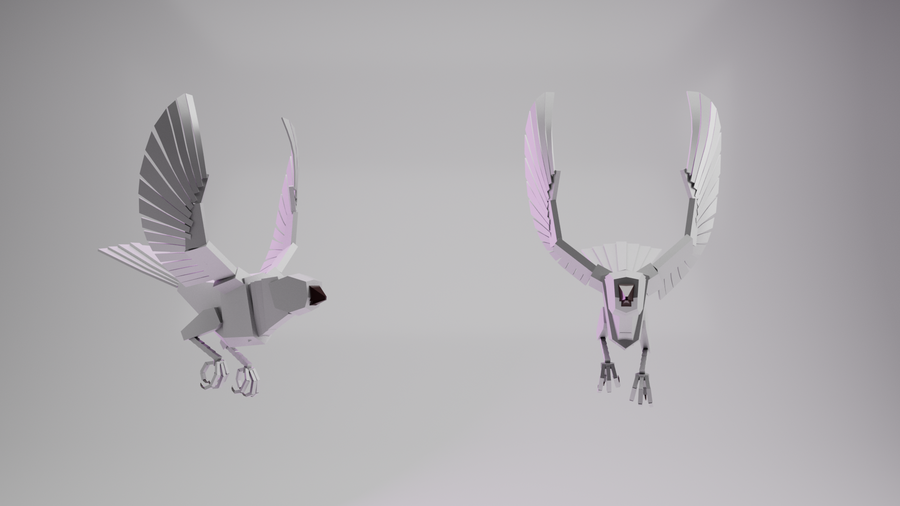
Before building a brand, it is necessary to understand what it represents. The professional field and self-positioning as a 3D Animator were chosen for the project.
Simply showing your work is often not enough, especially if you are not presenting to employers. Audiences expect something more than a video of a moving character—a trope viewers have seen hundreds, if not thousands, of times. The most important element is soul. And what constitutes soul in a profession related to CGI? For answers to such profound questions, there is no better resource than engaging with Chat GPT and DeepSeek and their capacity for deep reflection.
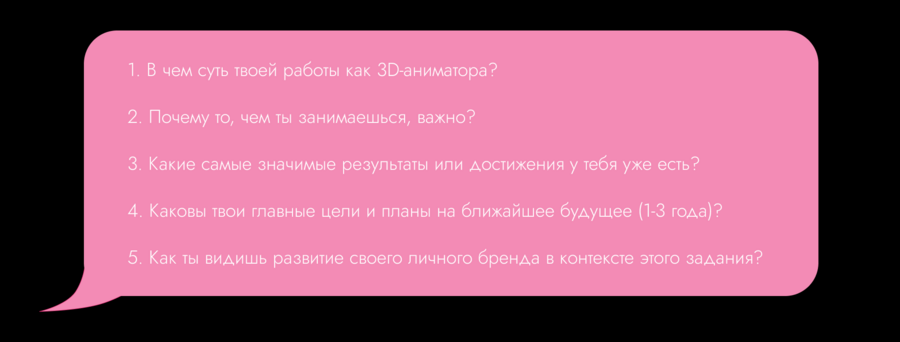
Interview-style questions from Deepseek
Interview Analysis from DeepSeek
This internal research helped clarify the main message of my own work and find an excellent slogan:
«Infusing lifeless polygons with meaning»
Additionally, a qualitative Lean Canvas was developed based on the extended responses, which not only allowed for a deep understanding of personal values and unique characteristics but also illuminated untapped skill potential for brand promotion.
Lean Canvas from ChatGPT (discussion/partial layout) + DeepSeek (framing) + ClaudeAI (style analysis)
AI APPLICATION
To test the integration of AI in promoting our projects, two pieces were created: an SEO article and a vertical video. Both publications focused on the topic of 3D animation and indirectly referenced my personal portfolio and work.
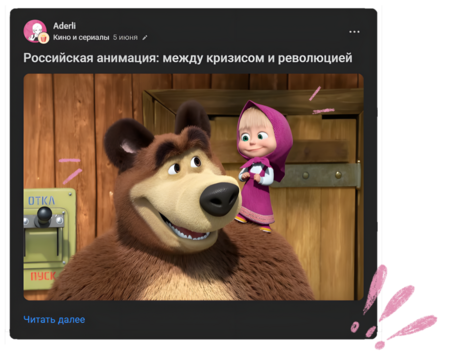
The article titled «Russian Animation: Between Crisis and Revolution» was published on the DTF website. It aimed, first, to analyze the current domestic market situation, and second, to reference personal academic projects as examples of a new generation of animators.
Several tools were used in writing the article:
— Chat GPT—as the primary and first assistant in combating «blank page» fear. We used it to brainstorm and formulate the article topics, and then select the most suitable one. It also assisted in editing the final text to give it a more natural, conversational tone.
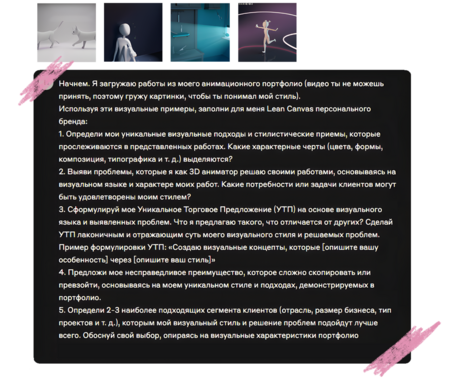
Claude AI assisted in analyzing the author’s visual style. To do this, examples of work from the animation portfolio were uploaded. The neural network analyzed the images, tracked the patterns, and provided a summary of the distinguishing features.
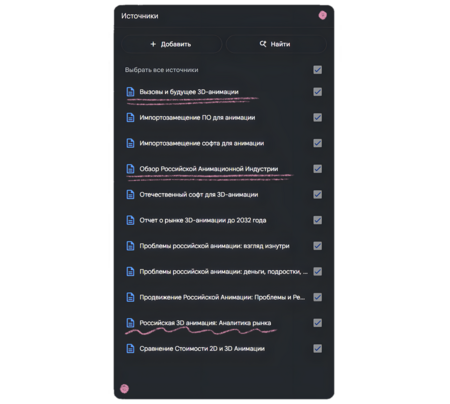
— The NoteBook LM tool proved crucial for completing the assignment. The system turned out to be indispensable because it allows users to upload various sources for analysis. For instance, after selecting the most popular articles on DTF using the «animation» tag and uploading them to NoteBook LM, I was able to extract key promotional information: keywords, the authors' narrative style, the article structure, and the specific conventions of titles and headings—in short, everything that could be useful for promoting my own article on that platform. This same neural network was used to outline the paper itself, which aided the analysis of the state of Russian animation.
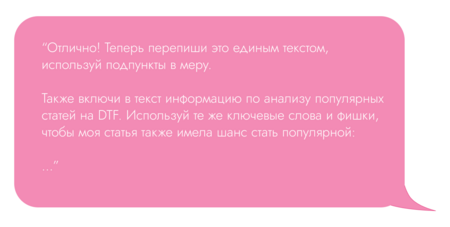
DeepSeek served as the final step, synthesizing all these disparate findings into a cohesive system. By utilizing the information gathered, the article took on its nearly final form at this point—with all its nuances and techniques—and was only lightly edited afterward by hand.
The second task was creating a short, vertical-format video. Generating a full narrative video using an AI seemed like an irrelevant idea, given that the goal was to promote my own animations. So, the decision was made to create a hybrid.
YouTube became the platform for hosting the content, as that is where the foundation already existed in the form of student works uploaded throughout the program. The first stage—analysis—was repeated. After reviewing a number of «shorts,» it became clear that their main feature was dividing the format into two halves, with one image at the top and one at the bottom. This led to the idea for a video comparing the animation created manually versus AI-generated: using the same starting frame, the same prompt, but different executors.
Next, neural networks became helpful:
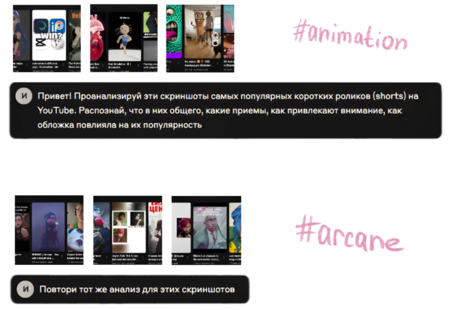
The platform analysis continued using the same Claude AI, which has «vision» capabilities and can analyze images. The screenshots from popular Shorts under the tags «arcane» and «animation» were sufficient to identify patterns: how the covers are designed to grab attention, what headlines are used, the angles, colors, and hashtags.
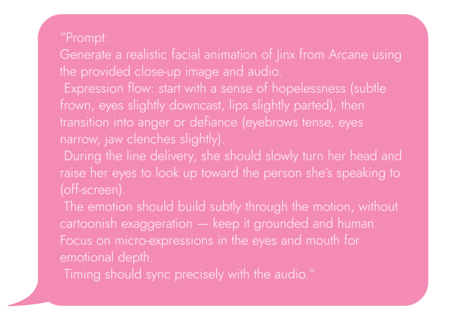
Chat GPT was subsequently utilized to formulate a high-quality prompt for generating comparative videos. This tool was also used to partially create the descriptions and hashtags, based on the information received from Claude.
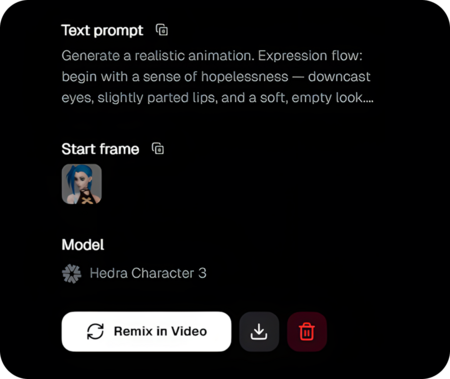
— The GPT prompt was sent directly to Hadra AI, which used this prompt, along with an image (the first frame of the animation) and the dialogue to generate a short video—a character facial animation.
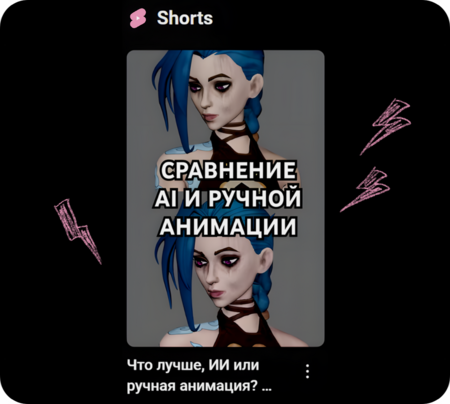
All of these materials were manually assembled into a single vertical video: two animations running parallel—a hand-drawn one on top and an AI-generated one on the bottom. A compelling title, a call to discussion, and several tags—and a viral video is ready!
AI-Powered Promotion Analytics
Data Visualization for Views
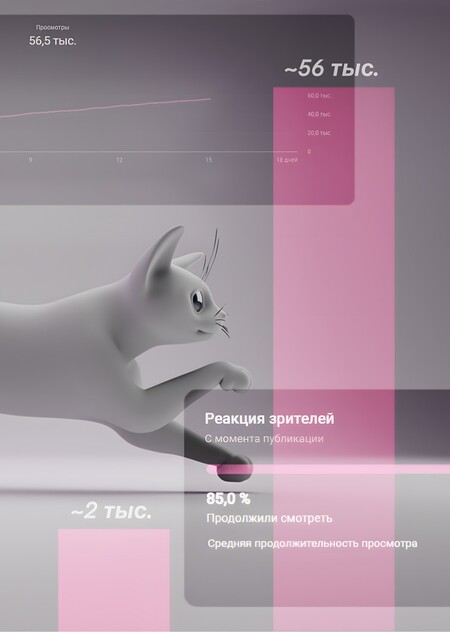
The effectiveness of the publications proved quite uneven: while the article did not garner much attention, the video clip quickly and effectively «took off"—this is clearly visible in the view statistics. The article on DTF, even accounting for combined views from the homepage and the article page itself, couldn’t come close to the results from YouTube, whose statistics continue to rise without any observable decline. And although the reading format itself suggests much lower engagement, the gap is colossal.