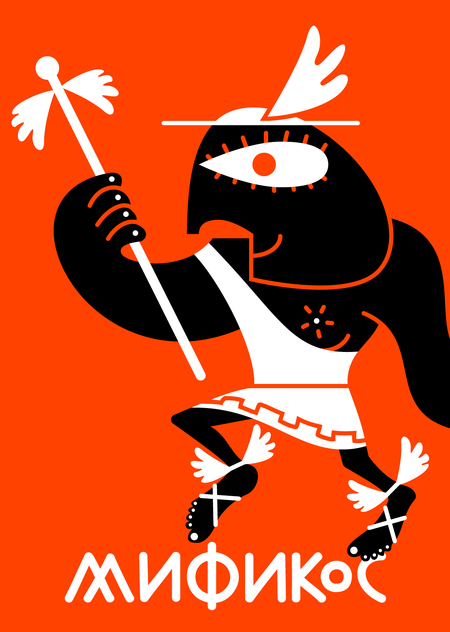
Today, rare languages are becoming increasingly popular for learning in game form. And Greek is no exception. However, the existing games on it are the adaptation of foreign platforms that ignore the features of the language’s structure. Mificos is a table game of learning Greek, allowing us to learn the basics of language, expand the dictionary supply, and get to know antique mythology more closely.
Big idea.
When it all started a few years ago, my brother Harris and I decided to teach Greek. They found a beautiful school with Greek teachers, and they took over. But at some point, I began to realize that I wanted to add more interactor to the learning process and get deeper into my own culture.
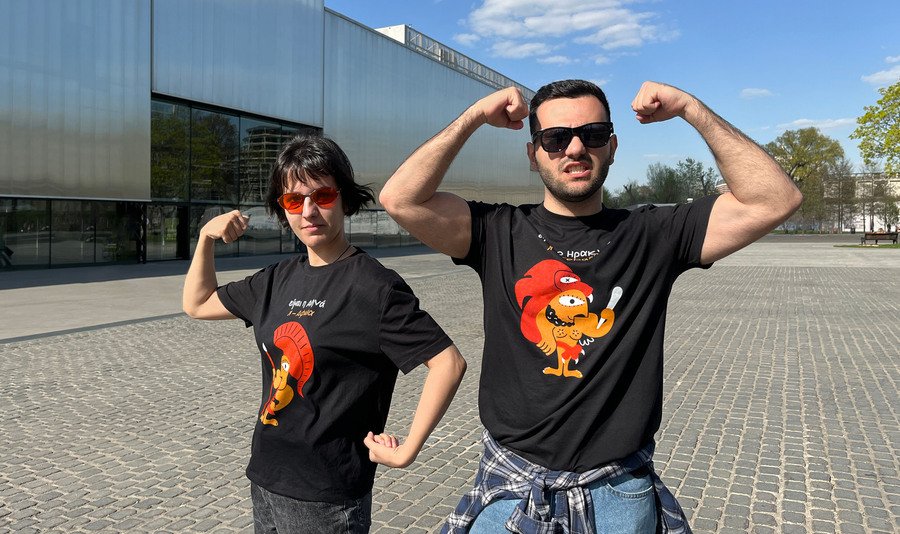
Me and Harris as Athens and Hercules.
The problem I started exploring mobile applications, cognitive channels, learning platforms that would help solve the problem. And she stopped at the board games. However, all the existing tablets were merely adaptations to foreign games that ignored the features of the Greek language. I wasn’t upset, I took it as a challenge. This was the idea of developing a table game mechanic and an identifier that would make it easy and fun to learn Greek. And at the same time, this project became the subject of my diploma.
After sharing my idea with my brother and school students, I was convinced that the idea was worthwhile. And the game could not only be integrated into the learning process, but could also be offered to people who learn language to go to a Greek university or get a job in Greece. The next step was to understand how the table game would help us to learn Greek. Then I re-analyzed the competitors and realized that the most effective games were designed to study alphabets, make sentences, pull grammars, select associations, find answers, and perform tasks. This led to the idea of combining these types of games into one and creating a product that allows us to learn the basic Greek language, as well as to supplement the dictionary supply. The only thing left was to come up with a story that would be close and understandable to the Russian-speaking audience.
First sketches
The search for an idea for us in Greece is both a tavern on the island off the coast of the sea, and a table breaking from the Mediterranean, and a famous Sirtaki dance performed under national music and ancient architecture, and… mythology, of course. This was the birth of a legend that became a visual metaphor for the project. The ancient Greek gods fell from Olympus directly into Aida’s Kingdom. The goal of the players is to bring them home while performing Greek-language assignments.
How to Play
The video features music inspired by Digital Minds Ltd on behalf of CobaltMusic. The trade is published on YouTube with time for use under the Continental ID system. My project is non-commercial and non-monetized. The video uses <a href="https://youtu.be/MngKooNfTM?si=Nletslzu6ztmeVMF>, a music to which Digital Minds Ltd belongs on behalf of CobaltMusic. The music track is published on YouTube with permission for use in the Continental ID system. My project is non-profit, there’s no monetization.
Details of the game
The box is packed manually. At the top is a folded game field, under it is a game drum and card compartments with assignments, characters and surprises, and a bag of chips and instructions.
Prepare the game to place the game field on a solid surface, and cards with gods, tasks, and surprises on piles of shirts up. Prepare the game drum. Get the chips and the cube out of the bag. The beginning of the game select the god you’re going to play for, using the game drum. You get a character card that describes his abilities and weaknesses, and you get his chip. All in the game of the 12 Olympic gods.
The Game Field is divided into four sections corresponding to four kingdoms: the Kingdom of Aida, the Kingdom of Poseidon, the Earth Kingdom, and Olympus. And each one of them has its own color code. Also, all objects or characters in the map have a signature for Greek and a translation. This allows for additional learning of words as the game progresses.
Start Put the chips on the start of the game field, drop the cube, and make a move on the number of points dropped.
You can put your thing on any of the four tracks.
The game cards each move in the game field is a random task or a surprise (the circles are painted in the color of exercise). If you have received a card with a mission — do it if you are surprised — follow the instructions. Then make the next move with a cube when it’s your turn. You get three points for every job that you’ve done correctly. The game ' s card categories are designed to develop two skills: language skills (normal assignments) and communication (tasks from characters). It’s a 350-card exercise game. The assignment to develop the language skills of the Regular Mission Card will make it easy to learn the basic Greek language. In total, there are three types of exercise in this category: in lexic, in the background and in grammar (in each of 50 cards). The former contribute to the study of adjectives, antonims, synonyms and omonims, the latter to the study of Greek sounds and diftongs, the setting of blows and syllables, the Greek alphabet, and the others to the study of the structure of words and proposals, the expansion of the dictionary. These tasks can be found throughout the game. There are 150 such cards in the game.
Communicating cards from characters will expand the dictionary, and teach people how to communicate on different topics and how to deal with household matters. In all, there are four types of exercise in this category: from Aida’s Kingdom, from Poseidon’s Kingdom, from the Earth Kingdom, and from Olympus (50 cards each). Unlike «Language Development Tasks», participants can only be caught in certain locations. There are 200 such cards in the game.
Specialty If you’ve got an assignment from the character you’re playing for, you can pass the exercise on to another participant. And if the player does it, he gets three points, if he doesn’t, then one score earns the player who gave the job.