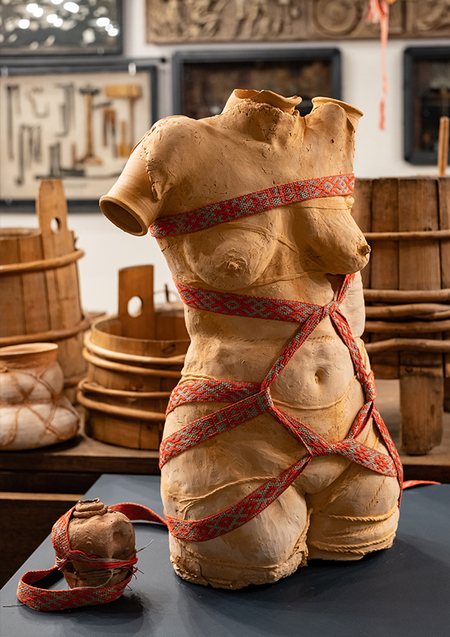
(Le Cru et le Cuit) exhibition-interview in basic exhibition of the Russian ethnography museum. ==History==In addition to the projects that were created for the First Comy Biennale, the National Gallery of the Republic of Comi of Syktyvkar in the autumn of 2021.
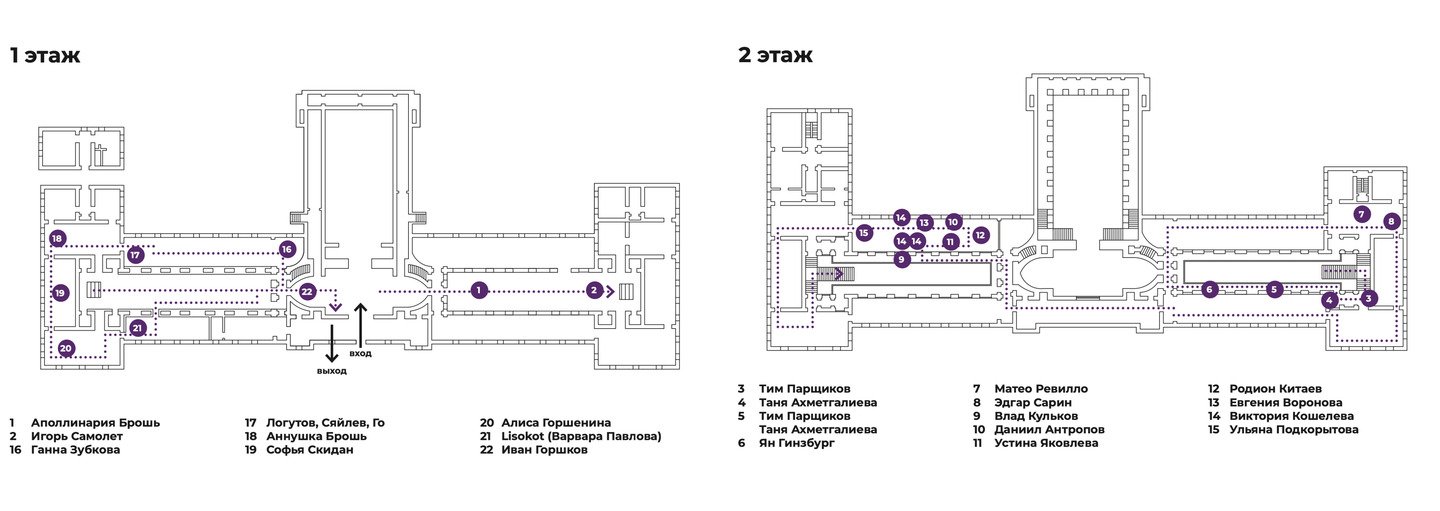
Exposition diagram
Twenty-three artists took part in the project: Apollinaria Brochá Brošnya Igor Airplane Tim Parskov Tanya Ahmetgalieva Mateo Revillo Edgar Sarin Jan Ginsburg Vlad Kulkov Victoria Košeljev Ustín Yakovlev Rhodion China Daniel Anthropniya Voronov Ulyanhov Podkorytov Gann Zubkov Vladimir Logutov Go Andrei Xailov Annoshke Sofa Skidan Alice Gorshein Vavlov (Lisokot) Ivan Gorshkov each visited Komi and personally interacted with the cultural context, interacted with local residents and studied their traditions.
Apollinary Brochus. Aurora Borealis, 2021. Wood, quartz, metal
Apollinary Brochus. Short circuit, 2021. Beton, quartz.
By carrying the objects created for Komi Biennale in the halls of the Russian ethnography museum curators chose the scene of a full comprehensive intervention in halls with permanent exposure. Thus, the exhibition project shifted the results of artistic research from one particular region — Comi — to the other cultures and raised questions about the the typical socio-cultural problems of different regions of the country, about the the diversity of cultural landscapes and ethnic identity, and o the comparison of these categories with in 0; the territorial specificity of both Russian North in 1; the whole of Russia.
Igor the plane. I will cut off your bones into flour and bake bread out of them, 2021.
Installation, mixed machinery
(Left) The Parkers. Workuta. 2021, 2021. Stick seal, bouncing at Dibond
(Right) Tanya Ahmetgaliev. Or the sun will stare again at the air depth, 2021. Paper, watermelon, marker
Jan Ginsburg. It’s the Red Cross, 2021. Mixed equipment, sites found
The title of the exhibition in the Russian ethnography museum <laqua; Cheese and prepared&raquao; refers to the class work <laqua; Mythology. Cheese and prepared by&raquao; French philosopher, ethnographer, sociologist and father of structural typologies of myth Claude Levy-Stross, who compiled detailed records of legends and North and South America’s Indian tribes; and who identified myth’s hidden patterns as such. In a book of the world ' s fundamental views of the world ' s cultures and 0; the nature of relationships and 1; the dialectics of natural harmony (» and 2;) and 3; acquired (» and 4;).
Mateo Revillo. Honey bear, 2021. Plaster, candle wax, oil
(left to right): Edgar Sarin. Kariaida, 2021. Pine, butter, paint
Edgar Sarin. Come on, boat, 2021. Pine, beret
Edgar Sarin. Kariaida under the veil, 2021. Tissue, pine, butter, paint
Like the inspired scientist who inspired us, the project’s handlers came to the conclusion that, like the formation of a myth (based on Levi-Stross), Comie’s passing biennale is perceived as a structural whole, consisting of `nbsp; units that are conceptually connected with one another. And each single job is certainly capable of transforming, then has to adapt to geographic and historical context. The global transformation started with the the transition from the the collective demonstration (biennale) that gathered work in the a defined place (the Comi Republic Map Gallery), not which has no specificity, to the the presentation in the the profile museum of a completely different kind.
The country of China. Shadows of Forgotten Ancestors, 2021. Tissue, embroidery
Eugenia Raronov. & quo; Forest spirits» from the series & laquo; Inside the landscape» , 2021. Halst, butter, embroidery
Victoria Košeljev. (left) Beret masks. (right) Pardoning the fire from the eyes of a phoenix that is crippled. The bread can be reminiscent of the human world, 2021. Halst, butter.
By intervening in the conceptually suitable halls, building a link between contemporary art works and objects from the museum collection, we provide an occasion for dialogue, both with separate objects that build communication among themselves and created a structural whole that enters into the even more in-depth discussion with an viewer who has the opportunity to look at a new way of history, culture.
(Left) Yakovlev’s Austin. Coat, 2021. Hand knitting
(Right) Yakovlev’s Austin. Locomon, 2021. Hand knitting
Daniel Anthropov. Structural anomaly, 2021. Suvel, porcelain
Ulyana Podcortov. Burn it, 2021. Video documentation of performance, Lightboxes
The system we have chosen for the existence of modern art within the exhibition is subject to the rules of transformation, i.e. adaptation to the geographic and the historical context of each room. The Ethnographic Museum is also viewed by the spectator as a new order within which the relationship between the exhibits is developed, re-thinking their value in the the context of a new-time man’s world view.
Ganna Zubkov. False sun. Part of 12.07.2021, 2021. Performance, installation, video
Andrei Xiaov. The growth sculpture of the hunter’s comedian, 2021. Installation, found objects
Vladimir Logutov. Trap / On Beast style, 2021. Halst, butter.
So the questions we’re asking are not only a single region — the Republic of Comy, in the context of this exhibit is becoming the starting point for rethinking Russia’s cultural heritage in a goal.
Annushka Broche. Underwear, 2021. Ceramic, weaving
Annushka Broche. Underwear, 2021. Ceramic, weaving