
The smartphone is not a miniaturized computer, but an existential prosthetic; it is embedded in the body. The lecture explains why mobile design is fundamentally different from desktopic design, which means «projecting within continuity» — and how the role of the designer shifts from the maker of the handsome to the maker of the hypotheses, against the background of Andy Clark, Donna Haraway, and the question of new cyborgization.

A phone is a device that lives in a user’s body and day-to-day environment. Everything you design here will exist in motion, in haste, in fatigue, in the cold, in bad signals and in lockdowns. So mobile service is a special form of design that is fundamentally different from desktop design. And we’re not starting with the buttons, we’re starting with the very scene of this existence.
Why aren’t we starting design from the screens anymore?
Rapidly generated screens are no longer a problem. EI makes «beautiful» in minutes; a beautiful UI has become a fairly cheap commodity. Then what does the designer do?
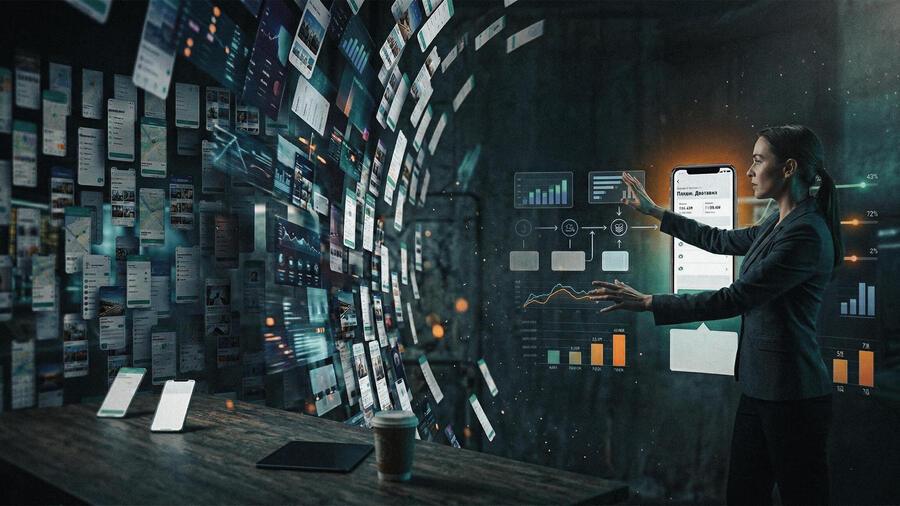
Designer is the person who formulates the hypothesis, concentrates on the main one, chooses the best. When screens can be generated quickly, they cease to be rare. So the project can no longer hold on to the beauty of the interface. The role of designer is shifting. Designing is no longer about «inventing beautiful things,» but «formulating hypotheses; proving that this task requires mobility; choosing what to show.»
Mobility is a characteristic of experience
Anthropological and ontological simulations
Today’s smartphone is a continuation of our body and consciousness — a kind of existential prosthetic, memory, perception, communication. We carry him around all the time, sleep next to him, first thing in the morning. He’s always at arm’s length. It’s a new form of cyborgization, the introduction of digital logic into our daily lives, our mental and social practices.
Andy Clarke and distributed agency.
Andy Clarke, a philosopher from Extended Mind, even introduced a special term for this phenomenon: widware, «broad» systems that include both biological and technical elements distributed in space. A man with a smartphone is a typical example of such a system. This is a private case of a more general trend: the blurring of the boundaries of the human entity, its distribution into networks and devices. The Cartesian concept of an autonomous, independent entity, clearly separated from the world, no longer works. Technology, algorithms, media are breaking into us at the micro level and shaping our behavior. We’ve always been infected by the unknown other, be it bacteria in our intestines or the recommendation algorithms in our smartphones. Our entity is always unclean, always contains something alien, and we cannot, in principle, completely control these «infection» processes. Technology, media, collective ideological fantasies act as some kind of «unhuman» actors that infiltrate us at the micro level and define our behaviour. Perhaps we should start moving from the creation of friendly interfaces to the more radical and «unhuman» forms that point to this fundamental technological transformation of the subject.
Cyborgization in htulucene
Donna Haraway and her family in the htulucene.
Donna Haraway, a key figure in modern technology philosophy and feminist theory, offers a figure of cyborg as a way of rethinking traditional boundaries — between man and inhuman, organism and machine, culture and nature. To her, the cyborg is not only a man with digital implants, but also any hybrid creature embodying the blurring of these boundaries. Moreover, a cyborg for Haraway is a political figure, a way to undermine established regimes of power and identity. Being a cyborg means slipping away from imposed categories, inventing new forms of solidarity and resistance. But the cyborg is ambivalent. These are not only releases, but also new forms of exploitation, such as the use of tracking and Big Data for manipulation. Aware of ourselves as cyborgs, we can be more critical of our technological conditionality and find new, more productive ways to coexist with technology — that is, to be cyborgs.
The phone’s closer to you than your juicy vein.
The Koran says: «God is closer to man than even his jugular vein.» (Surah 16, p. 50). The phone is now, of course, further away from man than God, but still closer to man than his jugular vein. It’s a finding of a profound psychological and even physiological connection that’s emerging between us and our vipers. Smartphone — we touch it thousands of times a day; it’s the most intimate personal thing, the continuation of our body. And that puts special responsibility on designers. It’s a centre of day-to-day management. It’s a 24/7 alarm, card, money, alarm and boredom shelter; it’s very staff, it’s a node of memory, navigation, communication, self-observation. Comfort causes a persistent habit, the slightest inconvenience — an irritation like a rock in a shoe.
Any negligence, any malfunction in this delicate emotional mechanism causes disproportionate irritation. Ugly icon, inaccuracy leveling, slow-down-- seem to be small, but they can ruin everything. It’s like a little pebble in a shoe that’s endlessly annoying until you shake it out. The smartphone interface is turning around as a continuation of our personal space, our territory. And any invasion, any breach of its integrity is perceived as a threat. Emotional design is a way to establish trusting, almost intimate relationships with the user. And, like in any close relationship, there’s no detail here. Moreover, emotional design has proved to be a powerful tool for differentiation in the oversaturated application world. When functionalities are about the same, it is emotion and style that become the decisive factors of choice.
The difference between a mobile device and our other screens
But there are limitations.
Small screen Unlike desktop computers and laptops, mobile devices have a much smaller screen area. This places severe restrictions on the amount of information that can be placed on the same screen and requires careful prioritization of content. ## Unstable Internet connection Smartphones are often used in unstable or slow Internet connections. To ensure business continuity, designers need to optimize rapid download applications, use data caches, progressive downloads, and provide offline access to key functions. Often, plugs are used, and the user has the illusion of uninterruptible downloading content, although in reality he sees an animated graph. ## The application battery, which quickly unloads the battery, causes irritation to users and may even lead to the removal of the application. Designers should optimize applications for energy efficiency, minimize the use of resource-intensive functions such as GPS or background synchronization.
Phenomenology of touchscrine