About the Project
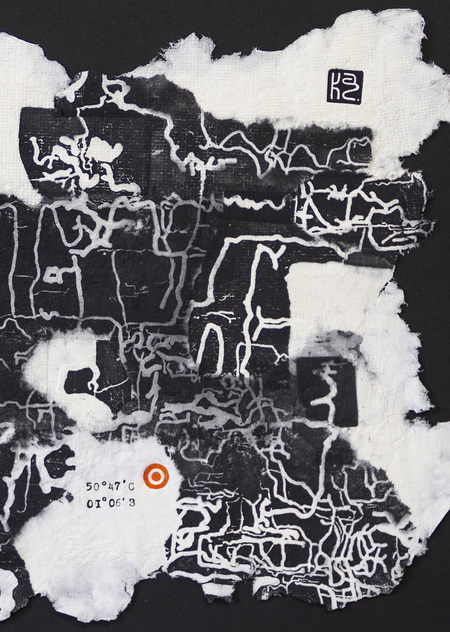
The «Labyrinths» project is a fantasy based on strange print sources, the heritage of an unknown civilization. Natural woodcut imagery prompts reflection on form convergence, craftsmanship, program, and mathematical calculation within naturally occurring forms—about the laws governing the emergence of our world’s shapes, and perhaps others. In a historical context, the project is a contemplation of archaeology, authenticity, and artifact interpretation: what created the object—nature or civilization—and how to distinguish between the two.
Technique
As printing blocks, treated pieces of wood riddled with insect larvae are used. The raw material for the paper and card stock is shredded paper packaging from egg cartons and trimmed printing paper from Hahnemuhle and Fabriano, sourced from test prints. The irregular shape of the paper plays a crucial role—holes and edges become part of the image, adding a fragmentation characteristic of many found artifacts. The form of the image, the botanical origin of the wooden blocks, and the handmade nature of the paper create a printed graphic sheet that is a highly organic object.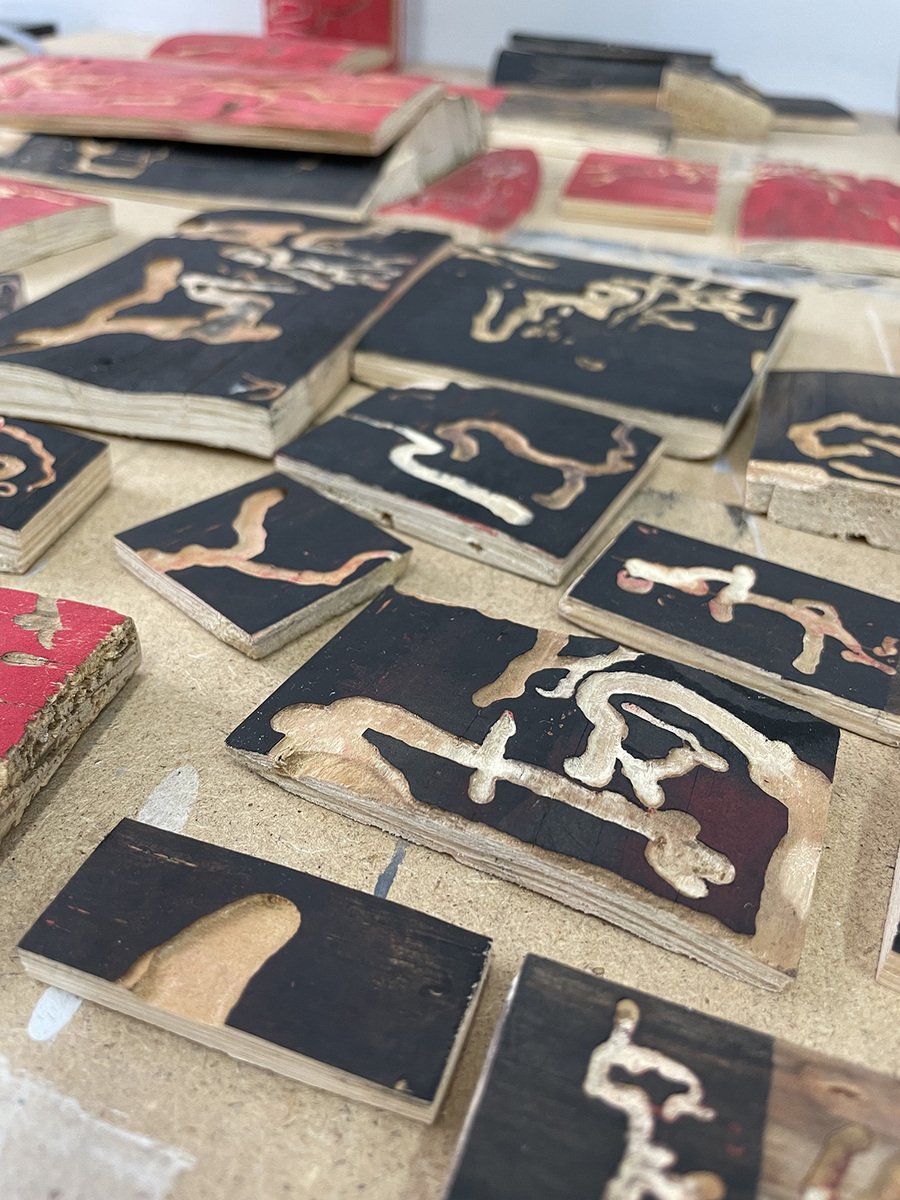
At the «Painted Hearth» exhibition in Luchnikov Lane: imprint and form.
Maps and Plans
Biomorphic forms inspire many designers, architects, and artists. The path of a larva through wood is akin to charting roads and tunnels. The result resembles city and park maps, or perhaps subterranean structures rendered on an unknown scale. To emphasize the geography, I included a compass rose icon and object coordinates. This creates a kind of «wanderer, ” and to label each image, the artwork titles are anchored to known locations, though they do not correspond to any specific plan or landscape on a contemporary world map.
«Where the Navigator Fails» is dedicated to the house at 7/4s3 Luchnikov Pereulok, where the «Drawn Hearth» exhibition took place in 2024—an exhibition I was fortunate to participate in. One time, my friends and I tried to call a taxi there, but the GPS navigator showed that we were in Johannesburg. The failure of the navigation inspired me to create this piece and prompted me to include the coordinates of the Moscow house in Luchnikov Pereulok alongside the coordinates of an art gallery on West Street in Johannesburg.
Where the navigator fails. 355×272 mm, 1/1, natural xylography, high print, handmade paper, 2024.
Ghosts, in order to confuse uninvited guests, point to the same coordinates for different locations. In my piece, «Phantom Labyrinth, ” I used the coordinates of the Belslore Grove cemetery in the United States because it is reputed to be one of the most haunted places in the world.
Phantom Labyrinth. 546×380 mm, 1/1, natural woodcut, high print, handmade paper, 2025.
On the «Square Tower Labyrinth» sheet, you can discern land, sea, and several square forms. The name and coordinates of the work come from one of Portsmouth, England’s oldest fortifications—the Square Tower.
Labyrinth of the Square Tower. 272×390 mm, 1/1, natural woodcut, high print, handmade paper, 2026.
The «Labyrinths» project’s geographical section also includes other, less «urban» maps: Dragon Labyrinth—dedicated to Huanglong Park (Huanglong, translating to «Yellow Dragon») in China; Faun’s Labyrinth, Faun’s White Labyrinth, and Grand Faun Labyrinth—are dedicated to filming locations of Guillermo del Toro in the Sierra de Guadarrama mountains; Forest Labyrinth and Squirrel Labyrinth.
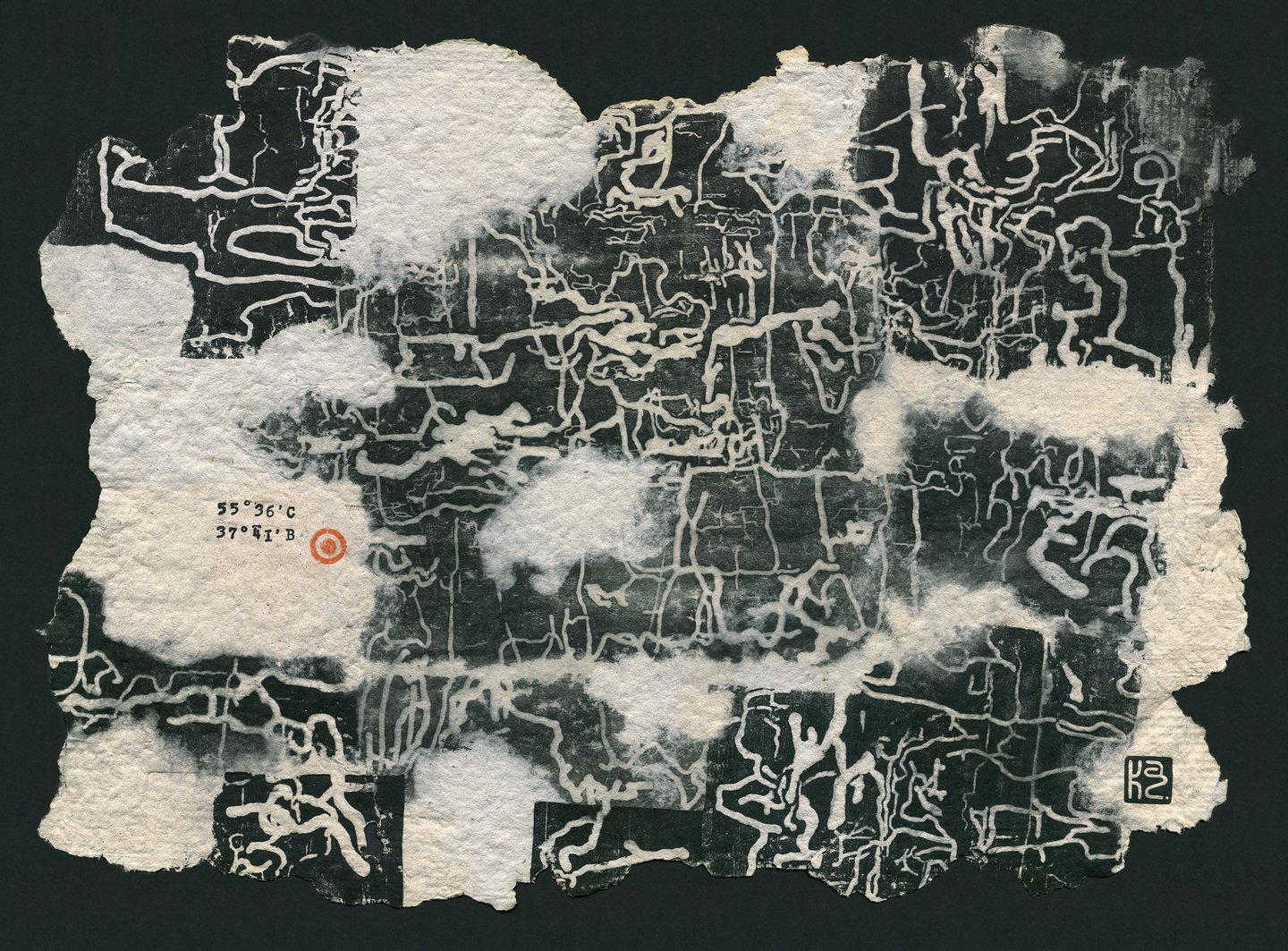
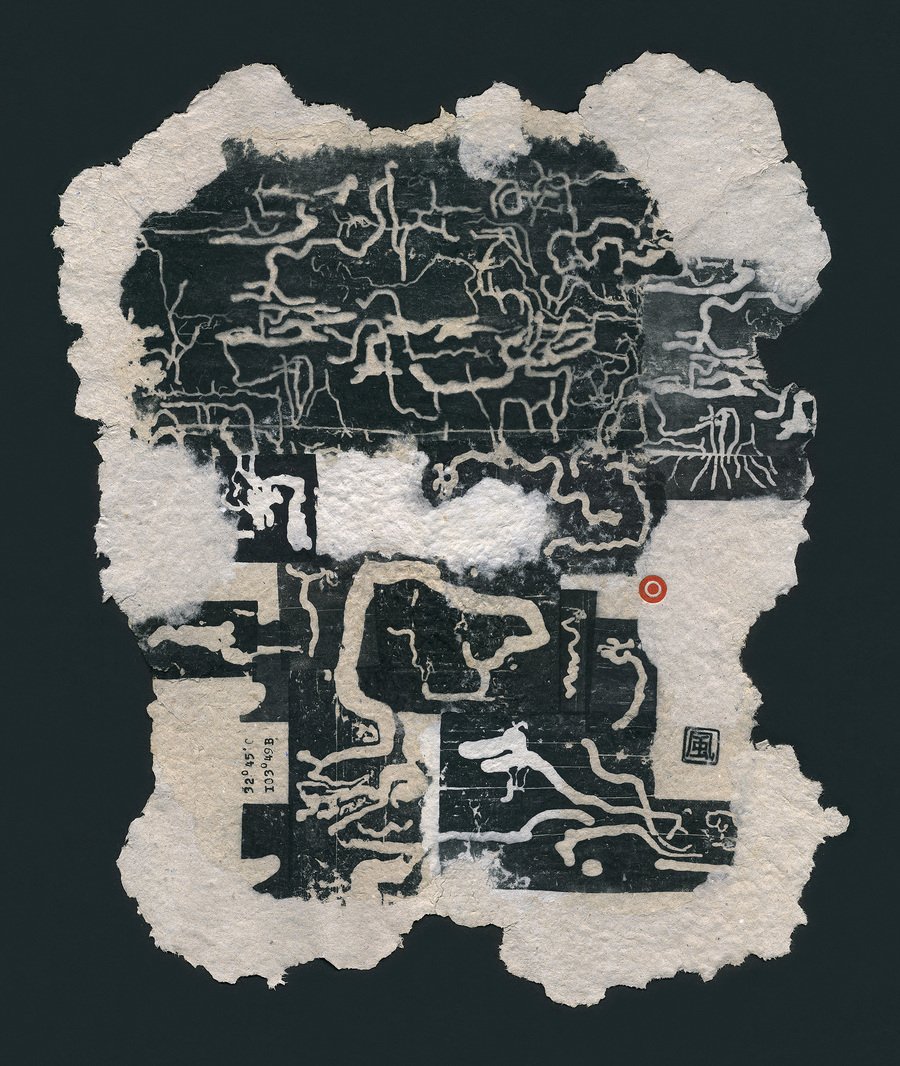
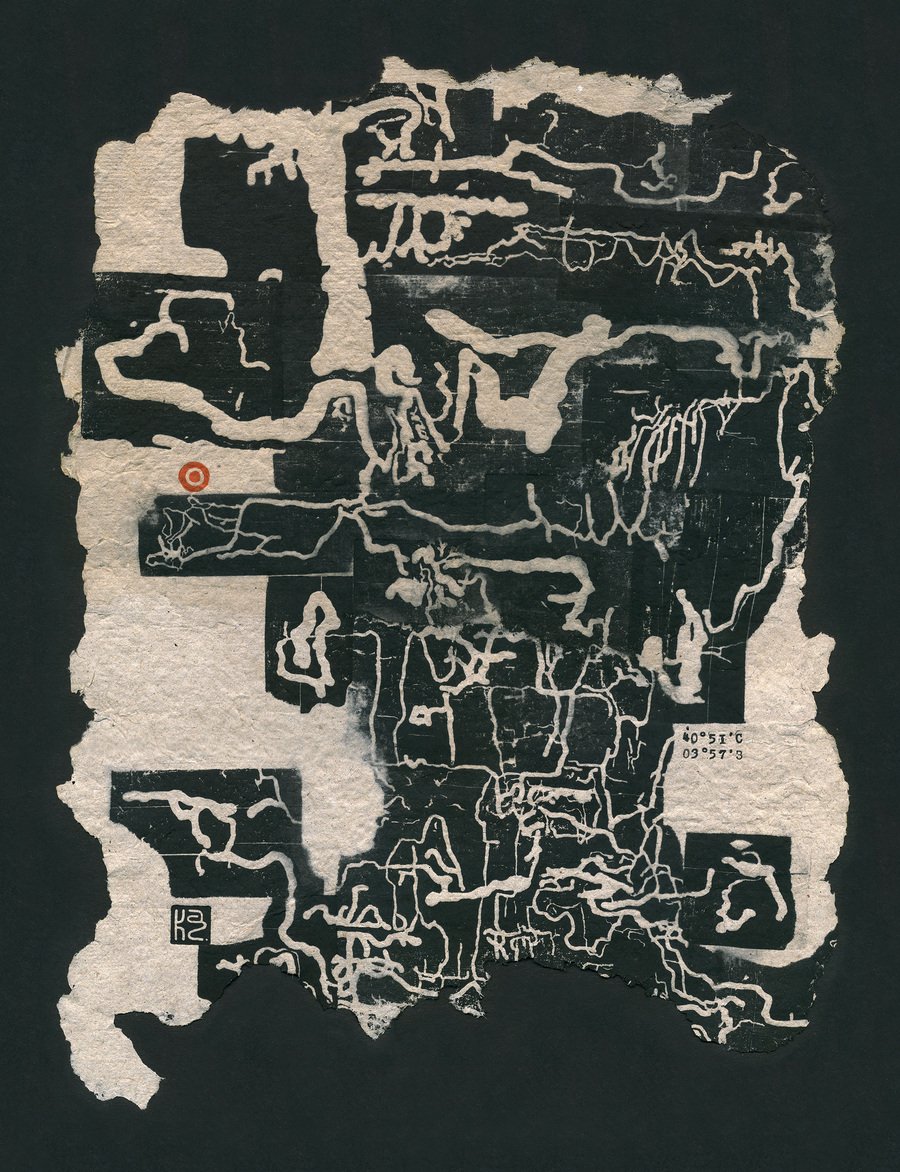
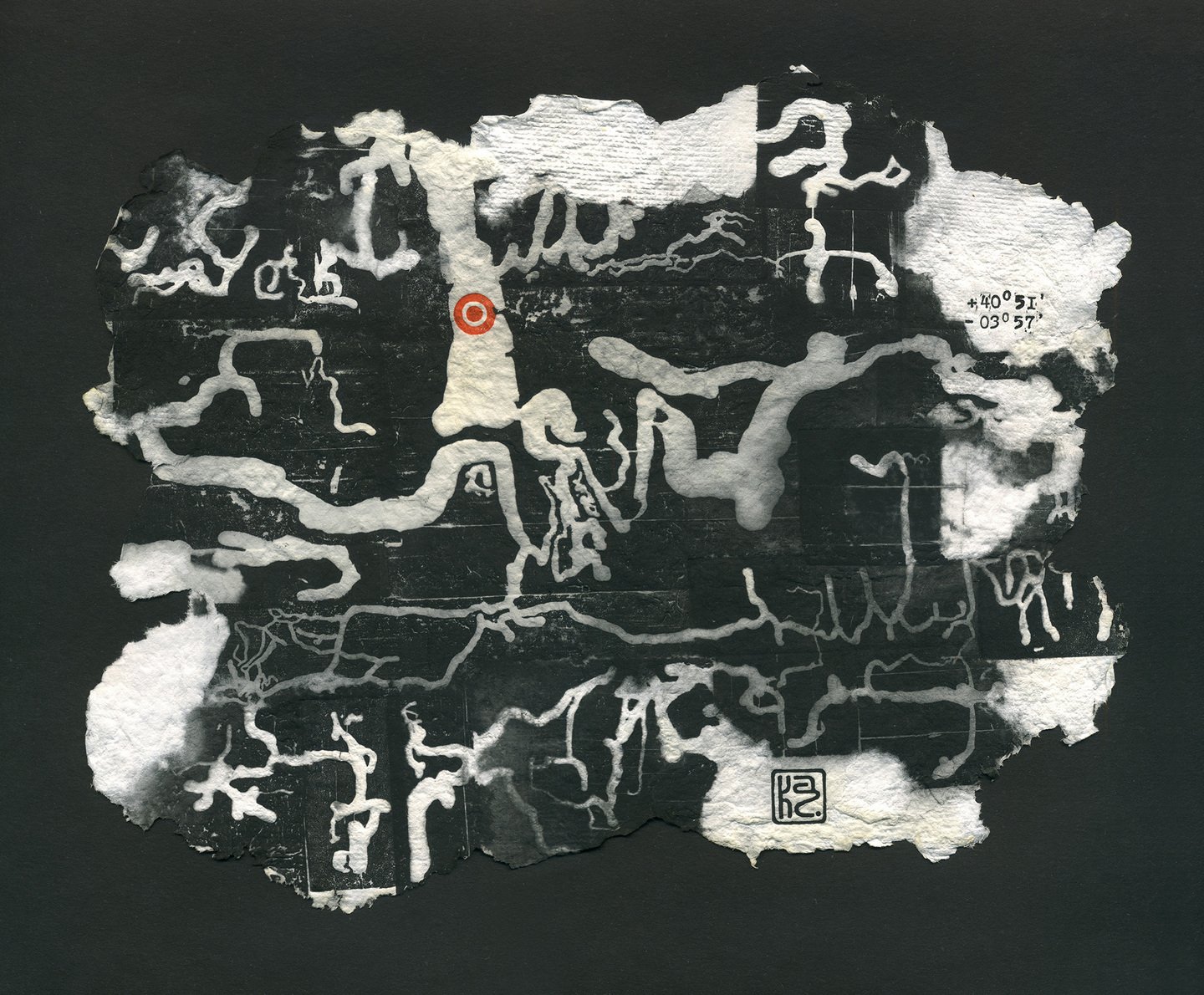
Dragon Maze (403×335 mm, 2025), Faun’s Large Maze (415×310 mm, 2026), Faun’s White Maze (235×305 mm, 2026), Squirrel Maze (285×400 mm, 2025)
Text or Foreign Code
The rendering of some paths more closely resembles hieroglyphic writing. Therefore, the Project features a «Text» section, although sometimes it is difficult to distinguish the text from the map. Future plans for the project include creating scrolls with «foreign» script.
Foreign text. 250×260 mm, 1/1, natural xylography, high print, handmade paper, 2025.
Kintsugi
Part of the project is the series «Labyrinths. Kintsugi.» Combining pieces of white paper with printed fragments transforms into an imitation of the Japanese art of mending broken pottery, Kintsugi. The Kintsugi concept is close to the philosophy of Wabi-sabi—the acceptance of imperfections and flaws. Cracks in an object are viewed not as a defect, but as an integral part of its history. Combining different pieces creates a new composition and a new object from fragments of the old. Just as cracks in ceramics become part of the piece, the background of the sheet molded from paper pulp becomes part of the image.
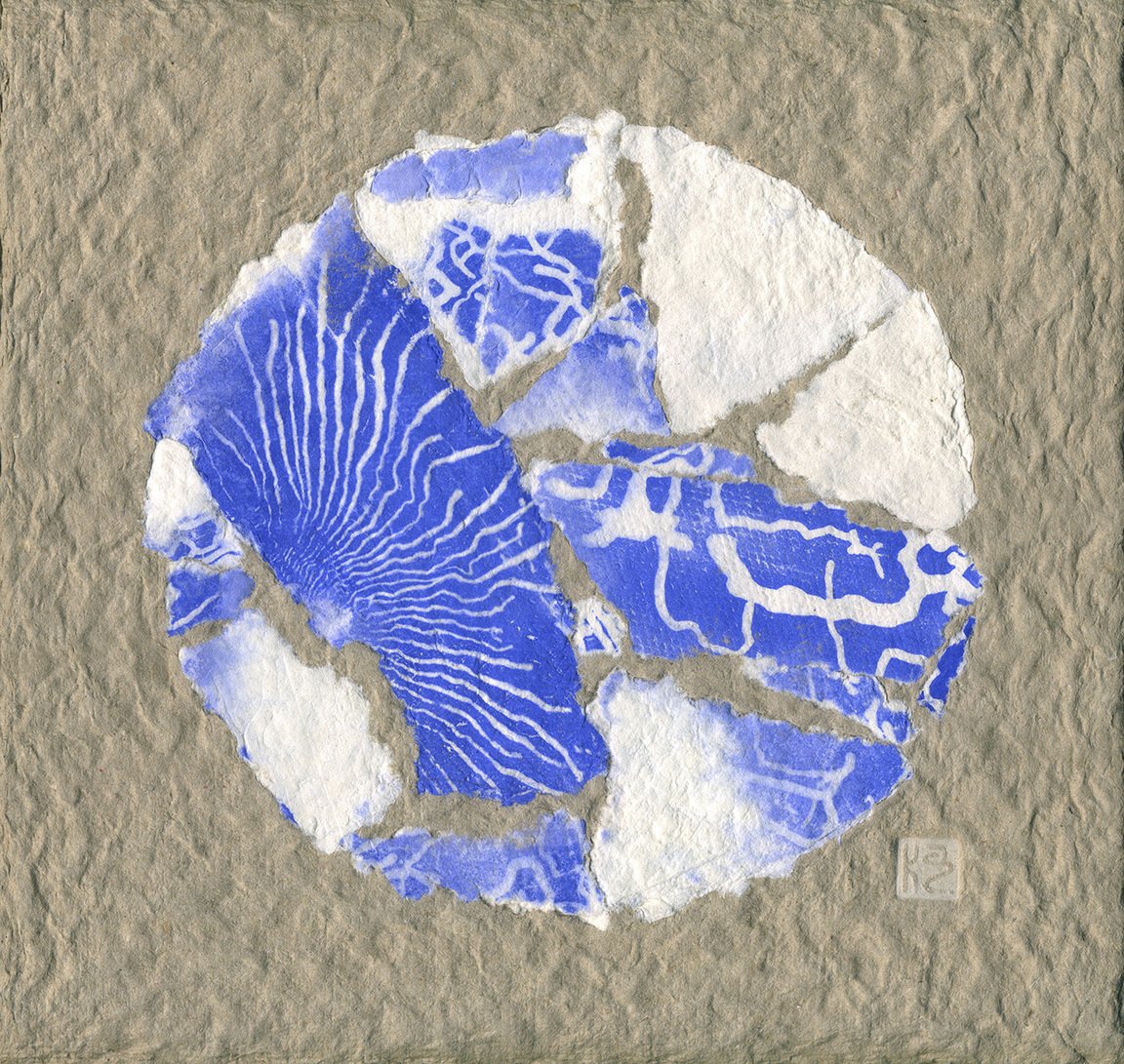
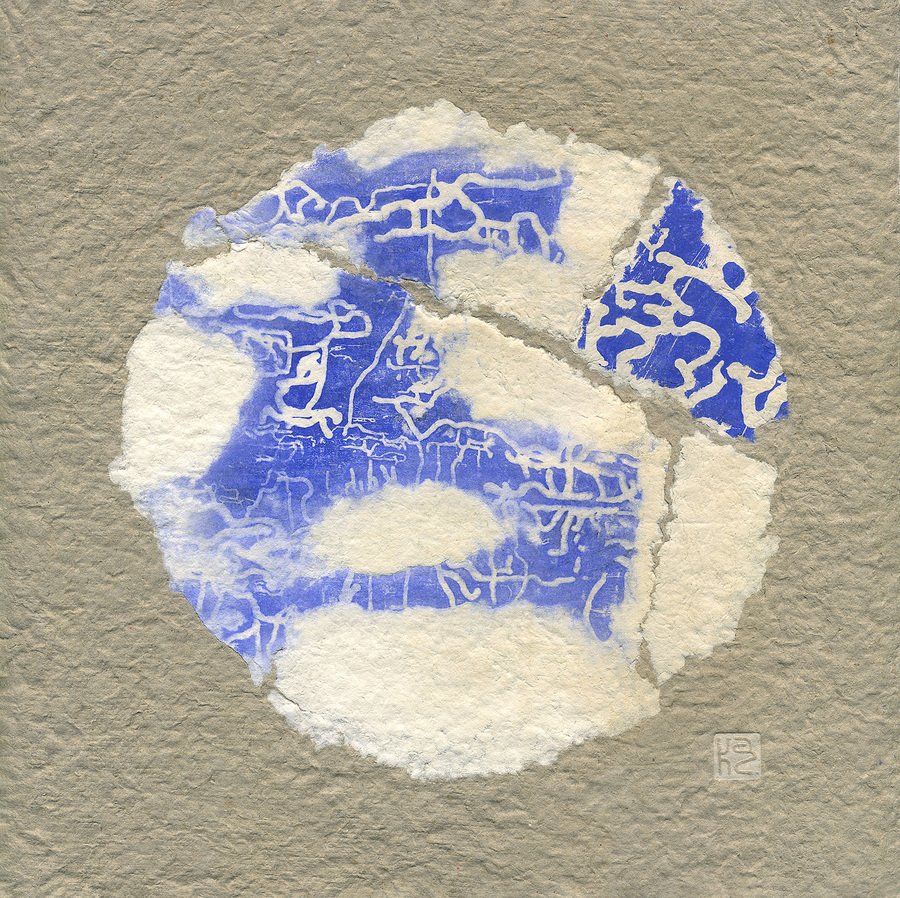
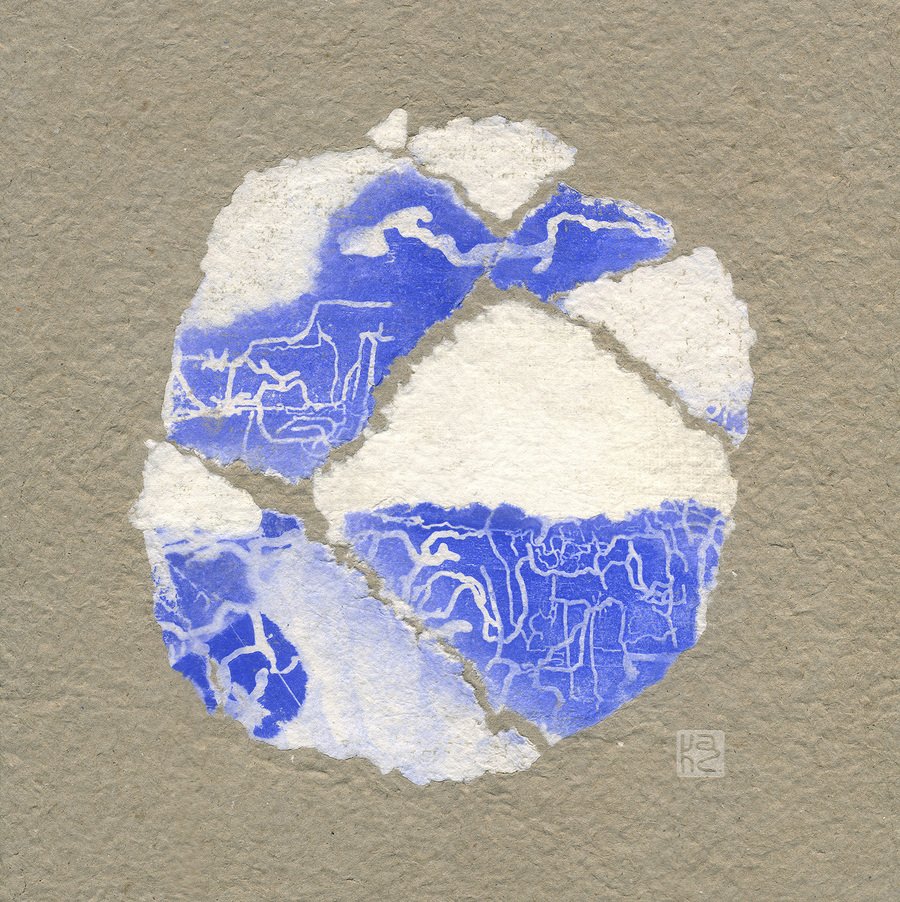
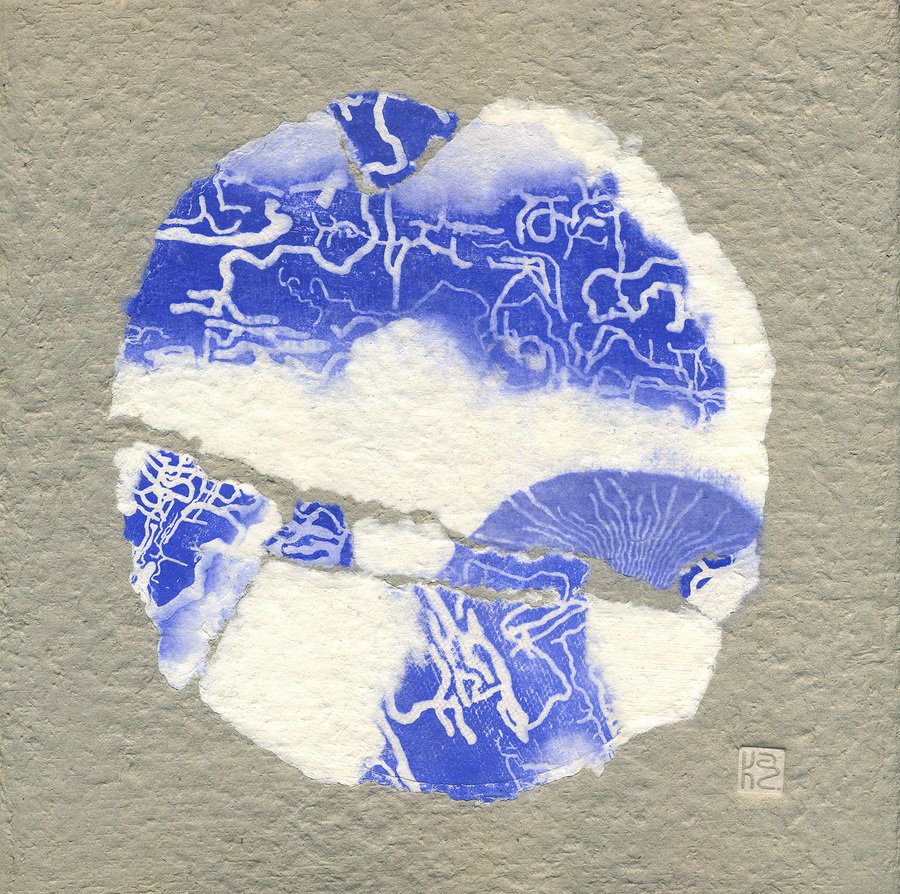
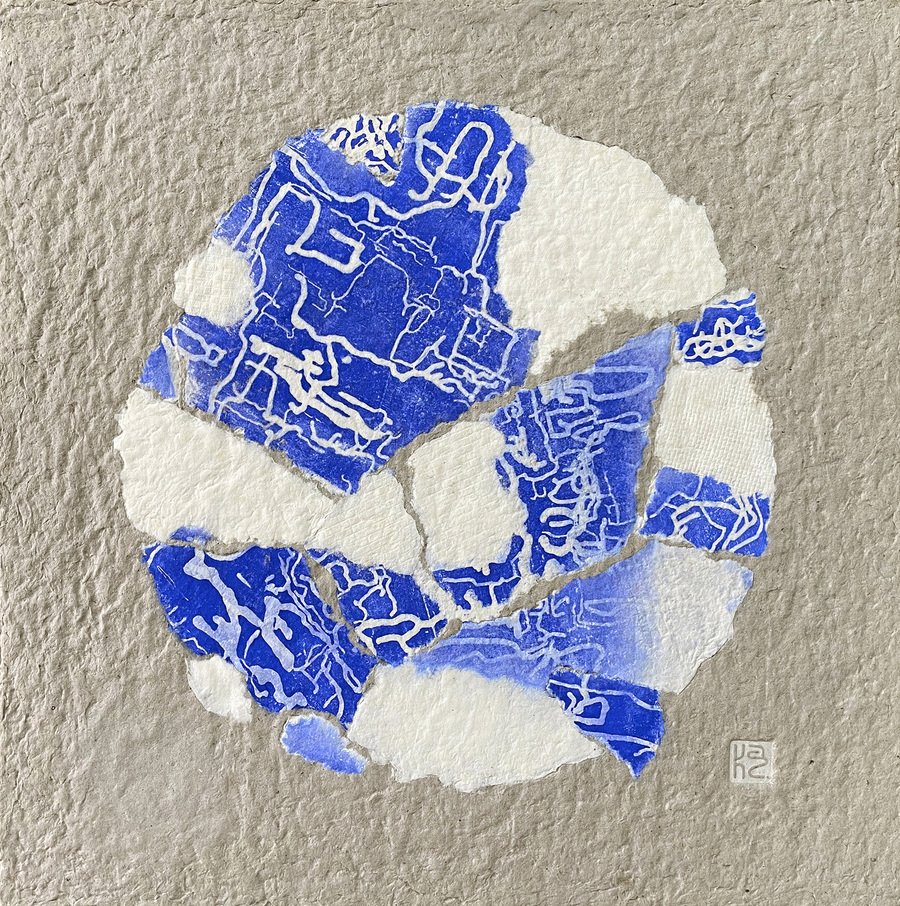
Kintsugi. Sheets 1, 3, and 6 are 300×300 mm, sheet 7 is 320×320 mm, sheet 9 is 220×220 mm, 2025–2026.
As a signature for this specific project, I cut out several seals from two drawings. Initially, I used the Chinese character for «wind, ” which sounds similar to the first syllables of my surname; later, I used my stylized signature.