START OF THE END
Year 2226
The world didn’t die all at once. First, the ocean claimed the fringes—fishing villages, beach resorts, and port warehouses. Then came the coastal cities: Miami, Shanghai, Rotterdam. The water rose, swallowing suburbs, then neighborhoods, then the centers of megalopolises. It wasn’t until the ocean reached the former capitals, situated hundreds of miles inland, that humanity understood—this wasn’t sea-level rise. This was the end. Scientists recalculated the models dozens of times. There could be no error. Seven days. Exactly one hundred and sixty-eight hours until the land ceased to exist.
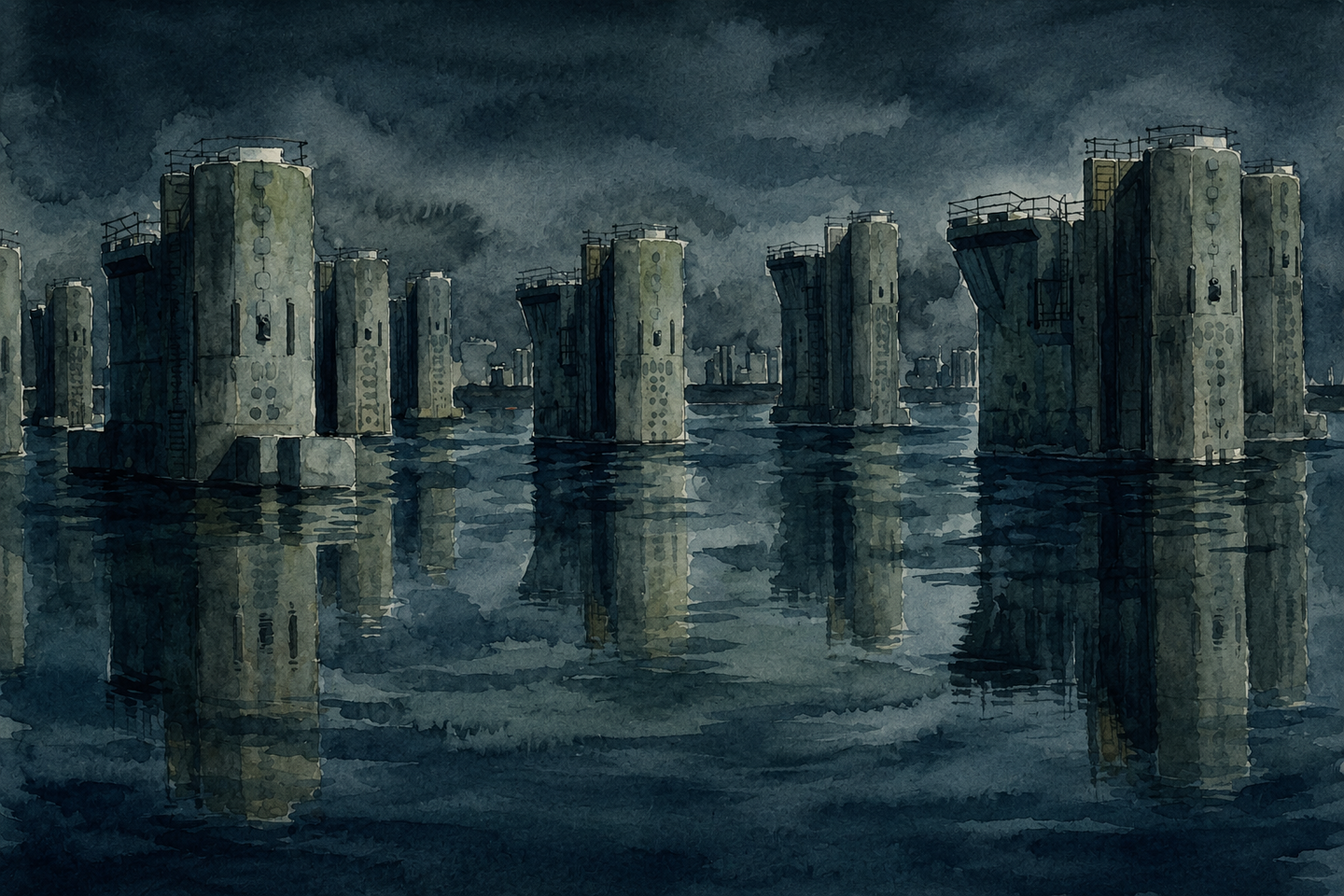
Marta drew everything she saw from the window of their temporary shelter. A ten-year-old girl with chestnut hair and eyes that already held an adult sorrow transformed fear into drawings. Her sketchbooks were a chronicle of the end of the world: leaning skyscrapers, cars floating upward on wheels, people with vacant expressions. She didn’t know how to talk about fear. The house smelled of dampness and dust. Thomas, her father, sat at a table with a map outlined in red marker. He was a former Navy man—a person trained not to panic, not to doubt, not to show weakness. Now, he stared at the map as if he could force the water to recede with sheer willpower. In the next room, Luiza, Marta’s mother, was packing things. A nurse with fifteen years of experience, she was accustomed to the pain of others, but she kept her own deep inside. Her hands moved methodically, almost mechanically: medicine, documents, photographs, a little food. She knew—in this new world, every item would be worth its weight in gold. The governments of the largest nations were operating in a mode the world had never seen. New underwater bunkers were being built around the clock, in a hurry, disregarding all building standards. Investors poured in their last trillions, understanding that money would soon cease to exist as a concept. It was a race where the prize was life itself.
On the seventh morning, the sky was gray, heavy, and low. The air smelled of salt and something metallic—the scent of an impending catastrophe. Evacuation began at dawn.
The crowd at the entrance to the evacuation shuttle resembled a living thing—breathing, groaning, surging forward. People screamed, cried, prayed, and shoved each other. Guards in black uniforms tried to maintain order. Thomas held Marta’s hand tightly. The girl was small and slender, and in that crush of people, she could easily be trampled. Luisa walked beside them, clutching a bag of documents to her chest. They had agreed: stick together, don’t let go of hands, don’t stop. But the crowd was stronger than any agreement. Somewhere between the airlock entrance and boarding, they were separated. In an instant, they found themselves on opposite sides of the throng.
Thomas turned around. He saw his wife’s face in the crowd—pale, contorted in a scream he couldn’t hear. He saw her reaching for them. He saw the security closing the shuttle hatch. Martha buried her face in his shoulder. Thomas held her, staring out the porthole at the receding silhouette of the large evacuation vessel. Somewhere out there, in one of the compartments, was Louise. Or wasn’t. He didn’t know. The shuttle was sinking into the water. The water washed over them—first the bow, then the portholes, then everything.
The world they knew remained above. Forever.
TWO WORLDS
Thomas and Martha’s Autonomous Mini-Bunker
Their bunker was tiny—a metal capsule designed for two, with minimal equipment. No connection to the outside world. No neighbors. No rules other than those Thomas set for himself. But in this closeness, there was one thing absent in larger settlements: freedom. Inside, it smelled of metal, recycled air, and something akin to old paper. Thomas arranged the provisions with the precision of a disciplined man: canned goods by expiration date, water canisters by volume, medications sorted by dosage. He created a schedule. Wake up at six, check life support systems, physical exercise, study time for Martha, sleep. Routine became their anchor. In a world that had crumbled, the schedule offered an illusion of control—an illusion Thomas was prepared to defend at all costs. Martha adapted in her own way. She drew. Album after album, page after page. She didn’t speak of her fear. She didn’t ask about her mother. Only sometimes, before sleep, her delicate fingers gripped the edge of the blanket so tightly that her knuckles turned white.
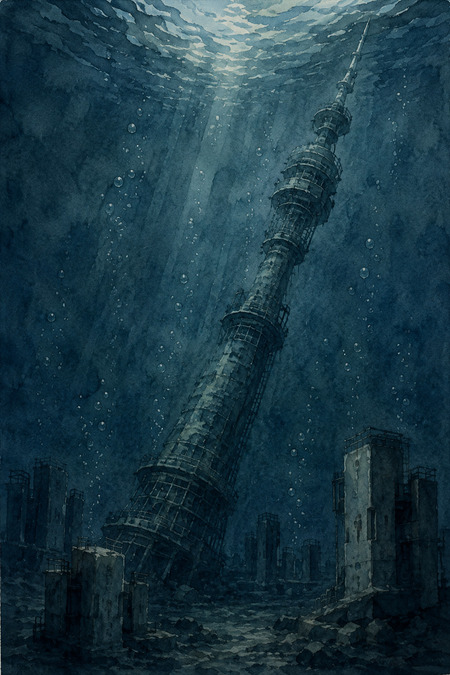
The first foray into the water happened three months later. Thomas checked Marta’s spacesuit three times. Every seam, every valve, every clasp. The airlock opened, and the outside world hit them with cold and silence. The water was dark—almost black—streaked with rare beams of light piercing down from somewhere above. Around them were debris: chunks of concrete, rusted vehicles, overturned trees. Marta froze, staring at the skyscraper vanishing into the darkness. This was a world she had only seen in her drawings. Only now, it was real. They gathered everything that could be useful: canned goods from flooded warehouses, metal parts, rare medications. Every expedition was a gamble. The current could pull them far from the bunker. The spacesuit might leak. And in the darkness, in the depths, lurked creatures best left unthought of—shadows too large to belong to any scientifically known species. Thomas taught Marta everything he knew himself. How to read the current by the movement of the sand. How to conserve oxygen by slowing her breathing. How not to panic when something goes wrong.
At night, listening to his sleeping daughter’s steady breathing, he looked through the porthole at the dark water and thought of Louise. Where was she? Was she alive? Did she remember them? He wouldn’t allow himself to dwell on it too long. Thoughts of his wife were too heavy, too dangerous. In this world, despair could not be afforded.
Louisa Bunker Settlement
Louise was luckier—or perhaps less lucky, depending on how you looked at it. Her shuttle arrived at a massive bunker-settlement, one of those built by governments. Thousands of people, entombed in a metallic cocoon at the bottom of the ocean. The hierarchy formed quickly, almost instantly—as is always the case in confined spaces where resources dwindle relative to the population.
The upper level belonged to those who had paid for this place. Scientists, administrators, investors—people whose names once appeared in magazines. It was spacious here. There was real light—not dim emergency lamps, but a soft, almost sunlit glow. Here, the food smelled like food, not a substitute.
The middle level was for the specialists. Doctors, engineers, those without whom the bunker could not function. Life was stable, but under constant surveillance. Cameras lined the corridors. Reports were filed for every hour of work.
The lower level was for those who ended up here simply because they made it onto the shuttle. Workers, support staff, random individuals. Cramped quarters. Dampness. A scarcity of everything. And illnesses that multiplied in the darkness, like the mold they resembled.
Louise worked on the middle level. Her office was a small, windowless room. People came to her—with cuts, burns, fractures, with coughs that wouldn’t quit for weeks. She treated everyone who came through the door. She didn’t ask which level they were from. She didn’t check their credentials.
Her colleagues warned her. Resources were distributed by decree. There were priority groups. There were those who were «worth» saving, and there were not. But Louise had been a nurse longer than this bunker had existed. She saw people, not categories.
She was working herself to exhaustion. By the end of her shift, her hands trembled. Dark circles had settled under her eyes. She suppressed the fatigue, suppressed the fear, suppressed the longing for Tom and Martha. She didn’t know if they were alive.
And then the bunker started to die.
The structure, hastily erected in seven days, could not withstand the pressure. Microcracks appeared somewhere deep within the hull, in places the engineers' hands could not reach. Water seeped through them—slowly, drop by drop, almost imperceptibly. But the water carried something worse than the water itself. Mold. At first, these were isolated cases. A cough that wouldn’t subside. A fever that wouldn’t break. A weakness that kept people confined to their beds. Louisa recognized these symptoms and knew—this was not a common infection. This was something new. Something they had never encountered. The mold spread through the ventilation, along the walls, and into people’s lungs. It was dark, almost black, with a strange, sweetish odor that could not be aired out. It appeared in the corners of the cabins, on the corridor ceilings, and wherever condensation gathered. Louisa went to the chief physician. She brought samples, data, and statistics. She spoke of the hull cracks, the necessity of disinfection, and new filtration systems. She spoke of the people dying on the lower level because they lacked oxygen, lacked medicine, lacked hope. The chief physician listened to her politely. Then he said what she already knew but hoped not to hear: there were no resources. The elite would not approve additional expenses. These were inevitable losses.
She left the office, clenching her fists so tightly that her nails dug into her palms. The hallway smelled of mildew. That scent was everywhere now.
ESCAPE
Two years have passed. Two years inside a cramped metal capsule at the bottom of the ocean. Two years of excursions into the cold, dark water. Two years fighting for every breath, every gram of food, every hour of peace. Thomas and Martha have changed. He has become harder, more taciturn; his movements now possess the economy characteristic of those who live under constant threat. She has grown—not so much in height, but in gaze. Her drawings have become more intricate, more detailed. Their excursions grew longer. They learned to read the underwater currents and locate submerged caches of resources.
And one day, Thomas found what he had been looking for all this time. It happened in a flooded government bunker—one of those built in the final days but never brought online. The servers were half-destroyed, the cables were severed, the screens extinguished forever. But in one of the compartments, inside a sealed capsule, Thomas discovered a working terminal.
Deciphering took weeks. He worked through the nights while Marta slept, staring intently at the flickering screen, decrypting the encoded files, restoring damaged data. And when he finally broke through the security, he saw the name.
Luiza. Status: alive. Location: bunker settlement «Atlant-7.» Level: medium, medical bay.