Part 1 WHITE.
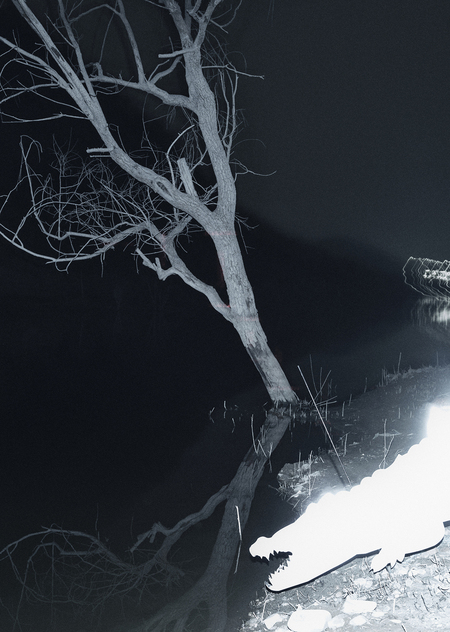
画⾯的⼀边是⼈类的时间和暴⼒,另⼀边动物时间的狗,嗅来嗅去。 One side of the image pulses with human time: chaos, violence, the blurring ticking clock; the other, as a dog immersed in animal time: sniffing, wandering, untouched.
«时间是⼀个较为抽象的概念,是物质的运动、变化的持续性、顺序性的表现。”时间是⼈类的发明,那么对于动物⽽⾔,是否也拥有⾃⼰的时间呢?动物时间是不是平⾏于⼈类时间的⼀个存在?于是想⽤空⽩的动物形象植⼊到⼈和动物共同⽣存的环境中,制造⼀副⼈类时间和动物时间的共存画⾯。 拍摄⽅式最初灵感来源于曼·雷(Man Ray)的中途曝光,想强化画⾯中的边缘效果,以体现动物时间的它们与⼈类时间结合时可能产⽣的隔阂与荒诞。时间概念包含时刻和时段两个概念,所以实际拍摄中每张图⽚⼀⽅⾯利⽤⾃然光完成对环境的呈现(⻓时间曝光虚化环境代表时段,慢速快⻔有时会错过传统意义的决定性瞬间,但却在⼀个世界和另外⼀个世界来回徘徊),另⼀⽅⾯利⽤闪光灯完成对动物部分的呈现(闪光灯瞬间曝光代表时刻)。另外在画⾯中,还刻意制造了表达时间概念的画⾯元素,⽐如动物的⾏动轨迹和背景虚化的表现⽅式。将⾃然光与⼈造光进⾏结合,⽤“我”的主观视⻆窥探动物时间的它们。
    „Time is a more abstract concept. It can be the movement of matter, the continuity of change and also the manifestation of sequentiality.“ Time is a human invention, but does the animal have its own time? Is animal time a parallel to human time? With all the thoughts in mind, the idea was to plant a white animal image in the environment where humans and animals share a common existence, and to create a picture of the coexistence of human time and animal time.
    The shooting method was originally inspired by Man Ray’s Solarization, and the idea was to strengthen the edges of the frame to reflect the disconnect and absurdity that can occur when animal time is combined with human time.The concept of time encompasses both periods and moments. Thus, in the actual shooting, on the one hand, each photograph was accomplished with the use of natural light to render the whole environment. (Using the long exposure blurs the environment to represent the time period. A slow shutter sometimes misses the traditionally decisive moment, but it seems to wander back and forth from one world to the other without leaving). On the other hand, the flash is used to complete the rendering of the animal parts (Using the flash exposure represents the moment. Holding the Splendid Moment). In addition, the frame was deliberately created to express the concept of time, such as the animals’ moving tracks and the blurring way of the background. The combination of natural light and artificial light is used to get a glimpse of the animals' time from a subjective „me“ point of view.
Part 2 BLACK.
它们,在人类留下的“文明”里不断的呼唤“野性”,文明即限制,野性即自由。 They, in the «civilization» left behind by mankind, keep calling for «wildness», civilization is restriction, wildness is freedom.
本组拍摄灵感来源于电影《人类消失后的世界》(Life After People)。一方面是被驯化的动物,它们没有了人类的限制,寂寞的在追寻着已经遗忘的那份野性,或许自由并不能给它们带来更多有益的帮助;另一方面,没有被人类驯服过的动物们,也并不能理解限制的概念,所以也就从来没有过对于自由的渴望。人类也是如此,在形成社会制度之前,并没有限制,也没有挣脱束缚的自由;社会制度形成之后,有了一定的规章制度来作为人类的行为准则,于是出现了对于自由的渴盼。所以限制和自由是相对且相互依赖的存在,只有在一定的限制范围之内,才有争取自由的空间。 画面中的动物均为呆滞、迷茫、无助的状态(猪除外),从而表现没有了人类的限制,它们寂寞的寻找着被遗忘的野性和自由。都与时间相关。 The inspiration for this set comes from the movie «Life After People». On the one hand, there are domesticated animals, which are free from human’s restriction, and they are lonely in pursuit of their forgotten wildness, perhaps freedom can’t bring them more useful help; on the other hand, animals who have not been tamed by human can’t understand the concept of restriction, and so they have never had the desire for freedom. The same is true for human beings. Before the formation of social system, there was no restriction and no freedom to break away from the bondage; after the formation of social system, there are certain rules and regulations to serve as the code of conduct for human beings, and then there is a longing for freedom. Therefore, restriction and freedom are relative and interdependent, only within a certain range of restrictions, there is room for freedom. The animals in the picture are all stagnant, confused and helpless (except the pig), thus showing that without the restriction of human beings, they are lonely and searching for the forgotten wildness and freedom. All related to time.