On November 26–27, 2021, the first international conference at the PERMM Museum of Modern Art—supported by the Goethe-Institut Russia and HSE University—took place, titled «Survival Environment: Strange Practices of Ecological Interaction». The conference explored the fundamental rethinking of the relationship between humanity and nature. The two-day program featured lectures by global experts in dark ecology and Anthropocene studies, art critics, artists, architects, philosophers, and biologists from Germany and Russia. The program curator was Yana Tsyrlina.
In the Darkness of the Kunstkamera: STS and the Museum of Strange Technoscience
It is said that a new, strange, and even «dark» epoch has recently arrived. The romantic nature of things is gone. Virtually everything around us and within us is mediated by techno-science: openly conceptualized, calculated, created, improved, or destroyed by it, containing its products and waste, ideas, and paranoias. Nature is intertwined with it in a mirror game of performativity. Techno-science is everywhere, though it constantly pretends not to be anywhere. It is so complex and diverse that grasping it will require a god’s trick on our part.
What could be stranger and more frightening than this force that consigned us to obscurity while evading any categorization, remaining utterly incomprehensible? What might the maturity of the mind be in such a world, and where could it grow?
The report discusses the possibilities for constructing an image of the world and nature as understood. The material for this exploration is the contemporary representation of science and technology in museums and science and technology centers—its genealogy, ideology, strengths, and shortcomings. A museum of technoscience could serve as an alternative to these institutions.
Unlike them, it would not be focused on what scientists know about the world, but rather on how they arrive at that knowledge, how it is applied, and the material and intellectual conditions underpinning these processes. It would be dedicated not only to the conceptual-methodological but also to the social and material structure of technoscience. Such an imagined museum-forum, based on the results of scientific and technological research and closer to curiosity cabinets than to modernist museums, would adhere to the principles of denaturalization, reductionism, generalized symmetry, estrangement, and would continuously reassemble its subject matter, position, and audience.
Timing. Day Two.
55:10 Maksim Bobrovsky: Ecological Transformation
2:40:06 Nikolai Smirnov: Psychoanalysis of the Anthropocene
5:00:01 Polina Khanova: To Be a Hyperobject
6:40:48 Alexander Pisarev: The Cabinet of Curiosities in Darkness Conference Closing Discussion.
8:34:36 Discussion: On the Dark Side. The Posthuman World of Art, Science, and Philosophy
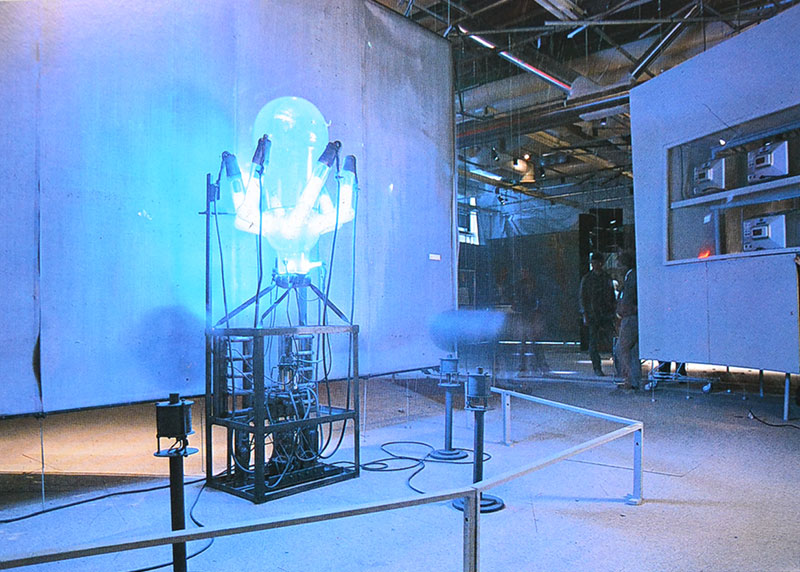
The cover design features a photograph from the Les Immatériaux exhibition, held in 1985 at the Centre Pompidou, curated by Jean-François Lyotard and Thierry Chapu.