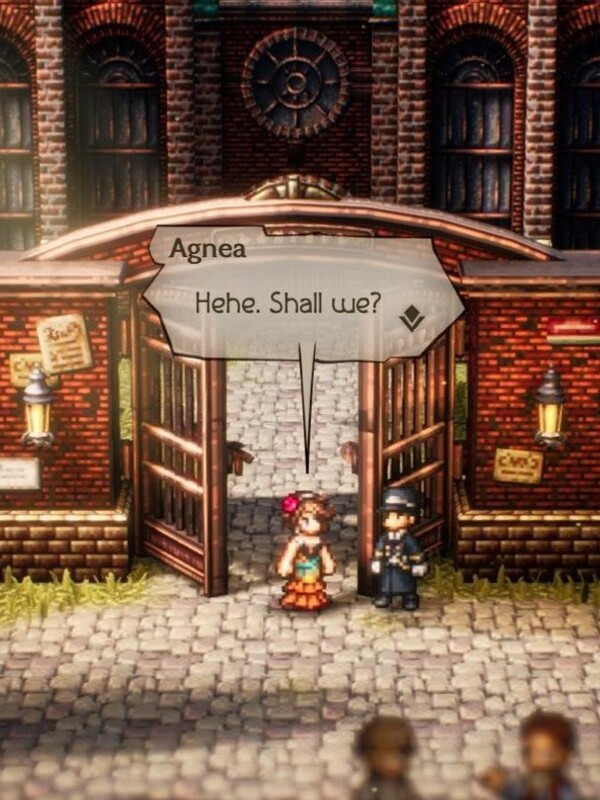
Concept
In the modern world, video games are one of the most popular forms of entertainment. Graphics in games play a crucial role because they influence how players perceive the game and how immersed they become in the game world. Video game developers are constantly searching for new ways to enhance the players' visual experience. One of the most compelling areas of exploration is the combination of 2D and 3D graphics, which allows for the creation of unique and memorable game worlds. The use of different graphic styles can evoke specific emotional responses in players. For instance, 2D sprites can evoke nostalgia for classic games, while 3D elements add a sense of modernity and realism. Combining 2D and 3D graphics can also be economically advantageous for small studios, as it enables the use of accessible 2D assets enhanced with 3D elements to create visually appealing content on a limited budget.
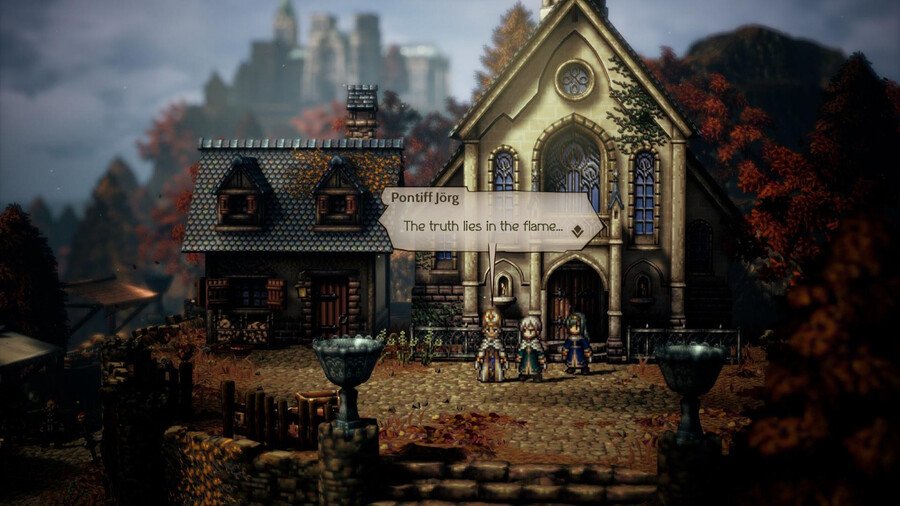
Game screenshot. Octopath Traveler 2. 2023.
Initially, games began with simple 2D imagery, gradually transitioning to increasingly complex 3D models. With technological advancements, numerous new methods have emerged to combine these two approaches, opening up new creative horizons for developers. Merging 2D and 3D graphics requires a specialized approach to design and programming. It is necessary to account for the differences in the perception of depth, perspective, and stylization. The future prospects of 2D and 3D graphics integration are quite substantial, as they encompass further refinement of animation, physics, and artificial intelligence methods to enhance player interaction with the environment. It is also possible to develop hybrid gaming worlds where a 2D environment can seamlessly transition into a 3D world and vice versa. Therefore, this visual study focuses on a broad overview of various approaches to combining 2D and 3D graphics in games and analyzing examples of successful implementation of these techniques.
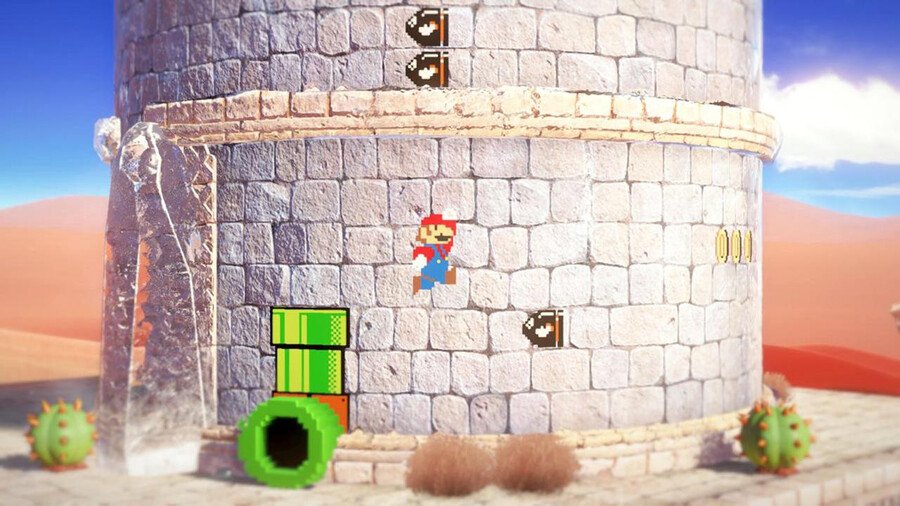
A 2D world embedded within a 3D world. Super Mario Odyssey. 2017.
This visual research topic was selected to consolidate disparate information and assist novice game developers in navigating the nuances of combining 2D and 3D graphics. The selection of material and analysis of sources is based on identifying the benefits of using this fusion technique. Drawbacks will be mentioned in the conclusion as a cautionary note. Furthermore, the focus will not be on marketing issues, target audience, the impact on the gaming industry, or the future development of 2D and 3D graphics integration in games—these topics are already subjects for separate, further research. The structure of this visual research, however, involves segmenting different techniques and approaches to 2D and 3D graphics integration.
2D Styling in 3D
One of the most popular techniques for merging two worlds is stylization. This involves developers striving to maintain a unique 2D aesthetic while simultaneously adding 3D world depth to the game. In such cases, stylization is the primary motif for employing this fusion technique. For instance, the developers at Ronimo Games, when creating their game Blightbound, aimed to preserve the 2D style of the drawn characters and imbue the game world with volume through 3D environments and effects.
Gameplay screenshot. Blightbound. 2021.
Gameplay screenshot. Blightbound. 2021.
Essentially, the effects and characters in the game remain 2D sprites. However, certain particles within the effects are rendered in 3D, and when combined with the fully realized 3D world, this adds a genuine sense of volume.
Character Sprite. Blightbound. 2021.
The developers successfully created memorable graphics for the game—adding volume while retaining a unique 2D style. Although Steam reviews are mixed, most player complaints relate to poor technical stability and the game’s general rawness. Conversely, the graphics are widely noted as a positive aspect in the reviews.
Developers of Octopath Traveler 2 at Square Enix, in collaboration with Acquire, followed a similar path. For this game, they aimed to create a 2D style that would evoke warm memories of the older Final Fantasy titles among its fans.
Game screenshot. Octopath Traveler 2. 2023.
Game screenshot. Octopath Traveler 2. 2023.
However, the developers were concerned that the classic 2D style might appear too dated. Therefore, they decided to diversify the game world with 3D environments. They used this approach in both parts of their games.
The 3D world of the game. Octopath Traveler 2. 2023.
The 3D world of the game. Octopath Traveler 2. 2023.
Hybrid Games
Another form of combination, not as large-scale but no less interesting, is hybrid games. In such games, both 2D and 3D worlds usually coexist simultaneously. However, they are not directly intertwined. Rather, they function as different «dimensions» within the game world. An example of this combination is the game Alice Madness Returns by Spicy Horse Games. Most levels of the game are rendered in 3D, but within the Paper Kingdom, there is a separate, complete 2D level.
The 3D world of the game Alice Madness Returns. 2011.
The 3D world of the game. Alice Madness Returns. 2011.
2D subspace of the game. Alice Madness Returns. 2011.
2D subspace of the game. Alice Madness Returns. 2011.
This 2D level represents a subsection of the game’s visual space. Its purpose is to transport the player into another dimension—not just technically, but visually as well—to intensify the sense of immersion and diversify the gaming experience. The 2D level is notably different from the rest of the 3D game, but it does not feel out of place, given that the game already features similar 2D cutscenes. Moreover, the game’s narrative inherently involves a significant degree of surrealism and psychedelia.
2D concept art. Alice Madness Returns. 2011.
2D concept scene. Alice Madness Returns. 2011.
Another fascinating example of hybrid use of 2D space in a 3D world is Super Mario Odyssey by Nintendo EPD. The game features the ability to transition into a 2D plane at various points within the game’s 3D world. Mario can jump into a pipe and become a classic 2D version of himself.