SOUNDPROOFING NOISE ISOLATION VIBRATION DAMPENING ACOUSTICS
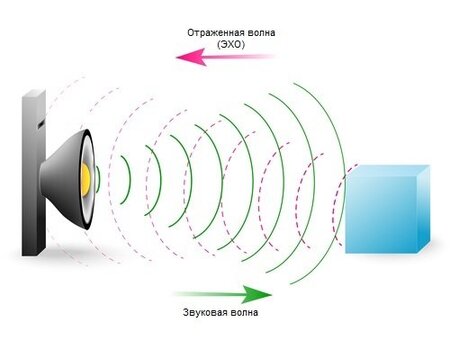
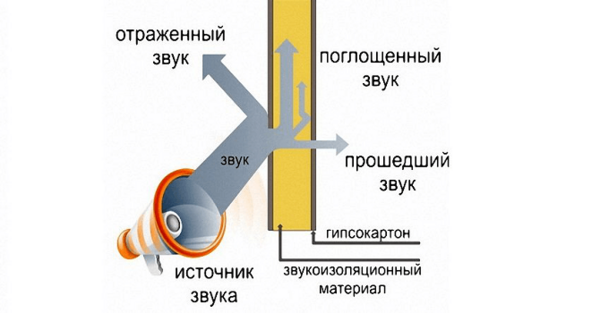
Soundproofing materials are divided into: damping, sound-absorbing, and sound-reflecting.
ACOUSTIC INSULATION AND SOUND ABSORPTION MATERIALS
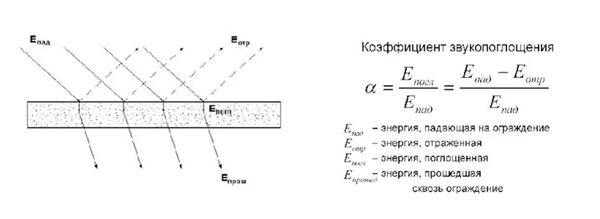
Sound Absorption Sound absorption refers to the reduction of sound wave energy through absorption. This occurs when the wave collides with an obstacle—such as a wall partition, floor, or ceiling. Sound-Absorbing Material according to GOST 23499-2009 — a material that has continuous porosity and is characterized by a relatively high sound absorption coefficient ($a > 0.2$).
In other words, conditions are created to absorb sound using specialized materials capable of trapping sound waves. Typically, sound-absorbing coverings are placed on ceilings and walls (primarily on the upper parts of the walls), and to achieve maximum absorption, it is recommended to cover at least 60% of the total surface area of internal surfaces with these materials. This ensures optimal sound quality when the sound source is in the same room. Absorption plays a key role in ensuring acoustic comfort.
Sound insulation is the reduction of external noise levels penetrating a space by reflecting sound waves. The goal of sound insulation is to reflect sound and prevent it from passing through a room’s wall. The characteristic structure of soundproofing materials creates an obstacle to sound propagation and reflects it. The quantitative measure of sound insulation for enclosing structures is expressed in decibels.
A sound insulation material according to GOST 23499-2009 is a material characterized by viscoelastic properties and possessing a dynamic stiffness of no more than 250 MPa/m.
Sound insulating padding materials and products are manufactured in the following types:
— soft — semi-rigid — rigid ready-made products in the form of mats or panels (stitched mats, wood fiberboards, products made from foam, neoprene, polyurethane); — fillers (baked sand, expanded clay aggregate, gravel from porous metallurgical slag, crushed stone and sand from expanded perlite, and other porous aggregates); — roll and tile floor coverings (base and non-base polyvinyl chloride linoleum, polyvinyl chloride tiles, synthetic pile carpets).
— Soundproofing helps prevent sound from entering one room from another, as well as blocking external noise from getting inside.
— Sound absorption, on the other hand, is intended to eliminate extraneous sound frequencies that arise inside a room by scattering or absorbing them. In short, soundproofing blocks the transmission of sound through a barrier, while sound absorption disperses the sound.
Sound-absorbing materials are used to improve sound quality inside a space, typically as additional elements applied to surfaces. Soundproofing is incorporated within walls or ceilings as part of the structural building material; it is fundamentally a component of the room’s structure, not merely a finishing material.
Acoustic panels absorb sound, while soundproofing materials reflect it. Therefore, acoustic panels are excellent for improving a room’s acoustics, reducing echo, and minimizing reverberation. However, to shield a room from external noise, these panels must be used in conjunction with soundproofing materials (mats, panels, membranes) that are at least 40 mm thick.
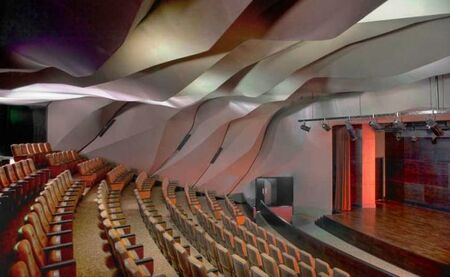
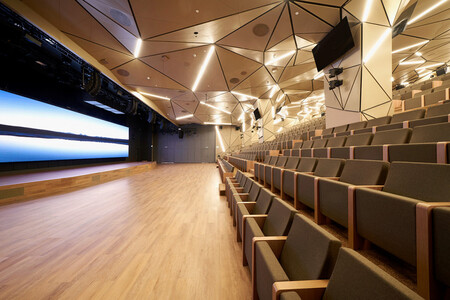
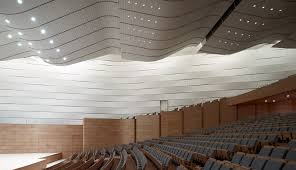
ARCHITECTURAL ACOUSTICS
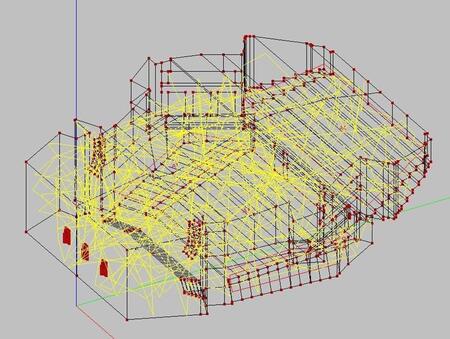
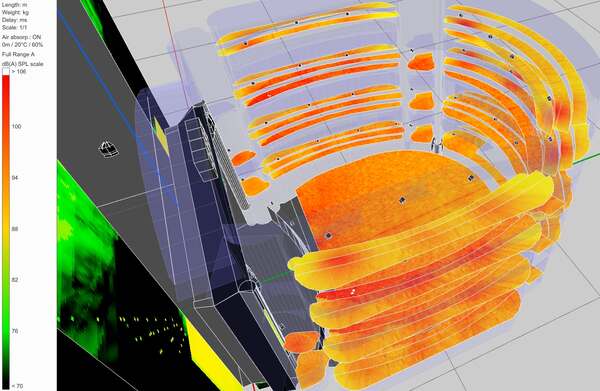
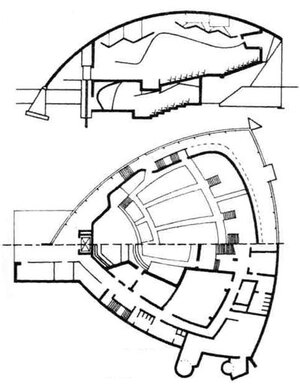
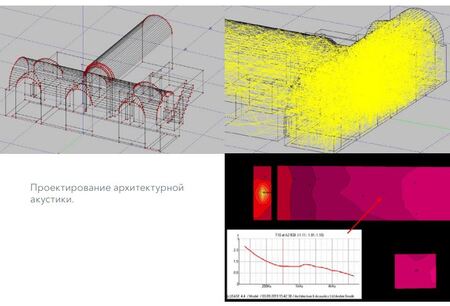
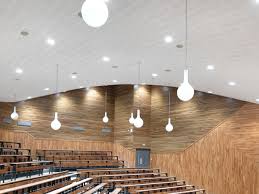
Example of modeling the sound ray propagation in a hall
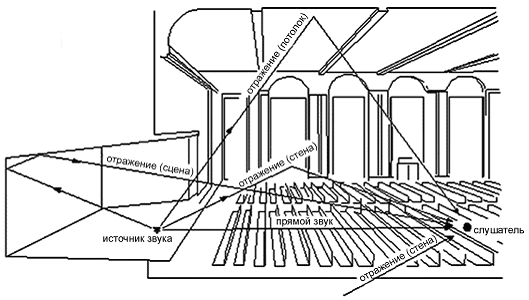
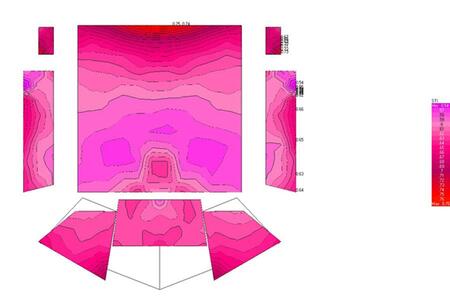
Distribution of the RaSTI Speech Intelligibility Index across the Viewing Area
SOUND AND NOISE INSULATION, ACOUSTIC COMFORT
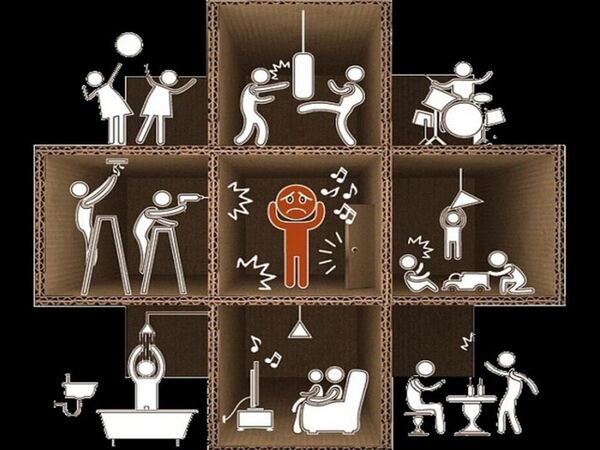
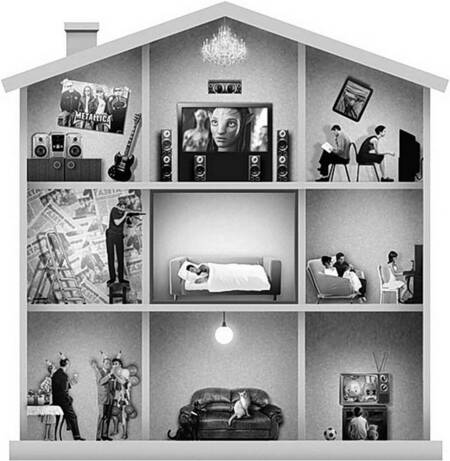
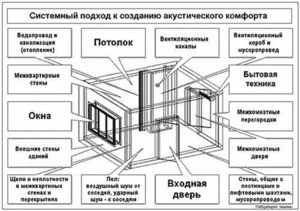
— Soundproofing is the process of preventing sound from entering a space.
— Noise isolation is the process of reducing the noise level inside a space.
— Vibration isolation effectively combats structure-borne noise but offers no protection against airborne noise.
— Room acoustics is a field of acoustics that studies the propagation of sound waves within a space, their reflection and absorption by surfaces, and the influence of reflected waves on speech and music intelligibility.
— Airborne noise occurs during initial radiation into the air. This includes shouting, barking, or the operation of television and radio equipment.
— Structure-borne noise arises from mechanical impact between objects and the building’s walls or floors. Structure-borne noise is generated by the operation of elevators, refrigeration units in air conditioning systems, or construction work (e.g., using a jackhammer).
— Impact noise is a type of structure-borne noise. It specifically relates to the sound isolation of floors. In modern construction, floors are simultaneously characterized by two distinct, unrelated parameters: isolation from airborne noise (such as speech) and isolation from impact noise (such as footsteps or moving furniture).
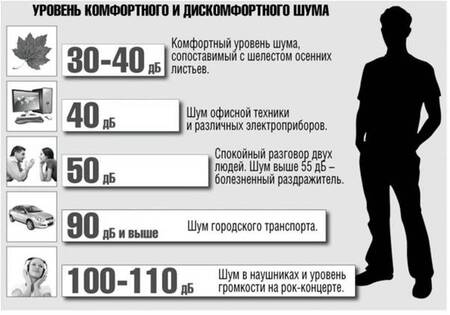
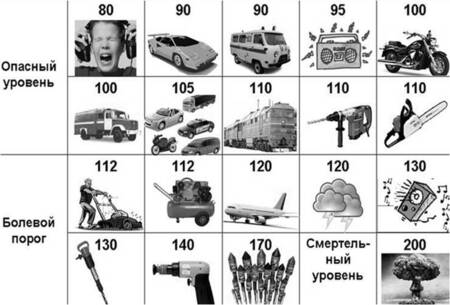
MGSN 2.04-97 «ACCEPTABLE NOISE LEVELS, VIBRATION, AND ACOUSTIC INSULATION REQUIREMENTS IN RESIDENTIAL AND PUBLIC BUILDINGS»
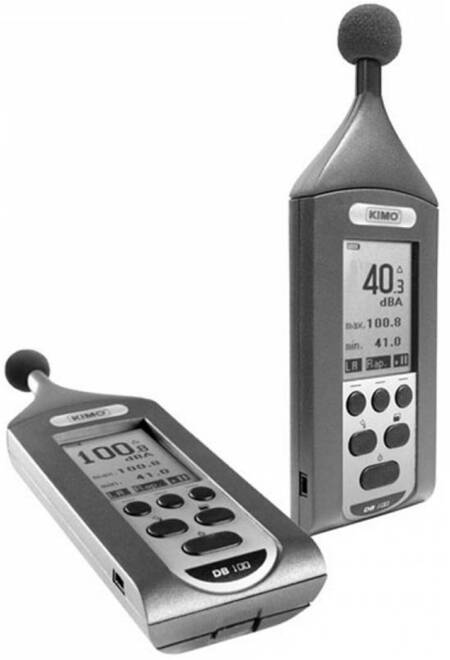
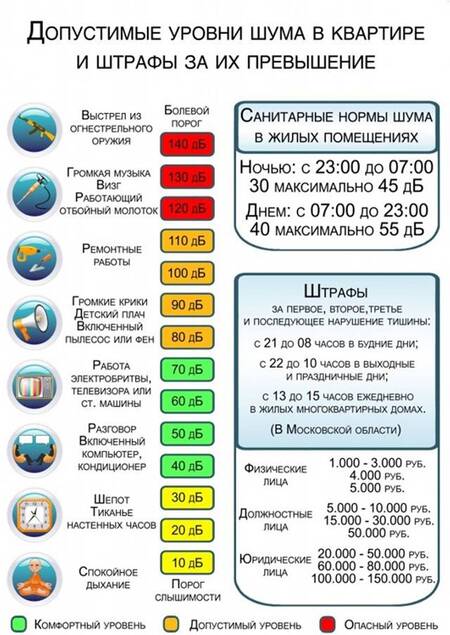
— During the daytime (from 7 a.m. to 11 p.m.), the average noise level must not exceed 40 dB. Periodically, sounds up to 55 dB are permitted, but these sounds must be brief. For example, during renovations, it is allowed to periodically run a loud drill, which will not violate the law; however, the drill cannot be left running continuously, as doing so would constitute a constant loud noise, which is a violation. — During nighttime hours (from 11 p.m. to 7 a.m.), the average noise level must not exceed 30 dB. Similarly, loud sounds up to 45 dB are permitted periodically, provided the sound is transient.
Only the loudness of a sound—and in some cases, its duration—is of primary concern; the origin of the sound does not matter. For instance, you can turn on your stereo system at any time of day without issue, and your neighbors cannot prevent you from doing so; however, the stereo’s volume must not exceed 40 dB during the day or 30 dB at night—and if this rule is violated, your neighbors can report you to the police.
Additional rules apply in Moscow and some other cities.
Moscow legislation introduces the term «quiet hours.» Quiet hours refer to two daily intervals—from 7 p.m. to 9 a.m. and from 1 p.m. to 3 p.m. During this time, the following activities are prohibited: construction work, fireworks, loud singing, whistling, and so on.
Additional restrictions are in effect in Moscow during holidays. On state holidays, the daytime hours run from 10 a.m. to 10 p.m. (instead of 7 a.m. to 11 p.m.), and during this period, sounds up to 40 dB are permitted, with the possibility of a brief increase in volume up to 55 dB.
SOUNDPROOFING MATERIALS
SOFT; SEMISOLID; HARD. Frame/Non-frame
POROUS-FIBROUS; POROUS-FOAMY. POROUS-GRANULAR;
STRUCTURAL SOLUTIONS FINISHING MATERIALS DECORATIVE
SOUNDPROOF PANELS SOUNDPROOF MEMBRANES SOUNDPROOF UNDERLAYMENTS SOUNDPROOF PANELS (SLABS) ACOUSTIC FOAM SOUNDPROOF GYPSUM BOARD VIBROACOUSTIC SEALANT DAMPENING TAPE VIBRATION ISOLATORS SOUNDPROOF UNDERLAYMENTS
MINERAL, BASALT, COTTON, GLASS WOOLL