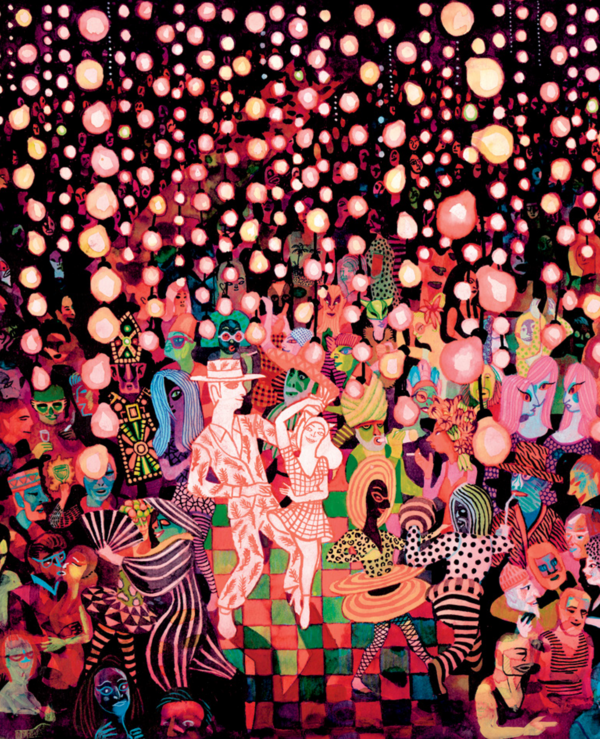
Essé for the online magazine Elephant in Boa.
Brecht Evans is exceptional. And although it’s kind of weird to say this now that we’ve kind of given up on a pyramid with a major artist on top in favor of the risoma, but I still want to record it somehow. It’s totally irrational and very personal impression that I have when I look at his work: it’s like they’re the ones where the comic book finally gets itself, like he was still in the shadow of animation, literature, painting, and only Evans legitimized him as a completely self-sufficient kind of art. While such a statement without adequate reinforcement seems extremely vulnerable, I would like to start with it: because trying to explain my own feelings has been the source of the observations and conclusions I want to share.
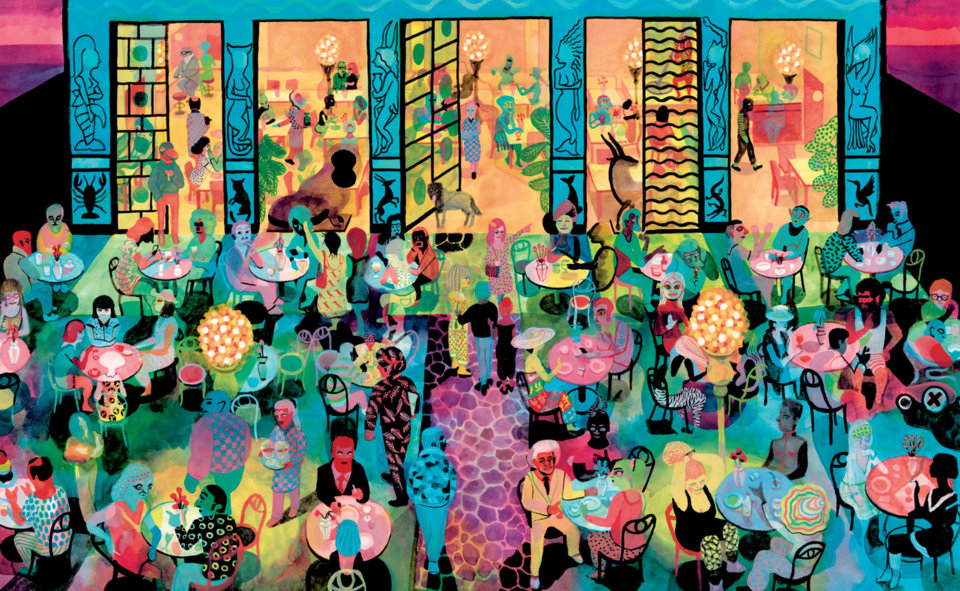
Midnighters, Brecht Evans, SBP.: Bookbook, 2021
Richard McGuire, from an interview for Lock At Me
This understanding of the comic book has found its perfect expression in McGuire’s novel «Here»: this book depicts the same room at each turn, and the video clippings, like pop-up Windows windows, depict the events that took place in this place at different times. And the time isn’t linear: at one turn, we can watch the Lenape Indians, and at the other, we can watch McGuire’s parents, who are also in the comic book, celebrate Christmas. You don’t have to read «here» from the first to the last page, we can read it from the end, from the middle, open it at random turns, and in a way that comes to mind just us. In this way, the book gives the reader an endless story, which is built only by his efforts. McGuire, followed by many comics, refuses to manage the reader’s view by delegateing the storyteller’s function to the reader, crossing the boundary between the author and the reader’s narration.
«Here,» Richard McGuire, Corpus, 2016
Another vector takes Ray Fawkes in its comic book «The People Inside». The comic book is built on a hard net of six frames on each strip. Each shot describes the history of the same couple’s relationship. The human resources grid is broken if the couple separates (the person divides into two) or if one of the two dies (the person divides into two, and one of the staff becomes black). So we keep track of the lives of 24 people at the same time from their encounter to their death, where all heroes speak at the same time. And if, in the case of McGuire, we’re dealing with a comic book that delegates to the reader the right to choose the order in which the story is built, then Fawkes in turn uses the comic book’s ability to tell several stories in parallel in such a way that no one interrupts the other (how loudly the animated version of The People Inside sounds). However, the expansion that Evens chooses seems to have a different nature. All the authors listed focus the reader’s attention in one way or another only on certain points in history, using the set-up principles that Scott McClaude described in the Comics Understanding.
Scott McClaude, Understanding Comics, M.: White Apple, 2016
Enlightenment, Antonia Kyun, S.B.: Bookbook, 2020
Enlightenment, Antonia Kyun, S.B.: Bookbook, 2020
Panther, Brecht Evens, S.B.: Bookbook, 2017
Panther, Brecht Evens, S.B.: Bookbook, 2017
Panther, Brecht Evens, S.B.: Bookbook, 2017
In other cases, Evens' heroes operate in an unlimited white-leaf space. This allows much more phases to be used without overloading the turn-off (the 12-seat strip inevitably looks very dense, but the absence of a human resources grid makes it possible to avoid it by providing the necessary air). But, most importantly, the exclusion of the scope in the case of Evens also means the disappearance of the inter-person space, the blindest area in which silence is hidden. The speculation in his comic books is kept to a minimum. It’s like we’re running a film where the action is continuous. One phase flows smoothly into another phase, and it creates an absolute sense of credibility and intimacy: we feel that nothing has been missed in the dialogue. No sighs, no jamming, no weird, awkward tone will go unnoticed.
Panther, Brecht Evens, S.B.: Bookbook, 2017
Sometimes, to highlight the continuity of action, Evans sleeps the phases in one rhythmic spot. The movement of heroes becomes like a heart pulse on a monitor: there’s gonna be problems if it stops. Evens' heroes, who are so alive and reliable, tend to act in absolute emptiness: so nothing distracts us; on the contrary, every confession, even though it is whispered, is so clearly heard. It makes every scene in which there’s space so amazing, so loud that it can hardly even hear itself. It seems even that the dialogues are therefore so piercingly sincere and alive that they are placed on a Wednesday that completely humanizes heroes. And to create such an environment, Evans uses a very unconventional set of tools for a comic book.
Midnighters, Brecht Evans, SBP.: Bookbook, 2021
Midnighters, Brecht Evans, SBP.: Bookbook, 2021
Although attempts to enter this genre have been made before (for example, the great turn of 1937, «New Year’s Party for the Most Known Comics» by artists of the then-known New Cartoon Action Group comic association for the Japanese magazine Asahi Graph), it was the end of the 1960s that proved to be the most iconic time for this type of graphical narration. Because it is at this time that Roland Bart is one of the first to wonder whether our approach to the text is as true as a code that we can decode, and can we really, by studying the figure of the writer and its text along and across, determine exactly what the author wanted to say?