The book «Fashion!”—an authorial exploration of events and facts that we classify as fashion phenomena, marking one of humanity’s most vital needs—to adorn oneself in order to stand out while simultaneously becoming part of the social collective.
The phenomenon of fashion is not confined to hemline or hairstyle; therefore, the authors of the book were interested in phenomena that, while not directly related to costume, are described with the epithet «fashionable» and develop according to the laws of fashion. Today, as the system of fashion undergoes revision amidst the fervent rhetoric surrounding its demise, the rise of new media, and digitalization, we can only speculate—what will fashion look like after fashion? However, fashion will show us.

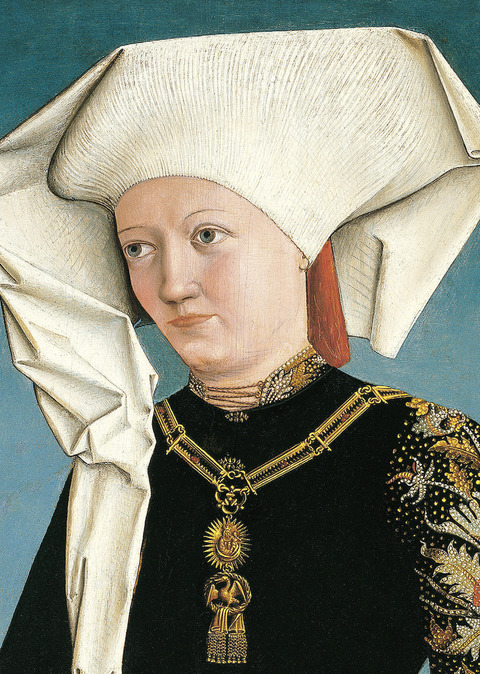
Philip III, Duke of Burgundy the Good (1396–1467), called himself the «Great Duke of the West» and patronized the arts. His court became the most splendid in Europe; the concept of «fashionable» was born there. Burgundy imported Italian silks, silk velvet, furs, and Eastern textiles, and produced excellent wool fabrics from English raw materials. Burgundian fashion was luxurious; the Burgundians were imitated—the ceremony of the Burgundian court became the foundation for the ceremonial life of European courts.
The earliest mentions of knightly tournaments date back to the 11th century, but their popularity lasted until the 16th century. Beyond demonstrating bravery and skill, the tournament served as a parade of fashion in the knights' attire and equipment. Armor details were covered with heraldic mantles, and bright embellishments were attached to the helmets. Squires and pages wore heraldic cloaks, while a knight’s lady could wear a dress featuring a coat-of-arms appliqué. She would give him a glove or a scarf, which he would fasten to his helmet or armor.
In 1444, the King of France, Charles VII, fell in love with Agnes Sorelle, a 22-year-old woman who would later exert enormous influence on women’s fashion at the French court. Jean Fouquet depicted her as the Maiden Mary in the Melens Double Panel. Her narrow, low-cut gown is voluminous, worn over a linen chemise. Sorelle was criticized for having excessively long shoes; here, her dress is draped over a girdle—a golden chain, intricately woven with Hercules knots, descends below.
The reign of Elizabeth I is called the «Golden Age of England.» She patronized science and the arts, defeated the Spanish, and made England the «mistress of the sea.» Like the era itself, the fashion of the time was vibrant. Women wore stiff bodices reinforced with whalebone, voluminous ruff collars, and hats with high netting. Men’s clothing was adorned with embroidery and pearls. The Queen’s gowns were studded with diamonds. She favored bright red, shimmering blue, and golden colors.
The great statesman of France, Cardinal-Minister Armand Jean de Richelieu, enjoyed embroidery. This craft was an exclusively aristocratic pursuit due to the high cost of its tools and fabric. Embroidery was used to adorn garments, furniture, and bedding. Perhaps it was a handkerchief with such embroidery that Aramis dropped on the ground during his first encounter with d’Artagnan. It is believed that Richelieu embroidered himself, and in any case, he frequently wore clothing decorated with intricate, embroidered lace.
In 1672, the writer Jean Donneau de Nemours began publishing the journal Mercure Galant, which covered court news, art, and theater. In 1677, the first major article dedicated to fashion appeared in the journal—it discussed sleeve lengths and ruffles, though the text was not yet illustrated. The first fashion illustration in the journal appeared in 1679 and depicted the dress of Princess Marie Louise of Orléans, which she wore at her wedding to King Charles II of Spain.
In the 19th century, it was believed that women could not ride horseback in a masculine way—it was considered improper. Therefore, ladies used a special saddle that allowed them to sit sideways. For riding, a special dress or jacket with an asymmetrically designed skirt was worn, which completely covered the rider’s legs. The longer side formed a «shleif,» which the woman, after dismounting, had to gracefully gather and attach to the skirt above the knee.
In the 1860s, the Western world discovered Japan: a fascination with all things Japanese arose in Europe and America. Western ladies dressed in kimonos and fanned themselves with oriental fans in boudoirs adorned with painted screens, porcelain vases, and lacquer boxes. European art, in turn, was influenced by Japanese prints with their asymmetric compositions, unexpected viewpoints, expressive outlines, and rich, local colors.
Advertisers in the latter half of the 19th century experimented with typography and text, but it gradually became clear that a beautiful image was worth a thousand words. The development of lithography, which allowed for the mass reproduction of color images, led to the evolution of the advertising poster as a distinct art genre, reflecting all the major artistic styles of the period: Art Nouveau, Symbolism, Cubism, Art Deco, and Constructivism.
At the beginning of the 20th century, women gained greater freedom and the opportunity to work. The core of women’s attire became the blouse, jacket, and cardigan—pieces that women also adopted from men’s wardrobes—along with skirts shortened to the ankle. Indispensable elements of the fashionista’s wardrobe in the early 20th century included fur mufflers, wraps, and clutch bags. Clutches were just beginning to enter fashion, and many—including Sigmund Freud—considered them terribly improper.
The silhouette of the robe de style is associated with the fashion house Lanvin, founded in 1889 by couturier Jeanne Lanvin. It is believed that thanks to Lanvin, it became popular in the 1920s. The unadorned top, low waist, and very wide skirt—which is supported by an underskirt with hoops—create a romantic and elegant silhouette that partially conceals the figure and recalls gowns from the 18th century, which was popular among young girls too young to wear daring outfits.